Breaking news from Washington Post. Reporter William Branigin writes:
The Supreme Court today delivered a stunning rebuke to the Bush administration over its plans to try Guantanamo detainees before military commissions, ruling that the commissions are unconstitutional.
In a 5-3 decision, the court said the trials were not authorized under U.S. law or the Geneva Conventions. Justice John Paul Stevens wrote the opinion in the case, called Hamdan v. Rumsfeld. Chief Justice John G. Roberts Jr. recused himself from the case.
The ruling, which overturned a federal appeals court decision in which Roberts had participated, represented a defeat for President Bush, who had ordered military trials for detainees at the Guantanamo Bay naval base. About 450 detainees captured in the war on terrorism are currently held at the U.S. naval base in Cuba.
The case of Salim Ahmed Hamdan, a 36-year-old Yemeni with links to al-Qaeda, was considered a key test of the judiciary's power during wartime and carried the potential to make a lasting impact on American law. It challenged the very legality of the military commissions established by President Bush to try terrorism suspects.
The case raised core constitutional principles of separation of powers as well as fundamental issues of individual rights. Specifically, the questions concerned:
• The power of Congress and the executive to strip the federal courts and the Supreme Court of jurisdiction.
• The authority of the executive to lock up individuals under claims of wartime power, without benefit of traditional protections such as a jury trial, the right to cross-examine one's accusers and the right to judicial appeal.
• The applicability of international treaties -- specifically the Geneva Conventions on the treatment of prisoners of war -- to the government's treatment of those it deems "enemy combatants."
Thursday, June 29, 2006


Wednesday, June 28, 2006
Behind the URL resumes at BFD
A lashing of apologies to George at Brewed Fresh Daily for letting my suggestion of blogger profiles lapse for a while. Paying work got the better of me, but now I'm back to profiling Northeast Ohio bloggers.
The latest is Daniella Lindquist-Dufaux of American Pink Collar. If you'd like to get into the queue for Behind the URL, send me an e-mail.
The latest is Daniella Lindquist-Dufaux of American Pink Collar. If you'd like to get into the queue for Behind the URL, send me an e-mail.
Time to make the donuts
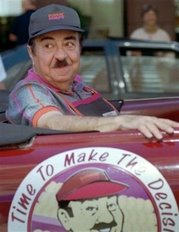
I'm not sure when it started but for quite a while now, Danny and I will drag ourselves out of bed, muttering, "Time to make the donuts." That's particularly the case when we've been on one of those work-home benders that gives us little time to talk and makes as feel as if we're hamsters on an exercise wheel.
But this week we've been using the line as a way to roust Patrick and Ryan for their summer jobs. Patrick is a Safety Town Counselor and Ryan has been doing a mishmosh of babysitting, pet sitting and lawnmowing this summer. This morning Danny asks Patrick, "What time is it?"
"Time to make the donuts," he mutters into his waffles.
How is that one line seemed to sum up the early morning drudgery/responsibility of going to work? I decided to Google the line to see what I could find.
This bit says that Fred the Baker was really autistic and living at Walbrook Psychiatric Institute in Cincinnati. Oh, wait, I think that was another character.
This one says that the commercial was named by the Television Bureau of Advertising as one of the five best commercials of the 1980s (was it really that long ago?).
The founder of Dunkin Donuts even wrote a book about his career in 2001 titled, “Time to Make the Donuts.”
But then I found that Fred the Baker, also known as Michael Vale, died last year at the age of 83. Turns out he studied acting at the Dramatic Workshop in New York with the likes of Rod Steiger and Ben Gazarra. But he is remembered for being Fred the Baker.
The ad man who wrote those first Dunkin' Donuts commercials is Ron Berger, now CEO at the advertising giant RSCG. CNN tracked him down on his BlackBerry in Mexico, on vacation.
"We went through hundreds of people in the auditions because the role was so defining. As soon as Michael Vale walked into the bathroom in his pajamas and said 'Time to make the doughnuts, time to make the doughnuts,' we knew," said Berger.
Google lists a number of times the phrase is used in headlines for everything from sports stories to business stories to features about kids and jobs. Hey, wait, that sounds familiar, too. So the phrase is a cliche, but it's a good one.
Jeez! Now it’s 8:30 and I’ve killed time Googling Fred the Baker when I really need to get back to making the donuts.
Saturday, June 24, 2006
CYO and Christian values
UPDATE FROM COACH SHERWOOD: It’s a program for Bay kids. It's a tiny district and it needs all the players it can get. "Our approach is to get kids involved in the game of football and if we can get them to stay and play in our football program that's great," says Sherwood.
This is downright hilarious. It seems that the Catholic Youth Organization, also known as CYO, has launched a “landmark program that puts Catholic values ahead of winning….”
Whoa! Wait a minute! This IS groundbreaking. You mean winning at all costs and creating a bunch of St. Ignatius and St. Ed’s hopefuls is not what CYO athletics is about? (Yes, that is filled with dripping sarcasm.)
After years of dashing children’s hopes and self-esteem by forcing them to ride the pine for games on end while the select few get the spotlight, it seems the good folks at the Diocese of Cleveland have created a policy that offers equal playing time for basketball players. David Briggs writes:
Under the new "No Child Left on the Bench" rules in the Cleveland diocese, each fourth- to sixth-grader on basketball teams of 10 or less (which is the great majority of squads) must play at least half the game. Seventh- and eighth-graders must play at least one quarter.
Pardon me while I clean up the coffee I spit out upon reading this article.
I’ve had plenty of experiences with CYO athletics as both the parent of athletes and the wife of a coach. In my experience there was nothing less Christian than that program. But hey, if it has suddenly had a spiritual awakening then that’s fabulous. Good for CYO.
I have one question: Why wasn’t this a policy all along?
It's part and parcel of the elitist mentality that pervades the parochial school structure. I say this having had a son who played every down of every football game, both offense and defense. I recognize that some kids thrive under this culture, but it can be downright destructive to others.
CYO runs afoul of Catholic values through parents who insist on winning and creating personal vehicles to spotlight their child’s athletic talent. It's been a program about reliving glory days, about egos and bragging rights and feeding the Ed's/Iggy athletic machine. If that's its mission, then let's be clear that the less-talented needn't join the team. The flaw in that argument, of course, is that these are children who all develop at different rates. You need only bring up the story about how Michael Jordan was cut from his 10th-grade basketball team to realize that there is such a thing as late bloomers--and early flamouts.
Danny’s last year of coaching Ryan’s CYO basketball team was in fifth grade. You'd think the coaches meeting was the NBA draft, where dads piss and moan and argue about what players they want to draft for their team.
Danny told me it was such a disgusting display (remember, we’re talking about grade school athletes) that he told them he’d take whoever, just to be congenial and move the process along. And that’s what he got. They gave him Ryan and some kids who had never played or even touched a basketball.
At the outset, Danny told the parents that his philosophy was equal playing time. The kids are too young and undeveloped at this age and what they need is playing time. On his team they probably wouldn’t win much, but every kid would play a half—and every kid would score a bucket in a game.They didn’t win much that season. And some of these kids passed the ball off as if it were a hot potato.
But Danny was determined to give them a good experience.
During the final games in the tiny St. Mary’s of Berea gym, Danny’s faith in his players was put to the test. All but one had scored in a game. They were losing big-time, but the scoreboard wasn’t the issue. Danny was trying to figure out how to get the ball into this boy’s hands so he could shoot a basket.
This boy looks as if he belongs more in a lab than on a court. Danny, who is quite animated on the sidelines, is waving his arms and yelling, “Get the ball to Wadi!” The clock was ticking down and he missed two shots already. Parents on the team knew what he was trying to do and started to cheer wildly. Then little Wadi got the ball at the top of the key. He hesitated for a moment and Danny yelled, “Shoot! Shoot!”
Swish! The ball went into the bucket. The entire gym erupted in cheers and the look on that little boy’s face put tears in my eyes. He was incredulous at first and then so, so proud. Danny was jumping up and down like a maniac on the sidelines yelling, “Way to go, Wadi!”
It was the highlight of the season. They lost the game, but all the players on Danny’s team got so much more from the experience. They learned about being a team, about supporting each other and that miracles can and do happen.
We’ve since left the world of CYO athletics and I’m not sorry. Patrick and Michael play on rec teams and Ryan now plays in interscholastic sports for Bay Schools. There are no more dads coaching their kids to greatness. It’s about team, sportsmanship and pride in your school and your community. Some would call those “Christian” values. For us it’s a more wholesome atmosphere.
During our orientation to Bay Middle School, one parent asked about the school’s policy on athletics. The principal at the time replied:
“Our interscholastic teams begin in seventh grade, which is the state standard under the Ohio High School Athletic Association rules. That's the norm unless you go to parochial schools where competition begins in kindergarten.”
The audience of parents laughed, but there were enough of us from parochial schools that we laughed even harder knowing just how true the sentiment really was.
The final straw came last summer. One of the CYO football coaches called our house and spoke to Ryan. He told him he’d get a lot of playing time and that he could get a scholarship to St. Ignatius or St. Ed’s if he played on the CYO team. He didn’t ask to speak to us, he told this to a 12-year-old.
I was livid. How dare he call our house and make promises he couldn’t possibly keep to a young kid. It was highly unethical, but hardly surprising. Ryan very confidently told him thanks, but no, he was playing for Bay.
About an hour ago I dropped Ryan off at Bay High. The varsity football coach was taking him, two other eighth-graders and the freshman, JV and varsity quarterbacks to a camp in Warren. He knows he loses potential good players to the Catholic high schools where, frankly, many of the Bay boys don’t even get to play.
So he’s nurturing his program from middle school on up. As a fifth-grade teacher he gets the kids excited about Bay football in addition to teaching them math. Every summer he runs a weeklong football camp with his varsity players as counselors and he discourages the Catholic school kids from attending.
CLARIFICATION FROM BAY HIGH COACH GARY SHERWOOD: It’s a program for Bay kids. It's a tiny district and it needs all the players it can get. "Our approach is to get kids involved in the game of football and if we can get them to stay and play in our football program that's great," says Sherwood.
This is downright hilarious. It seems that the Catholic Youth Organization, also known as CYO, has launched a “landmark program that puts Catholic values ahead of winning….”
Whoa! Wait a minute! This IS groundbreaking. You mean winning at all costs and creating a bunch of St. Ignatius and St. Ed’s hopefuls is not what CYO athletics is about? (Yes, that is filled with dripping sarcasm.)
After years of dashing children’s hopes and self-esteem by forcing them to ride the pine for games on end while the select few get the spotlight, it seems the good folks at the Diocese of Cleveland have created a policy that offers equal playing time for basketball players. David Briggs writes:
Under the new "No Child Left on the Bench" rules in the Cleveland diocese, each fourth- to sixth-grader on basketball teams of 10 or less (which is the great majority of squads) must play at least half the game. Seventh- and eighth-graders must play at least one quarter.
Pardon me while I clean up the coffee I spit out upon reading this article.
I’ve had plenty of experiences with CYO athletics as both the parent of athletes and the wife of a coach. In my experience there was nothing less Christian than that program. But hey, if it has suddenly had a spiritual awakening then that’s fabulous. Good for CYO.
I have one question: Why wasn’t this a policy all along?
It's part and parcel of the elitist mentality that pervades the parochial school structure. I say this having had a son who played every down of every football game, both offense and defense. I recognize that some kids thrive under this culture, but it can be downright destructive to others.
CYO runs afoul of Catholic values through parents who insist on winning and creating personal vehicles to spotlight their child’s athletic talent. It's been a program about reliving glory days, about egos and bragging rights and feeding the Ed's/Iggy athletic machine. If that's its mission, then let's be clear that the less-talented needn't join the team. The flaw in that argument, of course, is that these are children who all develop at different rates. You need only bring up the story about how Michael Jordan was cut from his 10th-grade basketball team to realize that there is such a thing as late bloomers--and early flamouts.
Danny’s last year of coaching Ryan’s CYO basketball team was in fifth grade. You'd think the coaches meeting was the NBA draft, where dads piss and moan and argue about what players they want to draft for their team.
Danny told me it was such a disgusting display (remember, we’re talking about grade school athletes) that he told them he’d take whoever, just to be congenial and move the process along. And that’s what he got. They gave him Ryan and some kids who had never played or even touched a basketball.
At the outset, Danny told the parents that his philosophy was equal playing time. The kids are too young and undeveloped at this age and what they need is playing time. On his team they probably wouldn’t win much, but every kid would play a half—and every kid would score a bucket in a game.They didn’t win much that season. And some of these kids passed the ball off as if it were a hot potato.
But Danny was determined to give them a good experience.
During the final games in the tiny St. Mary’s of Berea gym, Danny’s faith in his players was put to the test. All but one had scored in a game. They were losing big-time, but the scoreboard wasn’t the issue. Danny was trying to figure out how to get the ball into this boy’s hands so he could shoot a basket.
This boy looks as if he belongs more in a lab than on a court. Danny, who is quite animated on the sidelines, is waving his arms and yelling, “Get the ball to Wadi!” The clock was ticking down and he missed two shots already. Parents on the team knew what he was trying to do and started to cheer wildly. Then little Wadi got the ball at the top of the key. He hesitated for a moment and Danny yelled, “Shoot! Shoot!”
Swish! The ball went into the bucket. The entire gym erupted in cheers and the look on that little boy’s face put tears in my eyes. He was incredulous at first and then so, so proud. Danny was jumping up and down like a maniac on the sidelines yelling, “Way to go, Wadi!”
It was the highlight of the season. They lost the game, but all the players on Danny’s team got so much more from the experience. They learned about being a team, about supporting each other and that miracles can and do happen.
We’ve since left the world of CYO athletics and I’m not sorry. Patrick and Michael play on rec teams and Ryan now plays in interscholastic sports for Bay Schools. There are no more dads coaching their kids to greatness. It’s about team, sportsmanship and pride in your school and your community. Some would call those “Christian” values. For us it’s a more wholesome atmosphere.
During our orientation to Bay Middle School, one parent asked about the school’s policy on athletics. The principal at the time replied:
“Our interscholastic teams begin in seventh grade, which is the state standard under the Ohio High School Athletic Association rules. That's the norm unless you go to parochial schools where competition begins in kindergarten.”
The audience of parents laughed, but there were enough of us from parochial schools that we laughed even harder knowing just how true the sentiment really was.
The final straw came last summer. One of the CYO football coaches called our house and spoke to Ryan. He told him he’d get a lot of playing time and that he could get a scholarship to St. Ignatius or St. Ed’s if he played on the CYO team. He didn’t ask to speak to us, he told this to a 12-year-old.
I was livid. How dare he call our house and make promises he couldn’t possibly keep to a young kid. It was highly unethical, but hardly surprising. Ryan very confidently told him thanks, but no, he was playing for Bay.
About an hour ago I dropped Ryan off at Bay High. The varsity football coach was taking him, two other eighth-graders and the freshman, JV and varsity quarterbacks to a camp in Warren. He knows he loses potential good players to the Catholic high schools where, frankly, many of the Bay boys don’t even get to play.
So he’s nurturing his program from middle school on up. As a fifth-grade teacher he gets the kids excited about Bay football in addition to teaching them math. Every summer he runs a weeklong football camp with his varsity players as counselors and he discourages the Catholic school kids from attending.
CLARIFICATION FROM BAY HIGH COACH GARY SHERWOOD: It’s a program for Bay kids. It's a tiny district and it needs all the players it can get. "Our approach is to get kids involved in the game of football and if we can get them to stay and play in our football program that's great," says Sherwood.
Friday, June 23, 2006
Merton article wins in religion coverage
Just learned that my article on Thomas Merton that appeared in the Catholic Universe Bulletin tied for first place in Best Religion Coverage in the Ohio SPJ Awards competition. Here's the scoop from the Ohio SPJ Awards:
Best Religion Coverage— This prize is awarded for the
best coverage (story or series) on religion/ethics/values,
stories that explore spirituality, address the search for
faith among modern complexities, or underscore
journalism‟s place in matters of the soul.
First Place (tie): “W hat W ondrous Love Is This: In the Face
of Devastating News, the Former President of Ohio
Dominican, a Nun and a Scientist, Chose the Road Less
Traveled,” Ray Paprocki, Columbus Monthly.
First Place (tie): “Thomas M erton,” W endy Hoke, Catholic
Universe Bulletin.
Sadly, the story no longer available online.
Best Religion Coverage— This prize is awarded for the
best coverage (story or series) on religion/ethics/values,
stories that explore spirituality, address the search for
faith among modern complexities, or underscore
journalism‟s place in matters of the soul.
First Place (tie): “W hat W ondrous Love Is This: In the Face
of Devastating News, the Former President of Ohio
Dominican, a Nun and a Scientist, Chose the Road Less
Traveled,” Ray Paprocki, Columbus Monthly.
First Place (tie): “Thomas M erton,” W endy Hoke, Catholic
Universe Bulletin.
Sadly, the story no longer available online.
Wednesday, June 21, 2006
Loving wireless
How did I live without wireless for so long? After just a few short days, it seems impossible to believe I could ever again be chained to the DSL line.
I'm blogging from the comfort of my living room couch, with Mikey snuggled next to me asking, "Does the Internet work down here?" "How about in here?" It's been fun just moving from room to room to check out the signal. So far so good.
I also love the features on the new Microsoft Office. When I get an e-mail, a tiny little window opens on the bottom right-hand side of my screen with a brief description of the e-mail I received. If it's urgent, I can tend to it immediately, if not no biggie.
Tranferring files from one laptop to the other was a huge pain. The boys keep asking if they can delete my old stuff. It's not hurting anything just sitting there so I told them to leave it for now. I haven't yet figured out how to transfer e-mails and I'm not sure I will. That's okay because I have the old ones archived on the old laptop. But I suspect there may be a few e-mails that have slipped through the black hole in between. If you haven't heard back from me on something, chances are I didn't get the e-mail. Feel free to resend.
I'm blogging from the comfort of my living room couch, with Mikey snuggled next to me asking, "Does the Internet work down here?" "How about in here?" It's been fun just moving from room to room to check out the signal. So far so good.
I also love the features on the new Microsoft Office. When I get an e-mail, a tiny little window opens on the bottom right-hand side of my screen with a brief description of the e-mail I received. If it's urgent, I can tend to it immediately, if not no biggie.
Tranferring files from one laptop to the other was a huge pain. The boys keep asking if they can delete my old stuff. It's not hurting anything just sitting there so I told them to leave it for now. I haven't yet figured out how to transfer e-mails and I'm not sure I will. That's okay because I have the old ones archived on the old laptop. But I suspect there may be a few e-mails that have slipped through the black hole in between. If you haven't heard back from me on something, chances are I didn't get the e-mail. Feel free to resend.
Monday, June 19, 2006
Len Bias -- gone 20 years now
Do you remember hearing the shocking news about the death of University of Maryland basketball player and Boston Celtics pick Len Bias? At 19 years old the thought that someone so athletically gifted, so young could be gone was stunning. And that it was from cocaine was even more shocking. It shouldn't have been a shock. Cocaine was all over college campuses in the '80s.
Todays' Washington Post has an interesting retrospective on Bias' life and death. Reporters relive with others the night he died of a cocaine overdose just days after he was the second pick in the NBA draft, how the University of Maryland - College Park was forced to reveal the low academic performance of its basketball athletes and how NBA greats welcomed the chance to go head-to-head on the court with this young phenom.
But the piece in the retrospective that really moved me was this one about his mother, Lonise. She has turned Len's tragic death, and that of his younger brother Jay a few years later, into an educational opportunity. She has found strength in God and the grace to persevere in the wake of knife-piercing pain. As a mother, I am in awe of her strength and grace.
As I read the story I learned that Len had two other siblings. The article doesn't give their names, ages or even say whether or not they are brothers or sisters. I wanted to know, but I respect their need for being something other than the late Len and Jay Bias' siblings. Today they have their own children and the article ends with sentiments of a grandmother who knows how to find the spirit of her lost sons in the laughter of her grandchildren.
Todays' Washington Post has an interesting retrospective on Bias' life and death. Reporters relive with others the night he died of a cocaine overdose just days after he was the second pick in the NBA draft, how the University of Maryland - College Park was forced to reveal the low academic performance of its basketball athletes and how NBA greats welcomed the chance to go head-to-head on the court with this young phenom.
But the piece in the retrospective that really moved me was this one about his mother, Lonise. She has turned Len's tragic death, and that of his younger brother Jay a few years later, into an educational opportunity. She has found strength in God and the grace to persevere in the wake of knife-piercing pain. As a mother, I am in awe of her strength and grace.
As I read the story I learned that Len had two other siblings. The article doesn't give their names, ages or even say whether or not they are brothers or sisters. I wanted to know, but I respect their need for being something other than the late Len and Jay Bias' siblings. Today they have their own children and the article ends with sentiments of a grandmother who knows how to find the spirit of her lost sons in the laughter of her grandchildren.
News conversation
If you're even remotely involved in the pratice of news gathering and dissemination you should be reading Jay Rosen's PressThink. He's the a rebel outside the newsroom pushing journalists, editors and publishers to think bigger about the news experience -- and to think about it more as a conversation than pronouncements from on high.
Jay's got a provacative piece in this morning's Washington Post. He talks about the 10 years of news online and how it's finally dawning on the newsroom honchos that "repurposing" stories does not an online strategy make.
Newsrooms big and small often move with the quickness of a brontosaurus. But this statement by AP chief Tom Curley may signify that they have finally caught on to the changes that have taken place without the newsrooms.
"When the Web was born as a commercial content enterprise back in the mid-'90s, we thought it was about replicating -- that is, 'repurposing' -- our news and information franchises online," Curley said. "The news, as 'lecture,' is giving way to the news as a 'conversation'."
This summer, SPJ in Cleveland has invited editors and reporters from The Plain Dealer to talk more about the difficulties in making the shift. I'll keep you posted on the time, date and place. Don't prejudge their position, but plan to come if for no other reason than to encourage them to push for more creative and transparent news delivery online.
Let's move the conversation forward with open minds.
As Rosen concludes:
"To survive you have to be open."
Jay's got a provacative piece in this morning's Washington Post. He talks about the 10 years of news online and how it's finally dawning on the newsroom honchos that "repurposing" stories does not an online strategy make.
Newsrooms big and small often move with the quickness of a brontosaurus. But this statement by AP chief Tom Curley may signify that they have finally caught on to the changes that have taken place without the newsrooms.
"When the Web was born as a commercial content enterprise back in the mid-'90s, we thought it was about replicating -- that is, 'repurposing' -- our news and information franchises online," Curley said. "The news, as 'lecture,' is giving way to the news as a 'conversation'."
This summer, SPJ in Cleveland has invited editors and reporters from The Plain Dealer to talk more about the difficulties in making the shift. I'll keep you posted on the time, date and place. Don't prejudge their position, but plan to come if for no other reason than to encourage them to push for more creative and transparent news delivery online.
Let's move the conversation forward with open minds.
As Rosen concludes:
"To survive you have to be open."
Sunday, June 18, 2006
Live with my new MacBook
Wow! I'm am thrilled with this new laptop. Microcenter was out of stock so Ryan, Patrick and I headed to the Apple store at Legacy Village where we received top-notch service by very knowledgeable folks. I've been installing and registering software and hardware since 4 this afternoon. After a break for dinner, chatting with neighbors and a dash to the store for a spare USB cable, I'm finally up and running.
Bonus today was that I also picked up my very own iPod Nano. No more borrowing Danny's or Ryan's. And I can fill it with all my own music. And I'm able to take advantage of some timely rebates, bringing my total purchase about $500 under budget.
This thing is fast, but I'm still getting used to the new look of some familiar programs. And I've got a lot of files to transfer from the old laptop.
One pesky problem: Does anyone know how to set preferences on Dashboard so it doesn't give me the weather in Columbus? That's the nearest city to us in the time zone chart, but I'd really like to have Cleveland weather pop up.
Bonus today was that I also picked up my very own iPod Nano. No more borrowing Danny's or Ryan's. And I can fill it with all my own music. And I'm able to take advantage of some timely rebates, bringing my total purchase about $500 under budget.
This thing is fast, but I'm still getting used to the new look of some familiar programs. And I've got a lot of files to transfer from the old laptop.
One pesky problem: Does anyone know how to set preferences on Dashboard so it doesn't give me the weather in Columbus? That's the nearest city to us in the time zone chart, but I'd really like to have Cleveland weather pop up.
Friday, June 16, 2006
Farewell, old gal
This has been a hectic six weeks for me. I've finished up some major projects, been traveling a lot, started a part-time job that I'm having difficulty keeping to part-time and I've managed to get a few new assignments that will make writing this summer a load of fun.
I don't mean to neglect all my blogging activity, but it's been a necessity of late. By next week I hope to have settled into more of a summer routine to get some regular posting online. By then I'll be doing it from my new MacBook. Woo Hoo!
My trusty G3 iBook has been good to me over the past five years. It's been around the country and the world with me. It's seen my first daily newspaper feature that led to regular daily newspaper work, my first national magazine columns and stories and has nurtured me through my upstart blogging efforts.
But like the old gal she is, she's a little worn and weathered. The space bar no longer works, which means I've had to retire her traveling days. It's a little tough to get through the airport with a USB keyboard under arm. She's a little slower these days (actually a lot slower) and that gets plenty frustrating. My writing has worn out the letters E, R, T, S, H, N, M on my keyboard.
She also lacks some of the modern technological conveniences that didn't seem important in 2001 -- CD burner, wireless, DVD player. The battery has long-since outlived its usefulness, lasting at best a mere 15 minutes.
After taking the new MacBook for a spin, I can't believe the sharpness in display, the speed, the very cool dashboard feature and the Web-related software. I can kiss Classic operating system goodbye with the newest version of Microsoft Office, which runs on OSX.whatever the latest version is.
For the time being, my little iBook will find a place as the family computer until I get the kids their Dell in time for school to start. But we don't even want to think of school one week into summer vacation.
I don't mean to neglect all my blogging activity, but it's been a necessity of late. By next week I hope to have settled into more of a summer routine to get some regular posting online. By then I'll be doing it from my new MacBook. Woo Hoo!
My trusty G3 iBook has been good to me over the past five years. It's been around the country and the world with me. It's seen my first daily newspaper feature that led to regular daily newspaper work, my first national magazine columns and stories and has nurtured me through my upstart blogging efforts.
But like the old gal she is, she's a little worn and weathered. The space bar no longer works, which means I've had to retire her traveling days. It's a little tough to get through the airport with a USB keyboard under arm. She's a little slower these days (actually a lot slower) and that gets plenty frustrating. My writing has worn out the letters E, R, T, S, H, N, M on my keyboard.
She also lacks some of the modern technological conveniences that didn't seem important in 2001 -- CD burner, wireless, DVD player. The battery has long-since outlived its usefulness, lasting at best a mere 15 minutes.
After taking the new MacBook for a spin, I can't believe the sharpness in display, the speed, the very cool dashboard feature and the Web-related software. I can kiss Classic operating system goodbye with the newest version of Microsoft Office, which runs on OSX.whatever the latest version is.
For the time being, my little iBook will find a place as the family computer until I get the kids their Dell in time for school to start. But we don't even want to think of school one week into summer vacation.
Monday, June 05, 2006
One more call
Noted journalist, author and Case prof Ted Gup once told a group of SPJ folks the following (and I'm paraphrasing slightly):
"When you think you're done reporting, make one more phone call. You'll never be sorry."
He shared this nugget in light of a piece he wrote for Esquire magazine about corruption in a southern town. Gup described how many calls he had to make to accurately and colorfully describe the sound of a 2 a.m. train barreling through this sleepy town and how its residents collectively roll over at its arrival.
As I am fine-tuning my piece on small schools transformation at Cleveland Heights High School for KnowledgeWorks Foundation I found that advice most helpful. I'm thinking of taping a little reminder note above my laptop that reads, "One more call."
Thank you, Ted, for reminding us to push ourselves further.
"When you think you're done reporting, make one more phone call. You'll never be sorry."
He shared this nugget in light of a piece he wrote for Esquire magazine about corruption in a southern town. Gup described how many calls he had to make to accurately and colorfully describe the sound of a 2 a.m. train barreling through this sleepy town and how its residents collectively roll over at its arrival.
As I am fine-tuning my piece on small schools transformation at Cleveland Heights High School for KnowledgeWorks Foundation I found that advice most helpful. I'm thinking of taping a little reminder note above my laptop that reads, "One more call."
Thank you, Ted, for reminding us to push ourselves further.
Friday, June 02, 2006
Lament of the fashion challenged
I've never been a fashionista, in fact I'm quite the opposite. I'm a female who hates to shop and tends to hyperventilate when spending money. My sister (who is a miraculous shopper) chides me that I'm famous for carrying something around a store for an hour and then putting it back only to leave empty-handed.
This isn't a source of pride for me, it's rather embarrassing. I have good taste, I just lack the will and the know-how (and often the cash) to indugle it.
A result of working out of my house for so long is that I really have no professional wardrobe. I'm not talking necessarily suits, though I do like a good pantsuit. But I do need something beyond jeans, cropped pants and shorts. I nearly gagged when I read a report earlier this week claiming that Katie Couric will need to spend about $30,000 on a new professional wardrobe for her CBS Evening News gig.
Anyway, what I really need is for someone to outfit me. My closet contains uninspired selections in black, white, khaki, denim and the ocassional splash of hot pink or aqua blue. I'm not necessarily trendy, but I don't want to look frumpy either. Classic, I'm more classic in style (minus the pearls).
Work lately requires me to travel and dress in business casual (emphasis on business), and I've found myself in a quandary. Where can I find pants that aren't cropped, shoes that aren't flimsy sandals and skirts that don't look as if a seventh-grade home ec student pieced together some rags? I've found no-iron shirts at Eddie Bauer that travel well, but they do tend to be cut kind of boxy, which tends to make me look more buxom (not a desirable thing in my case). I like my fitted Ann Taylor blouses, but they wrinkle easily and I deplane looking as if I just crawled out of bed.
I confess that I'm not good at shopping department stores. Their size and inventory overwhelm me and I'm never sure where to go. The only store I'm good at navigating is Target, and that's just not the place for a work wardrobe.
So in my futile search I head to Crocker Park (somewhere other than Trader Joe's and Dicks) in hopes of finding something inspiring there. Alas, I found only dress pants for a woman with no shape and a 40-inch inseam. Why are women's dress pants so long these days? When I complained I had a sales clerk suggest I buy petite. I'm 5-foot-6-inches and have never been petite.
Then there's the waistline issue. I am a woman with curves. I have a narrow waist and bigger hips. I'm a runner and my thighs are thick and muscular and hate to be contained in some of the teeny, tiny cuts found today. That means when I try on a pair of pants, they hug my rear and thighs and gap six inches in my waist. Christ, I'm almost 40. I don't have the waifish body of a teenager.
And the shoes...my God are there some ugly shoes today. Barely there straps, enormous soles and chunky heels. My feet ache just looking at the selection. And bags...what's with all the bangles and buckles and rhinestones and labels? Even Coach bags look gauche these days.
My God, I do sound drippy. Really I just want to snap my fingers and have a couple pair of good, slim elegant leather shoes (black, of course, and brown) with the comfort of my sneakers, a couple of nice dress pants that don't have waists to my breasts or an extra foot in length and a great leather bag to contain essentials, plus reading material and notebook for traveling appear in my closet.
Wonder if Katie's personal shopper accepts pro bono cases...
This isn't a source of pride for me, it's rather embarrassing. I have good taste, I just lack the will and the know-how (and often the cash) to indugle it.
A result of working out of my house for so long is that I really have no professional wardrobe. I'm not talking necessarily suits, though I do like a good pantsuit. But I do need something beyond jeans, cropped pants and shorts. I nearly gagged when I read a report earlier this week claiming that Katie Couric will need to spend about $30,000 on a new professional wardrobe for her CBS Evening News gig.
Anyway, what I really need is for someone to outfit me. My closet contains uninspired selections in black, white, khaki, denim and the ocassional splash of hot pink or aqua blue. I'm not necessarily trendy, but I don't want to look frumpy either. Classic, I'm more classic in style (minus the pearls).
Work lately requires me to travel and dress in business casual (emphasis on business), and I've found myself in a quandary. Where can I find pants that aren't cropped, shoes that aren't flimsy sandals and skirts that don't look as if a seventh-grade home ec student pieced together some rags? I've found no-iron shirts at Eddie Bauer that travel well, but they do tend to be cut kind of boxy, which tends to make me look more buxom (not a desirable thing in my case). I like my fitted Ann Taylor blouses, but they wrinkle easily and I deplane looking as if I just crawled out of bed.
I confess that I'm not good at shopping department stores. Their size and inventory overwhelm me and I'm never sure where to go. The only store I'm good at navigating is Target, and that's just not the place for a work wardrobe.
So in my futile search I head to Crocker Park (somewhere other than Trader Joe's and Dicks) in hopes of finding something inspiring there. Alas, I found only dress pants for a woman with no shape and a 40-inch inseam. Why are women's dress pants so long these days? When I complained I had a sales clerk suggest I buy petite. I'm 5-foot-6-inches and have never been petite.
Then there's the waistline issue. I am a woman with curves. I have a narrow waist and bigger hips. I'm a runner and my thighs are thick and muscular and hate to be contained in some of the teeny, tiny cuts found today. That means when I try on a pair of pants, they hug my rear and thighs and gap six inches in my waist. Christ, I'm almost 40. I don't have the waifish body of a teenager.
And the shoes...my God are there some ugly shoes today. Barely there straps, enormous soles and chunky heels. My feet ache just looking at the selection. And bags...what's with all the bangles and buckles and rhinestones and labels? Even Coach bags look gauche these days.
My God, I do sound drippy. Really I just want to snap my fingers and have a couple pair of good, slim elegant leather shoes (black, of course, and brown) with the comfort of my sneakers, a couple of nice dress pants that don't have waists to my breasts or an extra foot in length and a great leather bag to contain essentials, plus reading material and notebook for traveling appear in my closet.
Wonder if Katie's personal shopper accepts pro bono cases...
Wednesday, May 31, 2006
"Writing ... is breathing"
I'm currently reading "Henry & June" by Anaïs Nin, based on the writer's relationship with writer Henry Miller and his wife, June. I shouldn't have picked up this book this week because I'm working on a big writing deadline and it keeps luring me away. But, oh, the inspiration found in her words.... Delicious! Nevermind that I'm writing about education reform. I'm still trying to capture a measure of the passion involved in such an effort. Nin writes luminously of complex emotions, of love and passion. I am humbled, as always, by the power of words.
I'm only 80 pages into the 274-page book, but here are a few passages I've underlined:
– "How late I have awakened and with what furor!"
– “Then at certain moments I remember one of his words and I suddenly feel the sensual woman flaring up, as if violently caressed. I say the word to myself, with joy. It is at such a moment that my true body lives.”
To Henry Miller she writes:
– “For you and me the highest moment, the keenest joy, is not when our minds dominate but when we lose our minds, and you and I both lose it in the same way, through love.”
– “Writing is not for us, an art, but breathing.”
– “I don’t hear your words: your voice reverberates against my body like another kind of caress, another kind of penetration. I have no power over your voice. It comes straight from you into me. I could stuff my ears and it would find its way into my blood and make it rise.”
I'm only 80 pages into the 274-page book, but here are a few passages I've underlined:
– "How late I have awakened and with what furor!"
– “Then at certain moments I remember one of his words and I suddenly feel the sensual woman flaring up, as if violently caressed. I say the word to myself, with joy. It is at such a moment that my true body lives.”
To Henry Miller she writes:
– “For you and me the highest moment, the keenest joy, is not when our minds dominate but when we lose our minds, and you and I both lose it in the same way, through love.”
– “Writing is not for us, an art, but breathing.”
– “I don’t hear your words: your voice reverberates against my body like another kind of caress, another kind of penetration. I have no power over your voice. It comes straight from you into me. I could stuff my ears and it would find its way into my blood and make it rise.”
Reporting as nourishment
One of the reasons I so admire New Yorker Editor David Remnick:
And I would never keep writing — to the degree that I do do it, which is not that much — if I thought it would hurt the magazine. Some people do this — editing — and play the piano. Or they have a rich social life. Or they study Greek. Reporting is what I do. It gets me out in the world. I can’t experience the world entirely through reading the newspaper in the morning.
And I would never keep writing — to the degree that I do do it, which is not that much — if I thought it would hurt the magazine. Some people do this — editing — and play the piano. Or they have a rich social life. Or they study Greek. Reporting is what I do. It gets me out in the world. I can’t experience the world entirely through reading the newspaper in the morning.
Water dreams
Ever have that dream where you're gliding through water smooth as silk? It's kind of like the one where I could run for days, only in this one I feel both strong and graceful. Hmmm...
Tuesday, May 30, 2006
Mother's May mayhem
The month of May can be hell on working mothers. Not a day goes by that another request (financial, signatory, donation, etc.) from school arrives home in the backpacks. It’s one thing when you have one child’s end-of-the-school-year activities to track. But multiply it times three and it can put any relatively sane, organized woman into the loony bin.
Isn’t there a better way to handle such needs? Can’t I sign a blanket permission slip at the beginning of the school year when I’m fresh and uber-organized? If we know we’re always taking the fifth grade to Greenfield Village and the first grade to Lake Farmpark and the seventh grade to the West Side Market at the end of the school year, what’s to stop us from signing those permission slips at year’s start?
Maybe it’s just me, but those pesky little $1 and $3 fees for things are really bothersome. In this era of debit cards, I rarely have cash in such small bills available. Frankly, if I do they tend to vanish from my wallet and I’m quite certain get deposited at the local Walgreen’s in exchange for PowerAde’s, Snickers Marathon Bars and LeBron Bubble Gum. Maybe the answer is to have a school slush fund payable at the start of each semester for all those little fees.
One of my most embarrassing moments as a mother came in May 2002. We were in the midst of a lengthy kitchen remodeling project. Having the hub of all family activity disassembled for any length of time is highly stressful.
My kitchen had been torn up since March and I was downright psychotic when my kids told me they needed a quarter each for the Relay for Life Popsicle fundraiser earlier in the week. My reaction was something like this:
“What?! Are you kidding me? Are they seriously going to deny you a 25-cent Popsicle because you turned your money in today instead of Tuesday!!!!!”
“I swear to God they have NO concept of how inconsiderate and ridiculous these pesky little requests weigh on working mothers. Why don’t those busy-bodies trying to tell me what charity to support get a FREAKING JOB!!!”
Yes, there you have it. It was ugly. Downright ugly. I was shaking and panting in front of my horrified family who stood silently, mouths agape. I sent them off to school with their delinquent quarters, refrained from writing a tirade to the principal and then excused myself to go up to my shower and cry.
Fortunately, THAT was my low point.
Isn’t there a better way to handle such needs? Can’t I sign a blanket permission slip at the beginning of the school year when I’m fresh and uber-organized? If we know we’re always taking the fifth grade to Greenfield Village and the first grade to Lake Farmpark and the seventh grade to the West Side Market at the end of the school year, what’s to stop us from signing those permission slips at year’s start?
Maybe it’s just me, but those pesky little $1 and $3 fees for things are really bothersome. In this era of debit cards, I rarely have cash in such small bills available. Frankly, if I do they tend to vanish from my wallet and I’m quite certain get deposited at the local Walgreen’s in exchange for PowerAde’s, Snickers Marathon Bars and LeBron Bubble Gum. Maybe the answer is to have a school slush fund payable at the start of each semester for all those little fees.
One of my most embarrassing moments as a mother came in May 2002. We were in the midst of a lengthy kitchen remodeling project. Having the hub of all family activity disassembled for any length of time is highly stressful.
My kitchen had been torn up since March and I was downright psychotic when my kids told me they needed a quarter each for the Relay for Life Popsicle fundraiser earlier in the week. My reaction was something like this:
“What?! Are you kidding me? Are they seriously going to deny you a 25-cent Popsicle because you turned your money in today instead of Tuesday!!!!!”
“I swear to God they have NO concept of how inconsiderate and ridiculous these pesky little requests weigh on working mothers. Why don’t those busy-bodies trying to tell me what charity to support get a FREAKING JOB!!!”
Yes, there you have it. It was ugly. Downright ugly. I was shaking and panting in front of my horrified family who stood silently, mouths agape. I sent them off to school with their delinquent quarters, refrained from writing a tirade to the principal and then excused myself to go up to my shower and cry.
Fortunately, THAT was my low point.
Thursday, May 11, 2006
The abridged version of what women want
A lively dinner conversation on Tuesday night in Columbus had some of the female writers in our storytellers group talking about what women want. In short (and I suspect this is true also of men, though very few would probably say so) is that women want to be cherished.
We want to know we're thought of as something other than the replacer of toilet paper. That our talents span our minds and our hearts as well as our ability to scour a sink to a gleaming shine. That part of what makes us sexually attractive is the way we think and look at the world.
So gentlemen, if you want to make your sweetie's day, tell her that you cherish her mind as well as her body. Trust me, you'll enjoy the response. After all, 98 percent of seduction is in the mind. The rest is just pheromones.
We want to know we're thought of as something other than the replacer of toilet paper. That our talents span our minds and our hearts as well as our ability to scour a sink to a gleaming shine. That part of what makes us sexually attractive is the way we think and look at the world.
So gentlemen, if you want to make your sweetie's day, tell her that you cherish her mind as well as her body. Trust me, you'll enjoy the response. After all, 98 percent of seduction is in the mind. The rest is just pheromones.
Great reader?
What does it say about me that I haven't read any of the books on the NY Times list of great books of the past quarter century?
I thought about reading Cormac McCarthy's Border Trilogy once. On several occasions I've held Toni Morrison's "Beloved" (the ultimate winner) in my hands, contemplating a purchase. But I've never read Philip Roth, Richard Ford or Don DeLillo and I'm sure I have no other reason other than I wasn't compelled. And I'm still not compelled.
My reading habits, much like my music-listening habits are quite eclectic. I'm a big fan of the little-known authors, the ones who don't create a stir but quietly go about their craft. Currently I'm reading David Guterson's "Our Lady of the Forest."
I recently returned with a collection from Sister Jen's Lending Library, including:
"Wide Sargasso Sea" by Jean Rhys
"Henry & June" by Anaïs Nin
"The Birth of Venus" by Sarah Dunant
and
"A Widow for One Year" by John Irving
And I add those to my stack that already includes:
"The Queen's Fool" by Philippa Gregory
and
"Any Bitter Thing" by Monica Wood
My reading is kicking into overdrive as it does from time to time, typically when I'm thinking about writing something different. Hmmmm...
I thought about reading Cormac McCarthy's Border Trilogy once. On several occasions I've held Toni Morrison's "Beloved" (the ultimate winner) in my hands, contemplating a purchase. But I've never read Philip Roth, Richard Ford or Don DeLillo and I'm sure I have no other reason other than I wasn't compelled. And I'm still not compelled.
My reading habits, much like my music-listening habits are quite eclectic. I'm a big fan of the little-known authors, the ones who don't create a stir but quietly go about their craft. Currently I'm reading David Guterson's "Our Lady of the Forest."
I recently returned with a collection from Sister Jen's Lending Library, including:
"Wide Sargasso Sea" by Jean Rhys
"Henry & June" by Anaïs Nin
"The Birth of Venus" by Sarah Dunant
and
"A Widow for One Year" by John Irving
And I add those to my stack that already includes:
"The Queen's Fool" by Philippa Gregory
and
"Any Bitter Thing" by Monica Wood
My reading is kicking into overdrive as it does from time to time, typically when I'm thinking about writing something different. Hmmmm...
Friday, May 05, 2006
Update on blogger lawsuit
Hot off the MBA presses:
UNCONDITIONAL SURRENDER BY NY AD AGENCY IN MAINE BLOGGER CASE
Moments ago, lawyers for the advertising agency suing MBA Member Lance
Dutson filed a Notice of Voluntary Dismissal in U.S. District Court in
Maine.
The notice reads simply:
"Pursuant to Federal Rule of Civil Procedure 41(a)(1), Plaintiff Warren
Kremer Paino Advertising, L.L.C. hereby dismisses the above-captioned action
without prejudice."
The decision to withdraw the lawsuit comes on the heels of a withering media
campaign orchestrated by the Media Bloggers Association on behalf of MBA
Member Lance Dutson. Hundreds of bloggers responded to the MBA's call to
arms and were joined by media outlets around the world in highlighting the
heavy-handed tactics of the state contractor.
"As it should be, the story of 'Warren Kremer Paino and the Maine Blogger'
is now a cautionary tale", said MBA President Robert Cox, "future potential
plaintiffs would do well to consider WKP's experience in attempting to
silence a blog critic through the Federal courts. Our message is simple:
'Don't Mess with the Bloggers'"
A big round of thanks is in order for the lawyers who volunteered their time
on Lance's behalf including MBA General Counsel, Ronald Coleman of the
Coleman Law Firm, Greg Herbert of Greenberg Traurig and private attorney Jon
Stanley.
"This demonstrates precisely what we have said all along," said Coleman,
"Suits like this are premised solely on the anticipation that there will be
no push back from the little guy. Here, there was."
"The plaintiff failed to understand it's a new world", said Stanley, "This
is a text book case of how blogs work. This result could not have come about
without the blogosphere. Lance's defense team was put together through the
blogs and pressure was brought to bear on WKP through the blogs."
"This is a great victory for the First Amendment and bloggers' rights, and
Exhibit A in a future case study of 'How Not to Handle an Internet
Critic''", said Herbert. "We are extremely gratified that Mr. Dutson will no
longer have the threat of litigation having over his head and censoring his
speech."
"This will make the Cinco de Mayo celebration tonight that much sweeter (and
may even mean it starts earlier) for the Dutson clan", noted Dutson on his
blog, "Maybe there's something more profound I should be saying at this
moment, but frankly, I'm going to go pick my wife up from work now, throw
her in the car, and buy her a very large cocktail."
UNCONDITIONAL SURRENDER BY NY AD AGENCY IN MAINE BLOGGER CASE
Moments ago, lawyers for the advertising agency suing MBA Member Lance
Dutson filed a Notice of Voluntary Dismissal in U.S. District Court in
Maine.
The notice reads simply:
"Pursuant to Federal Rule of Civil Procedure 41(a)(1), Plaintiff Warren
Kremer Paino Advertising, L.L.C. hereby dismisses the above-captioned action
without prejudice."
The decision to withdraw the lawsuit comes on the heels of a withering media
campaign orchestrated by the Media Bloggers Association on behalf of MBA
Member Lance Dutson. Hundreds of bloggers responded to the MBA's call to
arms and were joined by media outlets around the world in highlighting the
heavy-handed tactics of the state contractor.
"As it should be, the story of 'Warren Kremer Paino and the Maine Blogger'
is now a cautionary tale", said MBA President Robert Cox, "future potential
plaintiffs would do well to consider WKP's experience in attempting to
silence a blog critic through the Federal courts. Our message is simple:
'Don't Mess with the Bloggers'"
A big round of thanks is in order for the lawyers who volunteered their time
on Lance's behalf including MBA General Counsel, Ronald Coleman of the
Coleman Law Firm, Greg Herbert of Greenberg Traurig and private attorney Jon
Stanley.
"This demonstrates precisely what we have said all along," said Coleman,
"Suits like this are premised solely on the anticipation that there will be
no push back from the little guy. Here, there was."
"The plaintiff failed to understand it's a new world", said Stanley, "This
is a text book case of how blogs work. This result could not have come about
without the blogosphere. Lance's defense team was put together through the
blogs and pressure was brought to bear on WKP through the blogs."
"This is a great victory for the First Amendment and bloggers' rights, and
Exhibit A in a future case study of 'How Not to Handle an Internet
Critic''", said Herbert. "We are extremely gratified that Mr. Dutson will no
longer have the threat of litigation having over his head and censoring his
speech."
"This will make the Cinco de Mayo celebration tonight that much sweeter (and
may even mean it starts earlier) for the Dutson clan", noted Dutson on his
blog, "Maybe there's something more profound I should be saying at this
moment, but frankly, I'm going to go pick my wife up from work now, throw
her in the car, and buy her a very large cocktail."
Praise for narrative writing
Some random thoughts from last Saturday’s Sharpen Your Skills workshop sponsored by Cleveland SPJ:
• People who are no longer in the business of journalism are able to tell the truth about the business of journalism.
• Writers will procrastinate until the fear of not making a deadline eclipses the fear of not being good enough. (paraphrased from Joe Mackall, author of the memoir, “The Last Street Before Cleveland” and associate professor of English at Ashland University)
• When writing narrative nonfiction, fill your notebook but then choose wisely to find the essence of your story. Choosing the right details to include is an art form.
• Narrative nonfiction does not have to be long. Despite current newsroom beliefs, it can be accomplished in a six-inch police short just as it can in a 26-inch feature.
• Narrative nonfiction is more about writing from your heart and less about writing from your head. (paraphrased from Tom Hallman, Pulitzer Prize-winning feature writer from The Oregonian and leader of SPJ’s Narrative Writing Workshop)
• Good narrative journalism has a sense of urgency or immediacy to the story.
• When we leave who we are out of our work, the piece suffers. (Joe Mackall)
• Narrative nonfiction has a voice and that voice is you. It’s how you see the world and tells a bit about who you are.
• Mackall recommended Walt Harrington’s book “Intimate Journalism”. “The introduction is worth the price of the book,” says Mackall.
Check out River Teeth: A Journal of Nonfiction Narrative edited by Mackall and Dan Lehman, also a professor of English at Ashland. It doesn't pay but the exposure could have a long-term payoff.
An inspiring morning and all the more reason to give narrative a try. Go ahead, fight for it!
• People who are no longer in the business of journalism are able to tell the truth about the business of journalism.
• Writers will procrastinate until the fear of not making a deadline eclipses the fear of not being good enough. (paraphrased from Joe Mackall, author of the memoir, “The Last Street Before Cleveland” and associate professor of English at Ashland University)
• When writing narrative nonfiction, fill your notebook but then choose wisely to find the essence of your story. Choosing the right details to include is an art form.
• Narrative nonfiction does not have to be long. Despite current newsroom beliefs, it can be accomplished in a six-inch police short just as it can in a 26-inch feature.
• Narrative nonfiction is more about writing from your heart and less about writing from your head. (paraphrased from Tom Hallman, Pulitzer Prize-winning feature writer from The Oregonian and leader of SPJ’s Narrative Writing Workshop)
• Good narrative journalism has a sense of urgency or immediacy to the story.
• When we leave who we are out of our work, the piece suffers. (Joe Mackall)
• Narrative nonfiction has a voice and that voice is you. It’s how you see the world and tells a bit about who you are.
• Mackall recommended Walt Harrington’s book “Intimate Journalism”. “The introduction is worth the price of the book,” says Mackall.
Check out River Teeth: A Journal of Nonfiction Narrative edited by Mackall and Dan Lehman, also a professor of English at Ashland. It doesn't pay but the exposure could have a long-term payoff.
An inspiring morning and all the more reason to give narrative a try. Go ahead, fight for it!
Thursday, May 04, 2006
Exploring
When my older brother, Chris and I were 10 and 12 we used to wander around the woods and undeveloped tracts of land surrounding our Cincinnati subdivision.
We (and our neighborhood pals) called it the Smoky Mountains (as opposed to the Great Smoky Mountains). In reality, our playground was multiple mounds of earth pushed up by bulldozers and left for several years to become fertile ground for cottonweed, goldenrod, thistle and all manner of wild vegetation.
But it was our playground and we would spend hours every day wandering up and down the hills, playing hide and seek or war or adventure. My mom never worried about us being there. It was better than roaming in the creek, which ran along the northern side of our development.
Of course we did that, too. And we were busted when we went into the creek in our synthetic leather tennies (available at K-mart). The odor emanating from the shoebox was a dead giveaway. Our neighbors across the street were at least five years older than us (though they seemed a lot older than that) and they used to swing from grapevines into the creek. As fun as that appeared, I never did it because I was terrified of getting in trouble.
One day those boys brought home a four-foot snake and put it in their trash can for all to see. That was enough to turn me off of the creek for good.
My mom always describes that era of our lives as very innocent. Today as parents we have to worry about whether or not our children will be safe outside of our watchful eye. But at the same time, we want them to be explorers, to be curious, to discover things for themselves, to open a cottonweed pod and see the milky substance inside.
A couple-hundred feet down the road from my house is a new park. I don’t know if it’s open to the public yet, but Riley and I have been exploring. There’s a long road that goes back a half-mile and opens to nothing more than a lake (actually a retention basin that keeps our neighborhood storm sewers from flooding our basements during heavy rains) and a parking lot. Other than that, it’s empty fields and woods.
This is what green space should be.
Last night was gorgeous and so we walked there with a tennis ball, which we eventually lost. Once we were beyond the gate at the entrance to the road (which if unpaved would resemble a country lane lined with purple, pink and white crabapple trees) I removed the leash and let Riley run.
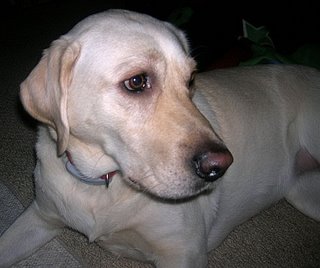
She’s a Labrador retriever, a bird dog, and she had all kinds of fun sniffing around, chasing after geese and birds. People always tell me how labs are smart dogs (I’ve always been a little skeptical). She quickly found the path through the tall grass that surrounds the lake. We managed together to find the path that circled its entirety.
Though she’s still a puppy, I’m amazed at how well and attentive she is to me. She may gallop ahead a bit, but then she’ll stop, turn around and wait for me to catch up. So maybe she does have more sense than is usually apparent at home…
As we made our way around the lake, I noticed in the woods some makeshift forts. Just the kind we used to make in our Smoky Mountains. I’m going back later to take pictures to send to my brother, Chris. I’m sure he remembers those forts and mud pies. Only he put his exploring skills to good use and eventually became an Eagle Scout and a member of the U.S. Air Force. And today, as the father of two, he also is a Boy Scout leader teaching others about exploring.

My older brother Chris and nephews Todd and Brian have already been out camping and exploring this spring.
We (and our neighborhood pals) called it the Smoky Mountains (as opposed to the Great Smoky Mountains). In reality, our playground was multiple mounds of earth pushed up by bulldozers and left for several years to become fertile ground for cottonweed, goldenrod, thistle and all manner of wild vegetation.
But it was our playground and we would spend hours every day wandering up and down the hills, playing hide and seek or war or adventure. My mom never worried about us being there. It was better than roaming in the creek, which ran along the northern side of our development.
Of course we did that, too. And we were busted when we went into the creek in our synthetic leather tennies (available at K-mart). The odor emanating from the shoebox was a dead giveaway. Our neighbors across the street were at least five years older than us (though they seemed a lot older than that) and they used to swing from grapevines into the creek. As fun as that appeared, I never did it because I was terrified of getting in trouble.
One day those boys brought home a four-foot snake and put it in their trash can for all to see. That was enough to turn me off of the creek for good.
My mom always describes that era of our lives as very innocent. Today as parents we have to worry about whether or not our children will be safe outside of our watchful eye. But at the same time, we want them to be explorers, to be curious, to discover things for themselves, to open a cottonweed pod and see the milky substance inside.
A couple-hundred feet down the road from my house is a new park. I don’t know if it’s open to the public yet, but Riley and I have been exploring. There’s a long road that goes back a half-mile and opens to nothing more than a lake (actually a retention basin that keeps our neighborhood storm sewers from flooding our basements during heavy rains) and a parking lot. Other than that, it’s empty fields and woods.
This is what green space should be.
Last night was gorgeous and so we walked there with a tennis ball, which we eventually lost. Once we were beyond the gate at the entrance to the road (which if unpaved would resemble a country lane lined with purple, pink and white crabapple trees) I removed the leash and let Riley run.

She’s a Labrador retriever, a bird dog, and she had all kinds of fun sniffing around, chasing after geese and birds. People always tell me how labs are smart dogs (I’ve always been a little skeptical). She quickly found the path through the tall grass that surrounds the lake. We managed together to find the path that circled its entirety.
Though she’s still a puppy, I’m amazed at how well and attentive she is to me. She may gallop ahead a bit, but then she’ll stop, turn around and wait for me to catch up. So maybe she does have more sense than is usually apparent at home…
As we made our way around the lake, I noticed in the woods some makeshift forts. Just the kind we used to make in our Smoky Mountains. I’m going back later to take pictures to send to my brother, Chris. I’m sure he remembers those forts and mud pies. Only he put his exploring skills to good use and eventually became an Eagle Scout and a member of the U.S. Air Force. And today, as the father of two, he also is a Boy Scout leader teaching others about exploring.

My older brother Chris and nephews Todd and Brian have already been out camping and exploring this spring.
Friday, April 28, 2006
Bringing you the sea

Because it's poetry month ... and Friday...
The Poet's Obligation
To whoever is not listening to the sea
this Friday morning, to whoever is cooped up
in house or office, factory or woman
or street or mine or harsh prison cell:
to him I come, and, without speaking or looking,
I arrive and open the door of his prison,
and a vibration starts up, vague and insistent,
a great fragment of thunder sets in motion
the rumble of the planet and the foam,
the raucous rivers of the ocean flood,
the star vibrates swiftly in its corona,
and the sea is beating, dying and continuing.
So, drawn on by my destiny,
I ceaselessly must listen to and keep
the sea's lamenting in my awareness,
I must feel the crash of the hard water
and gather it up in a perpetual cup
so that, wherever those in prison may be,
wherever they suffer the autumn's castigation,
I may be there with an errant wave,
I may move, passing through windows,
and hearing me, eyes will glance upward
saying, "How can I reach the sea?"
And I shall broadcast, saying nothing,
the starry echoes of the wave,
a breaking up of foam and of quicksand,
a rustling of salt withdrawing,
the grey cry of sea-birds on the coast.
So, through me, freedom and the sea
will make their answer to the shuttered heart.
~ Pablo Neruda ~
(translated by Alistair Reed, in On The Blue Shore of Silence)
Thursday, April 27, 2006
Blogger sued in U.S. District Court
This release is just in from Media Bloggers Association:
BLOGGER HIT WITH MULTI-MILLION DOLLAR FEDERAL LAWSUIT
Phone Sex Line Ad Embarrasses State of Maine Contractor
Lance Dutson, a tech blogger who publishes the Maine Web Report
(mainewebreport.com) was served Saturday with a lawsuit filed in the U.S.
District Court in Maine. The lawsuit, filed by attorneys for Warren Kremer
Paino Advertising, LLC seeks damages based on allegations of copyright
infringement and defamation for reporting and commentary written and
published by Dutson on his blog. Warren Kremer Paino Advertising is a New
York-based advertising agency hired by the State of Maine Tourism Board to
promote Maine as a tourism destination.
Most of the financial damages claimed in the lawsuit center on Dutson
publishing a sample advertisement contained in a presentation prepared by
Warren Kremer Paino for the 2006 Governor’s Conference. The presentation,
still publicly available on the State of Maine web site, included an ad
promoting a number, 1-800-MAINE24, which directs callers to a phone sex
line. The lawsuit asserts that Dutson’s publication of this advertisement is
a violation of their copyright and seeks $150,000 per instance of use.
Dutson has been highly critical of the Maine Tourism Board and Warren Kremer
Paino Adverting for what Dutson believes to be a web-based advertising
campaign that hurts Maine businesses by driving up the cost of local
“keyword” advertising on sites such as Google.
Dutson is a member of the Media Bloggers Association which provides “first
line” legal defense to member bloggers. Greg Herbert of the Greenberg
Traurig Law Firm is acting as lead counsel and providing his services on a
pro bono basis. The Media Bloggers Association, through MBA General Counsel
Ronald Coleman of The Coleman Law Firm, is acting as co-counsel.
“This case is nothing more than an attempt by a deep-pocketed litigant to
bully a blogger for criticizing state officials and state contractors"”,
said Robert Cox, President of the Media Bloggers Association. “We have
successfully defended MBA members in nine previous cases and I don’t expect
the outcome here to be any different.”
Dutson has vowed to fight the lawsuit.
“The idea that criticism of the state government can be defamatory is
absurd”, said Dutson, "This attempt to bludgeon critics of the state
government is not going to work."
Through its legal defense initiative, the MBA provides member bloggers with
"first line" legal defense, pro bono advice on how best to respond to legal
threats related to the member's blog.
"Bloggers don't usually have an in-house legal department or high priced
outside First Amendment counsel, but they're at least as likely to need one
as any MSM outlet. That's where we come in," said Coleman.
"Many of these cases, where a large corporation sues an individual for
criticism over the Internet, appear to be motivated, primarily, by an
attempt to silence legitimate criticism and suppress speech” said Herbert.
ABOUT THE MEDIA BLOGGERS ASSOCIATION
The Media Bloggers Association, a nonpartisan organization dedicated to
promoting, protecting and educating its member bloggers and citizen
journalists is the largest association of bloggers in the world. Members
include many of the most well-known and widely read bloggers. The MBA is
dedicated to supporting the development of "blogging" or "citizen
journalism" as a distinct form of media; and helping to extend the power of
the press, with all the rights and responsibilities that entails, to every
citizen.
BLOGGER HIT WITH MULTI-MILLION DOLLAR FEDERAL LAWSUIT
Phone Sex Line Ad Embarrasses State of Maine Contractor
Lance Dutson, a tech blogger who publishes the Maine Web Report
(mainewebreport.com) was served Saturday with a lawsuit filed in the U.S.
District Court in Maine. The lawsuit, filed by attorneys for Warren Kremer
Paino Advertising, LLC seeks damages based on allegations of copyright
infringement and defamation for reporting and commentary written and
published by Dutson on his blog. Warren Kremer Paino Advertising is a New
York-based advertising agency hired by the State of Maine Tourism Board to
promote Maine as a tourism destination.
Most of the financial damages claimed in the lawsuit center on Dutson
publishing a sample advertisement contained in a presentation prepared by
Warren Kremer Paino for the 2006 Governor’s Conference. The presentation,
still publicly available on the State of Maine web site, included an ad
promoting a number, 1-800-MAINE24, which directs callers to a phone sex
line. The lawsuit asserts that Dutson’s publication of this advertisement is
a violation of their copyright and seeks $150,000 per instance of use.
Dutson has been highly critical of the Maine Tourism Board and Warren Kremer
Paino Adverting for what Dutson believes to be a web-based advertising
campaign that hurts Maine businesses by driving up the cost of local
“keyword” advertising on sites such as Google.
Dutson is a member of the Media Bloggers Association which provides “first
line” legal defense to member bloggers. Greg Herbert of the Greenberg
Traurig Law Firm is acting as lead counsel and providing his services on a
pro bono basis. The Media Bloggers Association, through MBA General Counsel
Ronald Coleman of The Coleman Law Firm, is acting as co-counsel.
“This case is nothing more than an attempt by a deep-pocketed litigant to
bully a blogger for criticizing state officials and state contractors"”,
said Robert Cox, President of the Media Bloggers Association. “We have
successfully defended MBA members in nine previous cases and I don’t expect
the outcome here to be any different.”
Dutson has vowed to fight the lawsuit.
“The idea that criticism of the state government can be defamatory is
absurd”, said Dutson, "This attempt to bludgeon critics of the state
government is not going to work."
Through its legal defense initiative, the MBA provides member bloggers with
"first line" legal defense, pro bono advice on how best to respond to legal
threats related to the member's blog.
"Bloggers don't usually have an in-house legal department or high priced
outside First Amendment counsel, but they're at least as likely to need one
as any MSM outlet. That's where we come in," said Coleman.
"Many of these cases, where a large corporation sues an individual for
criticism over the Internet, appear to be motivated, primarily, by an
attempt to silence legitimate criticism and suppress speech” said Herbert.
ABOUT THE MEDIA BLOGGERS ASSOCIATION
The Media Bloggers Association, a nonpartisan organization dedicated to
promoting, protecting and educating its member bloggers and citizen
journalists is the largest association of bloggers in the world. Members
include many of the most well-known and widely read bloggers. The MBA is
dedicated to supporting the development of "blogging" or "citizen
journalism" as a distinct form of media; and helping to extend the power of
the press, with all the rights and responsibilities that entails, to every
citizen.
Tuesday, April 25, 2006
Transparency in the news
What does transparency in news coverage mean to you? It’s a prickly word in today’s newsrooms and Scott M. Libin, of The Poynter Institute just explained why.
In his piece, Trying Transparency he writes how he associated transparency with thinness, shallowness, not something to which most journalists aspire. But he has since been converted. He describes transparency in the reporting process as viewing the inner workings of a clock. It’s about process and timing and placement and context. And all of these things help readers better understand news coverage.
It’s a common assumption of news folks to think they don’t have to explain how or why they cover news. They are the experts and they dictate what is news. I’ve heard reporters suggest that they should do away with focus groups or reader surveys because readers aren’t in a position to know what they don’t know. Somehow reporters are?
That’s one of the biggest fallacies of the modern traditional media. Believing we know what readers should know is arrogant at best and borderline negligent.
Sure reporters have a feel for their beat that the average Joe or Jane lacks; and certainly editors develop a finely tuned sense of discernment when it comes to news decisions. But they don’t — and can’t — know it all.
Journalism is a participatory sport. The reporter may be running with the ball (story), but that toss came from a quarterback (concerned citizen/government official/cop) with a play (tip). And then there are the fellow players (copyeditors and mid—level editors) on the field who help to shape and finesse the run (reporting). Meanwhile the referee (editor) makes the call as to where the ball (story) gets placed. In the end the fans (readers) will either cheer or boo the efforts.
But make no mistake; they have a stake in the game.
Libin includes this example about the need for transparency:
In 2003, Joel Sappell was the Los Angeles Times senior entertainment editor, overseeing coverage of the business of Hollywood. Sappell also held the title of deputy business editor. He edited the newspaper's investigation of allegations that Arnold Schwarzenegger, then a candidate for governor, had a history of groping women. The investigative team was ready to publish just days before the election -- which raised a host of new concerns about a story that was already complicated enough.
"The old model was, you don’t drop any bombshells on the eve of the election," says Sappell. Now assistant managing editor of the Times and executive editor of latimes.com, Sappell is also a 2006 Poynter Ethics Fellow. He says California’s 2003 special election did not operate on a traditional timeline. So, "because of the compressed amount of time, we decided to run it," Sappell told me. "We knew it would be controversial."
They were right.
"In hindsight, because of all the questions we knew would arise… I think we underestimated the backlash," Sappell believes now. "I think we should have had an editor’s note that explained the timing, explaining why we broke with journalistic conventions in not breaking big stories on the eve of elections, and our methodology."
At the time, Sappell says he and his fellow editors felt the work should speak for itself, and that editor's notes could seem defensive and apologetic. Sappell says now he's changed his mind.
"I am a complete convert… I've come to believe a lot in explaining to readers our process," he told me. "I am a true believer in providing context for our large undertakings."
(Bold is mine.)
There’s so much that readers don’t know about the decision-making process in newsrooms. So maybe there are those who don’t want to see the sausage being made. That’s fine, but recognize that certain stories require more transparency. And it doesn’t matter if you’re the Podunk Gazette or the Washington Post. The public is highly cynical about our work, our ethics, our motive and our process. Maybe that's unfair, but it's reality. Mainstream journalism cannot afford to keep making the assumption that its work “speaks for itself.”
In his piece, Trying Transparency he writes how he associated transparency with thinness, shallowness, not something to which most journalists aspire. But he has since been converted. He describes transparency in the reporting process as viewing the inner workings of a clock. It’s about process and timing and placement and context. And all of these things help readers better understand news coverage.
It’s a common assumption of news folks to think they don’t have to explain how or why they cover news. They are the experts and they dictate what is news. I’ve heard reporters suggest that they should do away with focus groups or reader surveys because readers aren’t in a position to know what they don’t know. Somehow reporters are?
That’s one of the biggest fallacies of the modern traditional media. Believing we know what readers should know is arrogant at best and borderline negligent.
Sure reporters have a feel for their beat that the average Joe or Jane lacks; and certainly editors develop a finely tuned sense of discernment when it comes to news decisions. But they don’t — and can’t — know it all.
Journalism is a participatory sport. The reporter may be running with the ball (story), but that toss came from a quarterback (concerned citizen/government official/cop) with a play (tip). And then there are the fellow players (copyeditors and mid—level editors) on the field who help to shape and finesse the run (reporting). Meanwhile the referee (editor) makes the call as to where the ball (story) gets placed. In the end the fans (readers) will either cheer or boo the efforts.
But make no mistake; they have a stake in the game.
Libin includes this example about the need for transparency:
In 2003, Joel Sappell was the Los Angeles Times senior entertainment editor, overseeing coverage of the business of Hollywood. Sappell also held the title of deputy business editor. He edited the newspaper's investigation of allegations that Arnold Schwarzenegger, then a candidate for governor, had a history of groping women. The investigative team was ready to publish just days before the election -- which raised a host of new concerns about a story that was already complicated enough.
"The old model was, you don’t drop any bombshells on the eve of the election," says Sappell. Now assistant managing editor of the Times and executive editor of latimes.com, Sappell is also a 2006 Poynter Ethics Fellow. He says California’s 2003 special election did not operate on a traditional timeline. So, "because of the compressed amount of time, we decided to run it," Sappell told me. "We knew it would be controversial."
They were right.
"In hindsight, because of all the questions we knew would arise… I think we underestimated the backlash," Sappell believes now. "I think we should have had an editor’s note that explained the timing, explaining why we broke with journalistic conventions in not breaking big stories on the eve of elections, and our methodology."
At the time, Sappell says he and his fellow editors felt the work should speak for itself, and that editor's notes could seem defensive and apologetic. Sappell says now he's changed his mind.
"I am a complete convert… I've come to believe a lot in explaining to readers our process," he told me. "I am a true believer in providing context for our large undertakings."
(Bold is mine.)
There’s so much that readers don’t know about the decision-making process in newsrooms. So maybe there are those who don’t want to see the sausage being made. That’s fine, but recognize that certain stories require more transparency. And it doesn’t matter if you’re the Podunk Gazette or the Washington Post. The public is highly cynical about our work, our ethics, our motive and our process. Maybe that's unfair, but it's reality. Mainstream journalism cannot afford to keep making the assumption that its work “speaks for itself.”
Tuesday tidbit: Blogger vs. MSM part 57
An interesting tidbit from Poynter’s E-Media Tidbits:
Last Thursday, the mega-popular videoblog Rocketboom featured an interview with the prickly genius who played a key role in developing many popular new-media tools (such as feeds, OPML and podcasting), Dave Winer.
Here's my (Amy Gahran) favorite quote, and I love it because it's so controversial: "Amateur is not below professional. It's just another way of doing [media]. The root of the word amateur is love, and someone who does something for love is an amateur. Someone who does something to pay the bills is a professional. The amateurs have [more integrity than] the professionals. If you're an amateur you have less conflict of interest and less reason not to tell your truth than if you have to pay the bills and please somebody else."
I’ve heard it argued by members of the MSM that bloggers are amateurs and that passion doesn’t equal integrity. My argument has been the opposite, that it is precisely the passion and the labor of love that leads bloggers to doggedly pursue and research information.
This isn’t the case for all bloggers, but I think many are transparent about their motives for pursuing information. And doesn’t that in itself suggest integrity and transparency in the process? At its best, I think this approach is a fine complement to traditional news coverage. I will continue to argue that the news-consuming public will be best served when the two camps work together to provide the greatest level of coverage.
Last Thursday, the mega-popular videoblog Rocketboom featured an interview with the prickly genius who played a key role in developing many popular new-media tools (such as feeds, OPML and podcasting), Dave Winer.
Here's my (Amy Gahran) favorite quote, and I love it because it's so controversial: "Amateur is not below professional. It's just another way of doing [media]. The root of the word amateur is love, and someone who does something for love is an amateur. Someone who does something to pay the bills is a professional. The amateurs have [more integrity than] the professionals. If you're an amateur you have less conflict of interest and less reason not to tell your truth than if you have to pay the bills and please somebody else."
I’ve heard it argued by members of the MSM that bloggers are amateurs and that passion doesn’t equal integrity. My argument has been the opposite, that it is precisely the passion and the labor of love that leads bloggers to doggedly pursue and research information.
This isn’t the case for all bloggers, but I think many are transparent about their motives for pursuing information. And doesn’t that in itself suggest integrity and transparency in the process? At its best, I think this approach is a fine complement to traditional news coverage. I will continue to argue that the news-consuming public will be best served when the two camps work together to provide the greatest level of coverage.
Monday, April 24, 2006
The news I missed
A disadvantage to being purposefully unplugged is that you do miss out on a few things. I did not read one newspaper, watch a lick of television. log on to any Web site, answer any e-mail or read anything other than the books I brought with me.
It was necessary for the full benefit of decompression. But I did miss the Pulitzer (and let's please remember is Pull-itzer not Puhl-itzer) Prizes. I'm not surprised by many of the winners.
Dana Priest did some amazing reporting for the Washington Post, though I'm a bit edgy about the prolific use of unnamed sources in her piece on black sites in Europe.
HUGE kudos to the folks in Biloxi and New Orleans for the public service and deadline reporting under extaordinary circumstances.
I was disappointed, however, to see that Chris Rose of the New Orleans Times-Picayune (the best newspaper name in the country) didn't win for commentary. Nothing against Nicholas Kristof, but he's just so east coast and it would have been nice to follow up a Midwest win with someone from the south. Rose's columns in Katrina's aftermath were pure poetry. So maybe they didn't call much-needed attention to genocide in Darfur, but they sure did convey the humanity, the grace and the tremendous need of the people of New Orleans.
Here's a recent gem about enjoying the Mighty Mississippi River with his kids and dog.
Here's an excerpt:
People from out of town ask me since The Thing: Do you think New Orleans will survive?
I tell them: America has no choice.
Sometimes when I say that, I feel like Luna Biscuit howling at the moon. I am haunted by mortality issues like never before.
Sometimes I look at the river while my kids are off on their nature walks and I ask it: Will you kill us one day? Is that your plan?
I get no answer I can brook. The river, it just runs by silent and mischievous, in swirls and eddies that I swear sometimes look like the devil's smile, and seems to whisper to me: That is for you to find out, my friend.
Only time will tell.
Congrats to all. In the next months and year of Pulitzer madness may you be able to tap unreservedly that which has made you exceptional this year.
It was necessary for the full benefit of decompression. But I did miss the Pulitzer (and let's please remember is Pull-itzer not Puhl-itzer) Prizes. I'm not surprised by many of the winners.
Dana Priest did some amazing reporting for the Washington Post, though I'm a bit edgy about the prolific use of unnamed sources in her piece on black sites in Europe.
HUGE kudos to the folks in Biloxi and New Orleans for the public service and deadline reporting under extaordinary circumstances.
I was disappointed, however, to see that Chris Rose of the New Orleans Times-Picayune (the best newspaper name in the country) didn't win for commentary. Nothing against Nicholas Kristof, but he's just so east coast and it would have been nice to follow up a Midwest win with someone from the south. Rose's columns in Katrina's aftermath were pure poetry. So maybe they didn't call much-needed attention to genocide in Darfur, but they sure did convey the humanity, the grace and the tremendous need of the people of New Orleans.
Here's a recent gem about enjoying the Mighty Mississippi River with his kids and dog.
Here's an excerpt:
People from out of town ask me since The Thing: Do you think New Orleans will survive?
I tell them: America has no choice.
Sometimes when I say that, I feel like Luna Biscuit howling at the moon. I am haunted by mortality issues like never before.
Sometimes I look at the river while my kids are off on their nature walks and I ask it: Will you kill us one day? Is that your plan?
I get no answer I can brook. The river, it just runs by silent and mischievous, in swirls and eddies that I swear sometimes look like the devil's smile, and seems to whisper to me: That is for you to find out, my friend.
Only time will tell.
Congrats to all. In the next months and year of Pulitzer madness may you be able to tap unreservedly that which has made you exceptional this year.
Blast rocks Egyptian spring break
This is just coming in from one of the travel news blasts I regularly receive.
As of press time, over 22 people were reported dead and more than 150 injured Unconfirmed sources talked about more than 100 casualties following the third in a series of bombing incidents near Egypt’s Red Sea resort of Sharm el Sheikh.
Three bombs exploded at a marketplace in a quiet, tourist town of Dahab, about 1 1/2 hours by road from Sharm on the eastern Sinai Peninsula. Though it is still too early to confirm numbers impacted by the blasts, Dahab is reporting this period is a busy season. It is indeed high season on their tourism calendar.
People were celebrating Sham el Nessim
Three explosions rocked Dahab in an al Qaeda-type modus operandum. At this time, authorities cannot say who is responsible. But Bedouins related to the last blast in Naama Bay in downtown Sharm el Sheik were. Their act of violence killed over 80 mostly, local Egyptians working in hotels. Smoke coming from the market place has been reported.
Many tourists on spring break are in Dahab. Most are from Europe; a lot from Russia who are celebrating their Orthodox Easter.
Sham El-Nessim signifies the arrival of Spring -- an Egyptian tradition practiced since the days of the Pharaohs.
As of press time, over 22 people were reported dead and more than 150 injured Unconfirmed sources talked about more than 100 casualties following the third in a series of bombing incidents near Egypt’s Red Sea resort of Sharm el Sheikh.
Three bombs exploded at a marketplace in a quiet, tourist town of Dahab, about 1 1/2 hours by road from Sharm on the eastern Sinai Peninsula. Though it is still too early to confirm numbers impacted by the blasts, Dahab is reporting this period is a busy season. It is indeed high season on their tourism calendar.
People were celebrating Sham el Nessim
Three explosions rocked Dahab in an al Qaeda-type modus operandum. At this time, authorities cannot say who is responsible. But Bedouins related to the last blast in Naama Bay in downtown Sharm el Sheik were. Their act of violence killed over 80 mostly, local Egyptians working in hotels. Smoke coming from the market place has been reported.
Many tourists on spring break are in Dahab. Most are from Europe; a lot from Russia who are celebrating their Orthodox Easter.
Sham El-Nessim signifies the arrival of Spring -- an Egyptian tradition practiced since the days of the Pharaohs.
The Hoke Clan

The Hoke clan on the beach -- and this isn't even everyone. One family staying at another place missed the group photo before sunset.

The older brothers Hoke. Actually, they are not all brothers. From left to right they are:
Brian (first cousin but might as well be brother / aka Bob)
Danny (my hubby, aka Stupe, Tahz and "that mean scary guy in my pool," according to Little Lucy Hoke (age 2-1/2)
Jack (in the backround hiding his wet clothes because he was fishing / aka Big Daddy, Lanky (he's 6'4")
Jimmy (the favorite uncle among all the kids, known for very loud outbursts and one-liners and father of seven ages 17 to Lucy)
Tom (the oldest brother present in the absence of Michael / aka Tiny)
Chris Schmidt (niece Kelly's fiance and virtual member of the family because they've been dating for 10 years / aka Schmidthead)

I just love this photo. This is Clare and Moira — cousins, not sisters. They are as sweet as punch and were fascinating to watch.
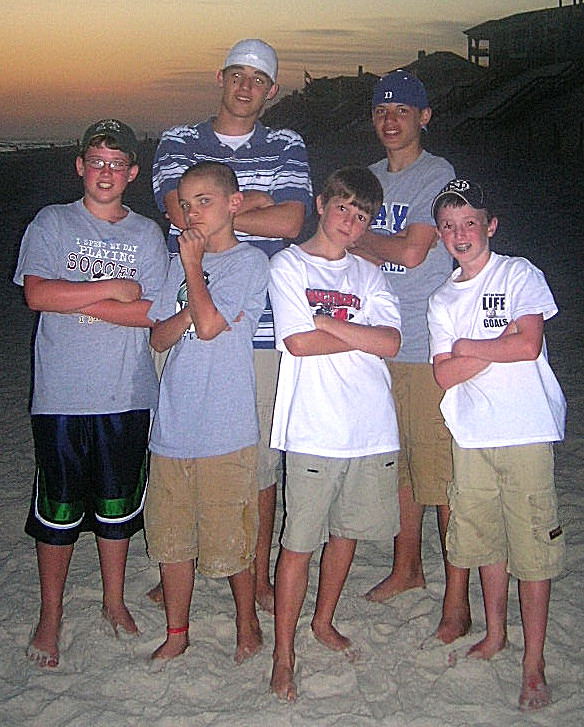
Now these guys were so fun. We're even missing a couple — someone grabbed Mikey by the sunburn shoulders so he was in no mood for the photo. Cousins Ted (14) and Jacob (11) weren't there. When it's time for an outing, I got to take boys to the Nike Outlet.
Pictured in front are:
Christopher (11)
Patrick (11)
Mark (11)
Kevin (12)
And in back are:
Matthew (15)
Ryan (13)
Room with a view

Feeling utterly refreshed after a week at the Adagio (or “Ahdahhsheo” as my brother-in-law, Jack called it). The map said we were on Florida’s Gulf Coast, but honestly it felt far more exotic than Florida.
I spotted it on the bend of Highway 30-A — a mustard-colored stucco resort ornamented with stone parapets jutting from its exterior, and wrought-iron balconies that overlooked a lush swimming pool resplendent with two waterfalls, a fountain and lined with palm trees.
We had traveled as a caravan of five cars. For the last hour, we switched kids and Danny and I drove with nieces, Molly and Erin. (It’s quite a different thing to drive with girls.)
“We’re staying here!” the kids yelled jumping out of the cars. Just at the moment of arrival, little Mikey jumped out of my niece Kelly’s car with a blond wig and sunglasses on. He threw his arms in the air and yelled, “Woooo!” at the top of his lungs, essentially setting the tone as comic relief for the remainder of the trip.
As we unlocked the door to our condo, Danny and I gasped. The sales agent told us the units sell for $1.5 to $2 million. And so it appeared once inside. We immediately saw glass tables and handcrafted pottery and ceramics. Barreling along behind was Mikey, with his football in tow.
“Oh no, buddy. There’s no football in here. We break one thing and there goes the $500 damage waiver.”
But it was far from stuffy. Quite the contrary, it was something out of the Pottery Barn catalog — painted black wood armoires, jute rugs, natural-colored sofas and chocolate brown round leather ottoman (which I covet). Ryan, who shares a room at home, was like a prince in a palace with his own queen bed and adjoining bathroom.
Danny and I oohed and aahed at the granite countertops, stainless appliances and ceramic tile floor in the kitchen. We’re pretty sure we were the first ones to use many of the kitchen items. I mean, the toaster had not one crumb or fingerprint.
Our master bedroom had an entry to the balcony and our own rattan chaise lounges. And then there was the master bathroom — complete with Jacuzzi tub for two and a shower with two massaging showerheads.
“I won’t want to go home to our crappy house,” I said.
We laughed at our luck at scoring such a great deal on such a beautiful place. Living would be very easy here. Sweetening the deal was the phone call Danny received on the drive down. He had been interviewing for a new job and was somewhat distraught about leaving town without hearing anything. I tried to reassure him that they wouldn’t have bothered to call his references earlier that week without planning to make an offer.
The offer came at 9:30 Friday morning somewhere north of Louisville, Kentucky. He was on cloud nine. And it only added to my news.
Beginning next Monday, I will be working part-time for the Society of Professional Journalists as a membership manager.
The executive director and I have been talking about such a position for a few months and though it’s a tad ambiguous, I’m very excited about the opportunity to build relationships through SPJ. It’s an extension of what I’ve been doing as a member and volunteer for 20 years.
My charge, as someone who "drank the Kool-Aid," is to develop strategies for member recruitment and retention. My efforts will largely be focused externally, helping chapters revive themselves and helping new chapters form. I’ll also be working on promoting SPJ to more news organizations and establishing effective communication between national headquarters and local chapters.
So this vacation was perfectly timed for relaxation and enjoyment. And it was a great opportunity for me (after 18 months of weekly book reviews and six months of intense writing projects) to enjoy reading again. I had an amazing balcony with a lovely view of the pool. Every morning I would rise at about 6:30, get my coffee and book and enjoy the relative coolness of the morning.
On the drive down I finished, Will in the World: How Shakespeare Became Shakespeare,” by Stephen Greenblatt. This was a fascinating look at what influenced Shakespeare’s writing. It’s full of great writing and some wonderful details.
On the shelves of our condo was Dan Brown’s “Angels & Demons” so I took advantage and read it while it was so readily available. I understand that Dan Brown is a publishing phenom, but I have to say, as a writer, he just doesn’t do it for me.
I think his books begin well and transition through multiple complex plot lines, carefully revealing motives and past and connections. But my criticism of him is that in both of his highly successful novels, he takes the easy way out in the end. Both books wrap up in such a neat and tidy — and utterly unbelievable — way that I was disgusted by the ending and felt cheated as a reader.
I don’t want convenient, tidy endings. Life is not neat and tidy. It’s very messy and I relate to fiction that reflects life’s untidiness. That’s why Edith Wharton’s novels are so appealing. There is no happily ever after.
But the book that moved me was Penelope Lively’s “The Photograph.” It was the haunting, spare story of a man who discovers a photograph of his late wife holding hands with her brother-in-law at an outing which he cannot remember. Though his wife has been long dead, the archaeologist digs for answers to the photograph and the relationship.
Along the way he — and the others in the family and assorted friends — discover things about themselves that alter how they view her. But mostly it reveals how little they really knew her — how her appearance led to assumptions and how most made little effort at uncovering the substance beneath her ephemeral exterior.

So we're back — well rested, tanned and excited about new ventures.
Thursday, April 13, 2006
Wednesday, April 12, 2006
Last week in photos
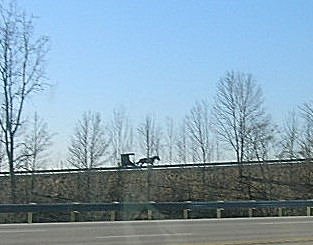
I'm pretty sure this is a gene passed down on my father's side, but I just love a road trip. Driving vacations illuminate so much about places and people and geography and history. Living in Cleveland I think we tend to forget how much of Ohio is agricultural. As I was driving down I-71 near Ashland, I snapped this photo of an Amish buggy making its way. I happened to appreciate (in lightning speed) the juxtaposition of the Interstate and the horse and buggy.

Scripps Hall, home of the E.W. Scripps School of Journalism. The SPJ student chapter there gave me a T-shirt that reads "You can't spell JOURNALISM without OU." Also had a chance to briefly meet Leonard Pitts, a visiting prof and Pulitzer Prize-winning columnist from The Miami Herald. It seems that Scripps Howard has decided to turn its financial backing (and, thus, naming rights) to the College of Communication. At least a few faculty members at the J-School are peeved because the new deal allows for no new funding for J-school programs.

Cutler Hall on the College Green at OU is the primary landmark of the university. It's home of the President's office (and dean and provost and all those important people). Honestly, I don't think I ever set foot in this building. If I did, it was probably to deliver something from the Admissions office in nearby Chubb Hall.

If you are at all familiar with OU, I needn't explain this photo. But for the unitiated, this is the famous Burrito Buggy at the corner of Court and Union streets in Athens. When I was a student you could get a Burrito Supreme for $2. At 2 a.m., nothing tasted better. I didn't have the chance to find out what they cost today. I shot this photo while at the traffic light.
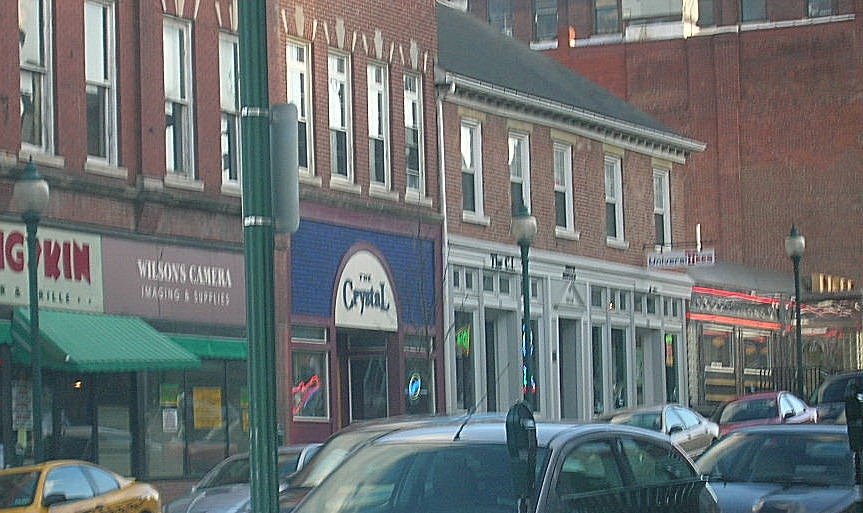
Court Street is infamous. I tended bar at The Crystal. The nearby CI was always known as a upper classmen bar. And I'm sure somewhere in his T-shirt drawer (cause he never gets rid of anything), Danny still possesses a "Get High at the CI" T-shirt.

Natalie, the little drummer girl, and her mom sneaking a smooch.
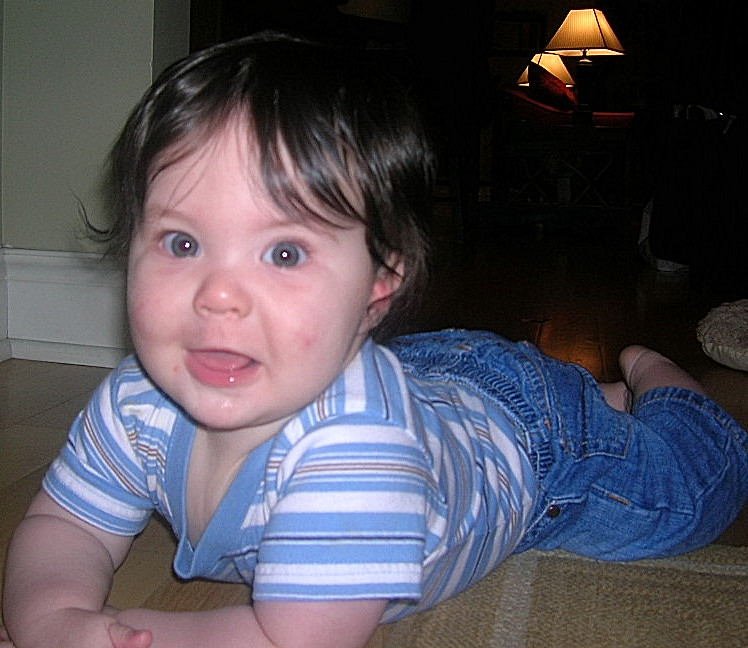
The little Charlie man is scooting around this days.
Tuesday, April 11, 2006
Catching up
Last week was a whirlwind of driving, speaking, workshopping, babysitting, networking, researching, etc. It's too much to recall this week since I'm also preparing for vacation. We leave for Florida on Friday morning and will be gone all next week.
Here's the abridged version:
1) OU was great fun and I enjoyed meeting the SPJ students. Can't believe how many PR majors are in SPJ. I popped in on Don Pepper, proprietor of the Crystal Casino where I tended bar and he still remembers me: "Wendy Lewis," he said as I walked in. Seems he's organizing a bartender reunion for Memorial Weekend. Anyhow, his three boys I used to babysit while I was a student are now in their upper 20s. Yikes! And the bar? Well, there are some improvements such as flat-screen TVs, but that same bar smell was there and the floor had its same stickiness.
2) Some day I'll have to look into the story behind the Nelsonville Cross. The sign still reads, "A tribute to God, a memorial to Betty." Twenty years later I'm still wondering, "Who was Betty?"
3) If you ever have the chance to get into a writing workshop, give it a shot. I learned so much about writing from spending two days discussing narrative nonfiction with other KnowledgeWorks storytellers.
4) My niece Natalie drums constantly and with incredible rhythm. She was drumming a syncopated rhythm while singing the "Hokey Pokey" on her little snare drum while I was babysitting her on Friday. Little brother Charlie was yelling in the background and she was utterly undeterred.
5) Staying at my sister, Jen's house beat the pants off spending sleepless nights in hotel rooms. I always require a Tylenol PM to sleep in hotels. I hate the smell of the sheets and I get skeeved out by the bed coverings. Oy! Anyway, Jen has an incredible in-law suite that guaranteed sleep for my busy days. And this phenomenal shower with two showerheads. Aahhh...
6) Columbus is a town for dining out. We had fish and chips at O'Shaughnessy's Public House in the Arena District and Greek at the Happy Greek in the Short North. On Friday I drove around while charging my cell phone and popped in for some wild blueberry and lavender ice cream at the Short North Market. Yum!
7) There is no more boring drive than that 90-minute stretch down I-71 from Columbus to Cincinnati.
8) Just how fast do you have to drive to get stopped for speeding on 71? Best not to think too much of that. Wouldn't want to press my luck. Let's just say that cruise control was set at 80 mph.
9) Enjoyed speaking to a lively group of freelancers, moonlighters and wanna-be freelancers at the SPJ Region 4 Convention. I'm sorry I couldn't stick around longer, but after five days away, I was ready to head home.
10) Cleveland, despite my frustration with its inability to progress to my timetable, is still and always will be...home.
Here's the abridged version:
1) OU was great fun and I enjoyed meeting the SPJ students. Can't believe how many PR majors are in SPJ. I popped in on Don Pepper, proprietor of the Crystal Casino where I tended bar and he still remembers me: "Wendy Lewis," he said as I walked in. Seems he's organizing a bartender reunion for Memorial Weekend. Anyhow, his three boys I used to babysit while I was a student are now in their upper 20s. Yikes! And the bar? Well, there are some improvements such as flat-screen TVs, but that same bar smell was there and the floor had its same stickiness.
2) Some day I'll have to look into the story behind the Nelsonville Cross. The sign still reads, "A tribute to God, a memorial to Betty." Twenty years later I'm still wondering, "Who was Betty?"
3) If you ever have the chance to get into a writing workshop, give it a shot. I learned so much about writing from spending two days discussing narrative nonfiction with other KnowledgeWorks storytellers.
4) My niece Natalie drums constantly and with incredible rhythm. She was drumming a syncopated rhythm while singing the "Hokey Pokey" on her little snare drum while I was babysitting her on Friday. Little brother Charlie was yelling in the background and she was utterly undeterred.
5) Staying at my sister, Jen's house beat the pants off spending sleepless nights in hotel rooms. I always require a Tylenol PM to sleep in hotels. I hate the smell of the sheets and I get skeeved out by the bed coverings. Oy! Anyway, Jen has an incredible in-law suite that guaranteed sleep for my busy days. And this phenomenal shower with two showerheads. Aahhh...
6) Columbus is a town for dining out. We had fish and chips at O'Shaughnessy's Public House in the Arena District and Greek at the Happy Greek in the Short North. On Friday I drove around while charging my cell phone and popped in for some wild blueberry and lavender ice cream at the Short North Market. Yum!
7) There is no more boring drive than that 90-minute stretch down I-71 from Columbus to Cincinnati.
8) Just how fast do you have to drive to get stopped for speeding on 71? Best not to think too much of that. Wouldn't want to press my luck. Let's just say that cruise control was set at 80 mph.
9) Enjoyed speaking to a lively group of freelancers, moonlighters and wanna-be freelancers at the SPJ Region 4 Convention. I'm sorry I couldn't stick around longer, but after five days away, I was ready to head home.
10) Cleveland, despite my frustration with its inability to progress to my timetable, is still and always will be...home.
Bloggers going mainstream
News from Wired yesterday tells about >Blog Burst a new service in which mainstream newspapers are subscribing to blogger content for commentary on specific areas, such as travel, parenting, tech, etc.
Here's a teaser from the Wired story:
A syndication service that delivers commentary from 600 bloggers for use by newspaper publishers is set to launch on Tuesday, further blurring the lines that divide blogs and mainstream media.
BlogBurst, as the service from blog technology company Pluck Corp. is known, includes headlines and articles for use by newspaper publishers in the news or feature sections of their online services, as well as print editions.
Pluck initially has signed up Gannett Co., Washington Post, San Francisco Chronicle, Austin American-Statesman and San Antonio Express. Eventually, the Austin, Texas-based company will offer BlogBurst editorial materials to niche business and overseas publications.
Newspapers are looking to BlogBurst to provide expert blog commentary on travel, women's issues, technology, food, entertainment and local stories, areas where publishers may not have dedicated staff, said Pluck's chief executive, Dave Panos.
In return, a select group of popular bloggers are offered wider distribution for their writings, he said. The online syndicate drives traffic to blog sites, allowing featured bloggers to make money from resulting online advertising fees.
Here's a teaser from the Wired story:
A syndication service that delivers commentary from 600 bloggers for use by newspaper publishers is set to launch on Tuesday, further blurring the lines that divide blogs and mainstream media.
BlogBurst, as the service from blog technology company Pluck Corp. is known, includes headlines and articles for use by newspaper publishers in the news or feature sections of their online services, as well as print editions.
Pluck initially has signed up Gannett Co., Washington Post, San Francisco Chronicle, Austin American-Statesman and San Antonio Express. Eventually, the Austin, Texas-based company will offer BlogBurst editorial materials to niche business and overseas publications.
Newspapers are looking to BlogBurst to provide expert blog commentary on travel, women's issues, technology, food, entertainment and local stories, areas where publishers may not have dedicated staff, said Pluck's chief executive, Dave Panos.
In return, a select group of popular bloggers are offered wider distribution for their writings, he said. The online syndicate drives traffic to blog sites, allowing featured bloggers to make money from resulting online advertising fees.
Tuesday, April 04, 2006
Back to my old school
Wow! OU has changed and yet it's still much as I remember. E.W. Scripps Hall, where I sit writing in the J-school library, used to be on the outer edges of the campus. But it's now going to be the center of action as the new Baker Center Student Union is completed just down the hill.
The drive on U.S. 33 is much the same as it always was -- my favorite one-tree hill is still visible (the U2 song by the same name was hugely popular in 1986), Dee's Diner is still in business. The Trade Post in Nelsonville is having a special on 9mm pistols and the trailer that Danny and I used to joke would be our first home is still falling apart up in the woods.
Athens still has the same overall skyline as you descend down that last hill into the valley. Has it really been 17 years? Seems hard to imagine. And yet...
Had a brief moment of panic before I left this morning, wondering where to park. We never had cars here; the campus wasn't conducive to keeping one. So I headed for the city parking garage next to the College of Communication, the only one I remember.
Everything seems smaller to me. The College Green used to always seem so vast -- tundra-like in winter -- but it was a lovely little stroll. And of course the weather couldn't be more beautiful. It's the second week of spring quarter, which is an absolutely lovely time in Southeast Ohio. The dogwoods are just beginning to bloom and the spring green grass is vivid in its emerald richness.
The students look the same as they did when I was here. J-students are still as serious as ever as they slouch along the hallways, reading the OU Post. And the Post itself looks more elegant, more sophisticated. Today's lead story: "Grads face thriving job market," by Michelle Simakis (wonder if she's any relation to PD reporter Andrea Simakis).
Big news this week is the Blogging Conference. Keynote speaker is Dan Gillmor, author of "We the Media: Grassroots Journalism by the People, for the People." And tomorrow is Pulitzer Day. Visiting professor Leonard Pitts, Pulitzer prize-winning columnist from The Miami Herald, will be on a panel with PD's PP-WC Connie Schultz. And Tom Suddes, former PD statehouse bureau chief and (according to the flyer) Ph.D. candidate at Scripps, will moderate.
Lot's happening. I'm trying to remember if we had access to such folks when I was here. I think not, but I could be wrong. Dr. Anne Cooper-Chen, who taught foreign correspondence when I was a student, told me over lunch that the visiting professorship is fairly new and began with former hostage Terry Anderson. Though he no longers teaches here, I'm told he owns the best blues bar in Athens.
Better go feed the meter. And I need to stop in the bookstore to by assorted sundries for the boys.
The drive on U.S. 33 is much the same as it always was -- my favorite one-tree hill is still visible (the U2 song by the same name was hugely popular in 1986), Dee's Diner is still in business. The Trade Post in Nelsonville is having a special on 9mm pistols and the trailer that Danny and I used to joke would be our first home is still falling apart up in the woods.
Athens still has the same overall skyline as you descend down that last hill into the valley. Has it really been 17 years? Seems hard to imagine. And yet...
Had a brief moment of panic before I left this morning, wondering where to park. We never had cars here; the campus wasn't conducive to keeping one. So I headed for the city parking garage next to the College of Communication, the only one I remember.
Everything seems smaller to me. The College Green used to always seem so vast -- tundra-like in winter -- but it was a lovely little stroll. And of course the weather couldn't be more beautiful. It's the second week of spring quarter, which is an absolutely lovely time in Southeast Ohio. The dogwoods are just beginning to bloom and the spring green grass is vivid in its emerald richness.
The students look the same as they did when I was here. J-students are still as serious as ever as they slouch along the hallways, reading the OU Post. And the Post itself looks more elegant, more sophisticated. Today's lead story: "Grads face thriving job market," by Michelle Simakis (wonder if she's any relation to PD reporter Andrea Simakis).
Big news this week is the Blogging Conference. Keynote speaker is Dan Gillmor, author of "We the Media: Grassroots Journalism by the People, for the People." And tomorrow is Pulitzer Day. Visiting professor Leonard Pitts, Pulitzer prize-winning columnist from The Miami Herald, will be on a panel with PD's PP-WC Connie Schultz. And Tom Suddes, former PD statehouse bureau chief and (according to the flyer) Ph.D. candidate at Scripps, will moderate.
Lot's happening. I'm trying to remember if we had access to such folks when I was here. I think not, but I could be wrong. Dr. Anne Cooper-Chen, who taught foreign correspondence when I was a student, told me over lunch that the visiting professorship is fairly new and began with former hostage Terry Anderson. Though he no longers teaches here, I'm told he owns the best blues bar in Athens.
Better go feed the meter. And I need to stop in the bookstore to by assorted sundries for the boys.
Monday, April 03, 2006
OU blogging conference
I begin my weeklong Ohio tour tomorrow morning beginning with a day at Ohio University, but how cool is this?
Hat tip to Jill Z for sending it along at this late hour. My schedule is fairly loose on Friday, so I may have to swing back down to Athens to catch a little of the action. At least I'll try to get some info out of the organizers while I'm hanging around the J-School tomorrow.
Stay tuned for more news from the road!
Hat tip to Jill Z for sending it along at this late hour. My schedule is fairly loose on Friday, so I may have to swing back down to Athens to catch a little of the action. At least I'll try to get some info out of the organizers while I'm hanging around the J-School tomorrow.
Stay tuned for more news from the road!
The John Allen Jr. interview
Following is the full content of my e-mail interview with John Allen Jr. A portion of this interview appears in this month's Quill magazine.
TEN: Quill poses 10 questions to people with some of the coolest jobs in journalism
John Allen, Jr., Vatican correspondent, National Catholic Reporter
One year ago this month, Vatican correspondent John Allen Jr. was a staple on CNN, covering the death of Pope John Paul II and the election of Pope Benedict XVI. From his home in Rome he talked about how his career path led him to journalism.
Q: What role did religion have in your childhood? Were you educated in
Catholic schools?
"I was brought up as a Catholic and educated largely in schools run by the Capuchin Franciscans until I went to college. To be honest, however, I was not an especially pious child. Indeed, I spent much of my childhood rebelling against pretty much whatever was on offer, with religion usually taking pride of place. I remember once arguing with my freshman religion teacher that our catechism class should actually be called “indoctrination”! Looking back, I can say that my teachers showed heroic patience. Once, when I was expressing doubts about Christianity to a senior religion teacher, he handed me a thick book on theology, Hans Küng’s On Being A Christian, and suggested that I read it. When I think about it, he was paying me an enormous compliment, because he honestly believed that at the age of 17, I was capable of reading and digesting such complex material. (I wasn’t, but his confidence left an impression). I suppose the point is that these experiences sowed seeds that would later flower in a genuine interest in religion, even if there was precious little evidence of it at the time.
"One defect of that experience, however, is that my religious education, which spanned roughly the period from 1970 to 1983 (first grade through high school), was heavily influenced by the post-Vatican II euphoria in the Catholic Church, so that I received large doses of social concern and compassion, but relatively little in the way of solid content about the Catholic faith. Hence I spent much of my young adult years rebelling against something that I really didn’t understand. Most of the doctrinal, liturgical and canonical knowledge I have is essentially self-taught. I suppose this gives me a certain degree of understanding for debates in the Church today about catechesis, meaning passing on the faith."
Q: Tell us about your career path? Did you set out to cover religion or was
it accidental?
"I never set out to be a journalist, let alone to cover religion. In 1992, I had just finished a master’s degree at the University of Kansas in religious studies, with a concentration in New Testament and early Christian literature. I went to the Claremont Graduate School in Los Angeles with the idea of earning a doctorate and going on to a career in teaching and scholarly publishing. My wife, who had just finished her undergraduate degree, was going to work while I studied, and then we would flip-flop. She, however, was unable to find a good job, so I decided to take a “part-time” position teaching religion at a Catholic high school. This school also needed someone to advise the student newspaper, and despite my lack of background, I got stuck with the assignment. Over time, I ended up being seduced by journalism, and started free-lancing for a variety of outlets, and not just on religion. (At one stage I was responsible for the “classic car” column in the Antelope Valley Press!)
Before long, the National Catholic Reporter offered me a job as opinion editor. I took it in 1997 because I liked the paper, not so much the job, since I wanted to write and report rather than edit. At roughly the same time, they were looking for someone in Rome to cover what they, along with every other media outlet in the world, believed would be the imminent death of John Paul II. Various candidates in Rome didn’t pan out, and eventually they asked if I would be interested. From my vantage point, covering the Catholic Church and being asked if you want to go to Rome is like playing baseball and being asked if you want to go to Yankee Stadium – in other words, a no-brainer. I arrived on a provisional basis to cover the European Synod in October 1999, and then on a permanent basis in July 2000.
"We set up shop at the same time that a number of American outlets were reducing their overseas presence, so when the sex abuse crisis, the war in Iraq, and finally John Paul’s death came along, we were well-positioned to be a leading point of reference in American discussion. I’d like to tell you it was all part of some cunning stratagem, but really it’s a simple matter of being in the right place at the right time."
Q: What’s it like living abroad and writing for an American news outlet? Are
there unique challenges in being remotely located?
"In some ways, covering the Vatican for an American outlet is an advantage. The Vatican, like many overseas institutions, has something of a love/hate relationship with the United States, but at bottom is profoundly convinced of the importance of America’s role on the world stage. Hence Vatican officials will often make time for American reporters they wouldn’t necessarily give to Austrians, Dutch, or Japanese outlets. As one small sign of that, whenever the pope travels, the largest national contingent among the press corps on the papal plane is usually the Italians, but in second place are the Americans. Vatican officials are likely to attach importance to what you write that can at times be slightly exaggerated, but it means they’re paying attention.
"On the other hand, the mainstream American press generally doesn’t take religion, let alone the Vatican, terribly seriously as a news beat, so it can sometimes be difficult to get the attention of American editors and producers for stories you may think are important. The main challenge is that reporters have to be terribly self-disciplined, with a strong internal editor, because the kind of fact-checking and question-raising that normally goes on in newsrooms on other beats just doesn’t happen on this one. If you were covering the President of the United States and wanted to write a story saying he was about to drop dead, you’d have fight through a dozen editorial layers with their own contacts and perspectives before your story saw the light of day. Write the same thing about the pope and it can sail through to A1, because nobody back home knows any better.
"Finally, if you do a lot of American TV, Rome can be brutal, because the 10:00 pm East Coast time slot for prime time broadcasts is 4:00 am here. In heavy news cycles, that means a correspondent or analyst based here has to get accustomed to essentially going without sleep for several days in a row."
Q: Americans, including some Catholic Americans, often view the Vatican as
a great monolithic entity. How has your work shaped your view of the Vatican
and how do you cultivate sources there?
"When you get to know the Vatican on an up-close-and-personal basis, what reveals itself is its complexity. This is not an organism with a unified intellect and will, but a complex bureaucracy that encompasses many different temperaments, visions, and policy positions. Hence sentences such as “the Vatican wants …” or “the Vatican is afraid that …” can make nice leads, but they’re almost always misleading over-generalizations.
"As far as cultivating sources, Woody Allen once said that 80 percent of success is showing up, and I’m a great believer in that. I go to a lot of conferences, book presentations, embassy receptions, symposia, and so on, all in order to make the personal connections that are the lifeblood of a beat like this. I also take a lot of people to lunch and dinner, which in Rome is where an awful lot of important business is done. My experience is that the Vatican really isn’t all that secretive. It’s more unique, in that it has a language and a psychology all its own. But if you have the time to “crack the code,” so to speak, you can usually find out most of what you want to know."
Q: You described the two weeks of John Paul’s funeral and the election of
Ratzinger as ‘the longest running infomercial for the Catholic Church in
primetime in the history of the planet.’ Nearly a year later, how do you
think the events of April 2005 have shaped the world’s view of the Catholic Church?
"First, especially in places such as the United States, it gave the media a ‘Catholic’ story to do other than the sexual abuse crisis. Cardinals could go on television and talk about something other than lawsuits, protests and cover-ups. That was of tremendous importance, because it reminded the world that as important as the sexual abuse crisis undoubtedly is, it’s not the whole Catholic story.
"Second, it reminded a very secularized media that religion still has a powerful hold on a vast cross-section of humanity, and not just narrow-minded fundamentalists. It spoke to the enduring power of religious belief in a heavily secularized world. I remember sitting with Aaron Brown at 5:00 am Rome time, after a live broadcast to the States, on a Roman roof looking down at the vast rivers of humanity that had formed to catch a glimpse of the pope’s body lying in state, and Brown said simply: “There’s something here I don’t understand, but I know now I need to understand it.” I think that summed up the reaction of a lot of media people over those days.
"Third, it drove home what a vitally important institution the papacy still is, especially in the hands of someone who knows how to utilize its unique resources effectively. John Paul II may not have had any divisions to put in the field against the Soviets, but he still played an instrumental role in bringing down the Soviet system, and went on to be one of the titans of his time. When 57 presidents and prime ministers turned out for his funeral, the largest gathering of heads of state for the funeral of any human being in history, it was impossible not to grasp that the papacy still matters."
Q: What is your most vivid memory of John Paul II?
"I covered John Paul for six years and traveled with him to 25 countries, so it’s essentially impossible for me to isolate one memory as most vivid. I could talk about the first time I met him, or the first time I was on the papal plane with him, or any number of other things. It’s easier to talk about the last memory I’ll have of him, because it’s still fresh. During the April 8 funeral Mass, I was part of CNN’s coverage team, seated next to Christiane Amanpour. I remember very clearly when the papal gentlemen lifted John Paul’s coffin at the end of the ceremony to take it inside St. Peter’s Basilica, and just before they passed through the main doors, turned it around for one last salute to the crowd. I described on television how appropriate this was, as this was a space John Paul had towered over in life, and now in death he had one final opportunity to enjoy that special magic he always enjoyed with crowds in the square. As I finished the sentence, I became emotional, because it flashed in my mind that this was the final sentence I would every write or speak about John Paul II in the present tense. Of course, I realize that John Paul was in some ways a controversial figure who governed in contentious times, and there’s a legitimate debate to be had about different aspects of his legacy. But he was nevertheless a unique, unrepeatable personality, and it struck me in that moment how much I would miss him."
Q: How did you become CNN’s Vatican correspondent? Does offering commentary
on television compromise your objectivity in print? Is it difficult to
maintain your objectivity given that you also are Catholic?
"I was hired by CNN in 2001, and have been under contract as a Vatican analyst for them since. I don’t think it compromises my objectivity, because they don’t bring me on for opinion (there are plenty of people willing to offer that), but for insight into why the Vatican does certain things, what certain Vatican formulae mean, and so on. In other words, it’s my job to explain, not to editorialize.
"As for being a Catholic and covering the Church, I do think some reporters struggle with it. Some become defensive on behalf of the Church, and end up acting as an apologist. Others have a chip on the shoulder because of some resentment against the Church, and end up practicing advocacy journalism, crusading for some reform or another. It’s a fine line to walk between being close enough to understand, but far enough away to be objective. I try to negotiate that as best I can."
Q: Do you have a favorite CNN reporter? Who and why?
"This is a dangerous question, because I have lots of friends at CNN and I hate to single out one person. I think people will forgive me, however, if I say it’s Delia Gallagher. Delia and I became good friends when she was in Rome for Inside the Vatican magazine, and we were CNN’s tag-team of analysts during John Paul’s 25th anniversary celebration in 2003 and during the death and conclave coverage in 2005. Delia is everything you want in a TV reporter; smart, unflappable under pressure, hard-working, and a transparently good person. I’m delighted, and very proud, about her success."
Q: Many people who have a brief papal audience talk about their inability to
speak in his presence. What was your reaction the first time you met the
Pope? Did the cat get your tongue or were you able to set emotion aside to
do the job? How often do you sit down with the pope?
"The pope very rarely grants interviews, so journalists don’t often have one-on-one access to him. I suppose I met John Paul maybe a couple dozen times over the course of covering him for six years. I knew the current pope, Benedict XVI, relatively well in his previous position as head of the Congregation for the Doctrine of the Faith, and have met him now four times since his election.
"The first time I met John Paul one-on-one was on the papal plane during the trip to Kazakhstan in 2001. As I was preparing for the encounter, I ran through all sorts of things I could say, since by that stage I had written maybe a million words about his pontificate. When the time came, however, all I could croak out in Italian was, “Nice to meet you!” Since then, I’ve managed to be a bit more composed."
Q: What kind of readership do you have for The Word from Rome? Was it your
idea? How much editing goes into your piece before it’s sent?
"It’s basically impossible to estimate readership on the Internet with any accuracy, though we conventionally use the number of 50,000. Before I came to Rome, I had suggested to my editors that I do a weekly “reporter’s notebook”-style feature on the Internet, since I would be gathering all sorts of material that for different reasons would not make it into the paper, and otherwise all that reporting would just be lost value. I had initially expected that maybe a few dozen Vatican junkies around the world would follow it, and I’ve been utterly astonished at the following the column has developed.
"Each week’s piece is read by Tom Roberts, the editor-in-chief at NCR, and by Dennis Coday, who does the technical work of posting it and sending out the e-mail alerts. Tom will often give me some editing suggestions, which I almost always follow, although he makes it clear that “The Word from Rome” is my space and ultimately it’s up to me. The selection of which stories to follow is always mine, since I’m the one on the ground.
"Probably the aspect of “The Word from Rome” of which I’m most proud is that its readership includes people from a wide variety of points of view, from quite conservative to quite liberal. I think that’s for two reasons. First, I try to offer solid reporting about the Vatican and the universal church that’s of interest to people regardless of their ideological perspective. Second, I make an effort to treat different perspectives with respect, and to try to understand people’s points of view sympathetically. My view is that there’s enough ideological “spin” out there, and people need places where they can find tools for doing their own thinking. I hope that, at its best, that’s what “The Word from Rome” provides."
Q: You file weekly reports from Rome, you write stories for the National
Catholic Reporter, you write in-depth books and you serve as a correspondent
for CNN. When do you sleep?
"The reality is that there are some times when the news interest in the Vatican is quite intense, and in those periods I work pretty much around the clock. They’re followed, however, by long stretches in which the interest is much more relaxed, and that’s the time in which I can do the reporting and writing for the next book, have some conversations that aren’t related to today’s deadline, and catch up on sleep.
"In truth, I’m lucky to be following a beat in which I’m intensely interested, and I never have to force myself to keep going. I always look forward to the next assignment, the next interview, the next conference, or whatever it is, because I believe I’ve got the best beat in journalism. The Vatican may be a small window, but it opens up onto the entire world. If I’m interested in Iraq, or in bioethics, or in Islam, or in cultural debates over homosexuality, or whatever, there’s always a natural “Vatican angle” on the story. The work never gets boring!"
Q: Does Rome ever become tiresome? What do you miss most about the States?
"The work isn’t tiresome, though Rome itself can sometimes be frustrating, especially for ex-patriates with American expectations about efficiency and customer service. I tell people that it’s the only city on earth where you can call a plumber in mid-November and he’ll tell you he’ll get back to you after the holidays, by which he means February! Yet going to one of the city’s magnificent restaurants, over fine wine and a four-course meal always eases the pain.
"As far as the States, in recent years I’ve been doing so much speaking across the country that I’m never more than a few weeks away from my next trip home, so I don’t really have time to miss it. I can say, however, that when I’m in Italy, the two things I crave from the States are real American breakfast and barbeque. When I’m in the States, however, after about 48 hours I get the shakes from withdrawal from bucatini all’amatriciana, my favorite Roman dish, so I guess it’s always a mixed bag."
TEN: Quill poses 10 questions to people with some of the coolest jobs in journalism
John Allen, Jr., Vatican correspondent, National Catholic Reporter
One year ago this month, Vatican correspondent John Allen Jr. was a staple on CNN, covering the death of Pope John Paul II and the election of Pope Benedict XVI. From his home in Rome he talked about how his career path led him to journalism.
Q: What role did religion have in your childhood? Were you educated in
Catholic schools?
"I was brought up as a Catholic and educated largely in schools run by the Capuchin Franciscans until I went to college. To be honest, however, I was not an especially pious child. Indeed, I spent much of my childhood rebelling against pretty much whatever was on offer, with religion usually taking pride of place. I remember once arguing with my freshman religion teacher that our catechism class should actually be called “indoctrination”! Looking back, I can say that my teachers showed heroic patience. Once, when I was expressing doubts about Christianity to a senior religion teacher, he handed me a thick book on theology, Hans Küng’s On Being A Christian, and suggested that I read it. When I think about it, he was paying me an enormous compliment, because he honestly believed that at the age of 17, I was capable of reading and digesting such complex material. (I wasn’t, but his confidence left an impression). I suppose the point is that these experiences sowed seeds that would later flower in a genuine interest in religion, even if there was precious little evidence of it at the time.
"One defect of that experience, however, is that my religious education, which spanned roughly the period from 1970 to 1983 (first grade through high school), was heavily influenced by the post-Vatican II euphoria in the Catholic Church, so that I received large doses of social concern and compassion, but relatively little in the way of solid content about the Catholic faith. Hence I spent much of my young adult years rebelling against something that I really didn’t understand. Most of the doctrinal, liturgical and canonical knowledge I have is essentially self-taught. I suppose this gives me a certain degree of understanding for debates in the Church today about catechesis, meaning passing on the faith."
Q: Tell us about your career path? Did you set out to cover religion or was
it accidental?
"I never set out to be a journalist, let alone to cover religion. In 1992, I had just finished a master’s degree at the University of Kansas in religious studies, with a concentration in New Testament and early Christian literature. I went to the Claremont Graduate School in Los Angeles with the idea of earning a doctorate and going on to a career in teaching and scholarly publishing. My wife, who had just finished her undergraduate degree, was going to work while I studied, and then we would flip-flop. She, however, was unable to find a good job, so I decided to take a “part-time” position teaching religion at a Catholic high school. This school also needed someone to advise the student newspaper, and despite my lack of background, I got stuck with the assignment. Over time, I ended up being seduced by journalism, and started free-lancing for a variety of outlets, and not just on religion. (At one stage I was responsible for the “classic car” column in the Antelope Valley Press!)
Before long, the National Catholic Reporter offered me a job as opinion editor. I took it in 1997 because I liked the paper, not so much the job, since I wanted to write and report rather than edit. At roughly the same time, they were looking for someone in Rome to cover what they, along with every other media outlet in the world, believed would be the imminent death of John Paul II. Various candidates in Rome didn’t pan out, and eventually they asked if I would be interested. From my vantage point, covering the Catholic Church and being asked if you want to go to Rome is like playing baseball and being asked if you want to go to Yankee Stadium – in other words, a no-brainer. I arrived on a provisional basis to cover the European Synod in October 1999, and then on a permanent basis in July 2000.
"We set up shop at the same time that a number of American outlets were reducing their overseas presence, so when the sex abuse crisis, the war in Iraq, and finally John Paul’s death came along, we were well-positioned to be a leading point of reference in American discussion. I’d like to tell you it was all part of some cunning stratagem, but really it’s a simple matter of being in the right place at the right time."
Q: What’s it like living abroad and writing for an American news outlet? Are
there unique challenges in being remotely located?
"In some ways, covering the Vatican for an American outlet is an advantage. The Vatican, like many overseas institutions, has something of a love/hate relationship with the United States, but at bottom is profoundly convinced of the importance of America’s role on the world stage. Hence Vatican officials will often make time for American reporters they wouldn’t necessarily give to Austrians, Dutch, or Japanese outlets. As one small sign of that, whenever the pope travels, the largest national contingent among the press corps on the papal plane is usually the Italians, but in second place are the Americans. Vatican officials are likely to attach importance to what you write that can at times be slightly exaggerated, but it means they’re paying attention.
"On the other hand, the mainstream American press generally doesn’t take religion, let alone the Vatican, terribly seriously as a news beat, so it can sometimes be difficult to get the attention of American editors and producers for stories you may think are important. The main challenge is that reporters have to be terribly self-disciplined, with a strong internal editor, because the kind of fact-checking and question-raising that normally goes on in newsrooms on other beats just doesn’t happen on this one. If you were covering the President of the United States and wanted to write a story saying he was about to drop dead, you’d have fight through a dozen editorial layers with their own contacts and perspectives before your story saw the light of day. Write the same thing about the pope and it can sail through to A1, because nobody back home knows any better.
"Finally, if you do a lot of American TV, Rome can be brutal, because the 10:00 pm East Coast time slot for prime time broadcasts is 4:00 am here. In heavy news cycles, that means a correspondent or analyst based here has to get accustomed to essentially going without sleep for several days in a row."
Q: Americans, including some Catholic Americans, often view the Vatican as
a great monolithic entity. How has your work shaped your view of the Vatican
and how do you cultivate sources there?
"When you get to know the Vatican on an up-close-and-personal basis, what reveals itself is its complexity. This is not an organism with a unified intellect and will, but a complex bureaucracy that encompasses many different temperaments, visions, and policy positions. Hence sentences such as “the Vatican wants …” or “the Vatican is afraid that …” can make nice leads, but they’re almost always misleading over-generalizations.
"As far as cultivating sources, Woody Allen once said that 80 percent of success is showing up, and I’m a great believer in that. I go to a lot of conferences, book presentations, embassy receptions, symposia, and so on, all in order to make the personal connections that are the lifeblood of a beat like this. I also take a lot of people to lunch and dinner, which in Rome is where an awful lot of important business is done. My experience is that the Vatican really isn’t all that secretive. It’s more unique, in that it has a language and a psychology all its own. But if you have the time to “crack the code,” so to speak, you can usually find out most of what you want to know."
Q: You described the two weeks of John Paul’s funeral and the election of
Ratzinger as ‘the longest running infomercial for the Catholic Church in
primetime in the history of the planet.’ Nearly a year later, how do you
think the events of April 2005 have shaped the world’s view of the Catholic Church?
"First, especially in places such as the United States, it gave the media a ‘Catholic’ story to do other than the sexual abuse crisis. Cardinals could go on television and talk about something other than lawsuits, protests and cover-ups. That was of tremendous importance, because it reminded the world that as important as the sexual abuse crisis undoubtedly is, it’s not the whole Catholic story.
"Second, it reminded a very secularized media that religion still has a powerful hold on a vast cross-section of humanity, and not just narrow-minded fundamentalists. It spoke to the enduring power of religious belief in a heavily secularized world. I remember sitting with Aaron Brown at 5:00 am Rome time, after a live broadcast to the States, on a Roman roof looking down at the vast rivers of humanity that had formed to catch a glimpse of the pope’s body lying in state, and Brown said simply: “There’s something here I don’t understand, but I know now I need to understand it.” I think that summed up the reaction of a lot of media people over those days.
"Third, it drove home what a vitally important institution the papacy still is, especially in the hands of someone who knows how to utilize its unique resources effectively. John Paul II may not have had any divisions to put in the field against the Soviets, but he still played an instrumental role in bringing down the Soviet system, and went on to be one of the titans of his time. When 57 presidents and prime ministers turned out for his funeral, the largest gathering of heads of state for the funeral of any human being in history, it was impossible not to grasp that the papacy still matters."
Q: What is your most vivid memory of John Paul II?
"I covered John Paul for six years and traveled with him to 25 countries, so it’s essentially impossible for me to isolate one memory as most vivid. I could talk about the first time I met him, or the first time I was on the papal plane with him, or any number of other things. It’s easier to talk about the last memory I’ll have of him, because it’s still fresh. During the April 8 funeral Mass, I was part of CNN’s coverage team, seated next to Christiane Amanpour. I remember very clearly when the papal gentlemen lifted John Paul’s coffin at the end of the ceremony to take it inside St. Peter’s Basilica, and just before they passed through the main doors, turned it around for one last salute to the crowd. I described on television how appropriate this was, as this was a space John Paul had towered over in life, and now in death he had one final opportunity to enjoy that special magic he always enjoyed with crowds in the square. As I finished the sentence, I became emotional, because it flashed in my mind that this was the final sentence I would every write or speak about John Paul II in the present tense. Of course, I realize that John Paul was in some ways a controversial figure who governed in contentious times, and there’s a legitimate debate to be had about different aspects of his legacy. But he was nevertheless a unique, unrepeatable personality, and it struck me in that moment how much I would miss him."
Q: How did you become CNN’s Vatican correspondent? Does offering commentary
on television compromise your objectivity in print? Is it difficult to
maintain your objectivity given that you also are Catholic?
"I was hired by CNN in 2001, and have been under contract as a Vatican analyst for them since. I don’t think it compromises my objectivity, because they don’t bring me on for opinion (there are plenty of people willing to offer that), but for insight into why the Vatican does certain things, what certain Vatican formulae mean, and so on. In other words, it’s my job to explain, not to editorialize.
"As for being a Catholic and covering the Church, I do think some reporters struggle with it. Some become defensive on behalf of the Church, and end up acting as an apologist. Others have a chip on the shoulder because of some resentment against the Church, and end up practicing advocacy journalism, crusading for some reform or another. It’s a fine line to walk between being close enough to understand, but far enough away to be objective. I try to negotiate that as best I can."
Q: Do you have a favorite CNN reporter? Who and why?
"This is a dangerous question, because I have lots of friends at CNN and I hate to single out one person. I think people will forgive me, however, if I say it’s Delia Gallagher. Delia and I became good friends when she was in Rome for Inside the Vatican magazine, and we were CNN’s tag-team of analysts during John Paul’s 25th anniversary celebration in 2003 and during the death and conclave coverage in 2005. Delia is everything you want in a TV reporter; smart, unflappable under pressure, hard-working, and a transparently good person. I’m delighted, and very proud, about her success."
Q: Many people who have a brief papal audience talk about their inability to
speak in his presence. What was your reaction the first time you met the
Pope? Did the cat get your tongue or were you able to set emotion aside to
do the job? How often do you sit down with the pope?
"The pope very rarely grants interviews, so journalists don’t often have one-on-one access to him. I suppose I met John Paul maybe a couple dozen times over the course of covering him for six years. I knew the current pope, Benedict XVI, relatively well in his previous position as head of the Congregation for the Doctrine of the Faith, and have met him now four times since his election.
"The first time I met John Paul one-on-one was on the papal plane during the trip to Kazakhstan in 2001. As I was preparing for the encounter, I ran through all sorts of things I could say, since by that stage I had written maybe a million words about his pontificate. When the time came, however, all I could croak out in Italian was, “Nice to meet you!” Since then, I’ve managed to be a bit more composed."
Q: What kind of readership do you have for The Word from Rome? Was it your
idea? How much editing goes into your piece before it’s sent?
"It’s basically impossible to estimate readership on the Internet with any accuracy, though we conventionally use the number of 50,000. Before I came to Rome, I had suggested to my editors that I do a weekly “reporter’s notebook”-style feature on the Internet, since I would be gathering all sorts of material that for different reasons would not make it into the paper, and otherwise all that reporting would just be lost value. I had initially expected that maybe a few dozen Vatican junkies around the world would follow it, and I’ve been utterly astonished at the following the column has developed.
"Each week’s piece is read by Tom Roberts, the editor-in-chief at NCR, and by Dennis Coday, who does the technical work of posting it and sending out the e-mail alerts. Tom will often give me some editing suggestions, which I almost always follow, although he makes it clear that “The Word from Rome” is my space and ultimately it’s up to me. The selection of which stories to follow is always mine, since I’m the one on the ground.
"Probably the aspect of “The Word from Rome” of which I’m most proud is that its readership includes people from a wide variety of points of view, from quite conservative to quite liberal. I think that’s for two reasons. First, I try to offer solid reporting about the Vatican and the universal church that’s of interest to people regardless of their ideological perspective. Second, I make an effort to treat different perspectives with respect, and to try to understand people’s points of view sympathetically. My view is that there’s enough ideological “spin” out there, and people need places where they can find tools for doing their own thinking. I hope that, at its best, that’s what “The Word from Rome” provides."
Q: You file weekly reports from Rome, you write stories for the National
Catholic Reporter, you write in-depth books and you serve as a correspondent
for CNN. When do you sleep?
"The reality is that there are some times when the news interest in the Vatican is quite intense, and in those periods I work pretty much around the clock. They’re followed, however, by long stretches in which the interest is much more relaxed, and that’s the time in which I can do the reporting and writing for the next book, have some conversations that aren’t related to today’s deadline, and catch up on sleep.
"In truth, I’m lucky to be following a beat in which I’m intensely interested, and I never have to force myself to keep going. I always look forward to the next assignment, the next interview, the next conference, or whatever it is, because I believe I’ve got the best beat in journalism. The Vatican may be a small window, but it opens up onto the entire world. If I’m interested in Iraq, or in bioethics, or in Islam, or in cultural debates over homosexuality, or whatever, there’s always a natural “Vatican angle” on the story. The work never gets boring!"
Q: Does Rome ever become tiresome? What do you miss most about the States?
"The work isn’t tiresome, though Rome itself can sometimes be frustrating, especially for ex-patriates with American expectations about efficiency and customer service. I tell people that it’s the only city on earth where you can call a plumber in mid-November and he’ll tell you he’ll get back to you after the holidays, by which he means February! Yet going to one of the city’s magnificent restaurants, over fine wine and a four-course meal always eases the pain.
"As far as the States, in recent years I’ve been doing so much speaking across the country that I’m never more than a few weeks away from my next trip home, so I don’t really have time to miss it. I can say, however, that when I’m in Italy, the two things I crave from the States are real American breakfast and barbeque. When I’m in the States, however, after about 48 hours I get the shakes from withdrawal from bucatini all’amatriciana, my favorite Roman dish, so I guess it’s always a mixed bag."
Reporter shares view from Rome
Here's the latest "Ten" interview in Quill magazine.
John Allen Jr. is the Vatican correspondent for the National Catholic Reporter and CNN. He was an amazing interview and the Quill piece is only half of what he shared. I'll post the full interview here later today.
John Allen Jr. is the Vatican correspondent for the National Catholic Reporter and CNN. He was an amazing interview and the Quill piece is only half of what he shared. I'll post the full interview here later today.
Subscribe to:
Posts (Atom)