Whenever my family moved as I was growing up, which was often, I felt physical pain at leaving a home, as if somehow we were abandoning it to an unknown fate, to people who wouldn't care for it and love it and live in it the way we did. When the movers were gone and the rooms were empty, I would walk through each room imagining that there were tiny traces of us left throughout the house.
I've always believed that a home has a soul. Actually, it's more something I feel. Most of my middle school and high school years were spent in an old 1920s home with all the wonderful hardwood floors, built-in cabinets and lead-glass windows that come with a home that age.
We were only the second owners and the original owner, a widow who had recently passed away, hadn't redecorated since the 1950s. We had a vintage 1950s GE kitchen, complete with lights inside the metal cabinets. The dining room wallpaper had been ordered from New York. And the wool carpet was worn thread-bare over the decades.
My parents were in their 30s when they bought the house and they poured their own blood, sweat and tears into renovating it from top to bottom, inside and out. We rewired, installed new cherry kitchen cabinets and ripped out carpeting and steamed off wallpaper. We hunted down chunks of Berea sandstone to make a patio. There wasn't a section of the house that didn't receive some tender loving care.
I was in college and had been gone for a few years when my parents left that house. As I was packing up to head back to OU for my junior year, we were also packing up the house to move to a new adventure in Columbus. I can still see the late afternoon sun as it shown on the hardwood floors of our living room -- floors that my entire family helped to sand, buff and wax to their current gleam.

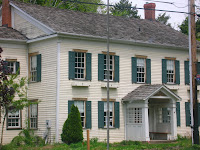
I mention all of this because today the soul of a home was harshly exposed and then destroyed. The Christopher Saddler House in Bay Village was built in 1838. Here is its brief origins, according to the
Bay Village Historical SocietyChristopher Saddler, born in Germany, came to Dover Township with his wife and oldest son, William, from New York in 1814 and built a log cabin on Lake Road. In 1815, William brought his young wife Elizabeth and their daughter to Bay Village. He brought them to a cabin that he had built for them, replacing it a few years later with a large frame house.
William spoke English, German and Native American Indian and was, for many years, an interpreter for the Indians and the many German farmers who settled in Dover. He and his wife donated the land and the lumber to build the first church in Bay Village, the Methodist Church, on land near the corner of Lake and Bassett Roads.
Saddler's home is being demolished today, probably to be replaced with a large modern monstrosity, given its prime location just across from Lake Erie. I've always admired the little home on my runs and found it a charming feature amid Lake Road's otherwise exploding real estate.

The demolition is in progress today. Soon enough the debris will be cleared and the land regraded and construction crews will arrive.

Propped against a tree, as if waiting for someone to claim it, lies the front door and sidelights to the home. Maybe the new owners will incorporate the detail into their new home. I imagine the Christopher Saddler would like that a piece of his family's history would remain. But I'm doubtful.

Because when this demolition is complete, there's another historic Bay Village home just west of Huntington Beach awaiting the wrecking crew.