I’m an early riser. Didn’t used to be, but there’s something peaceful and serene about the morning that sets my day right. The addition of Riley into our household has also required an early riser to handle the morning constitution. So after launching e-mail, I head downstairs with my puppy and outside for the paper and, well, you know.
With coffee in hand and Riley content, I head back to my desk to begin my morning reading habits, what I've come to view as my morning classroom. First up, the New York Times online. I receive the day’s headlines in e-mail and I’ve become so accustomed to reading in that fashion that to have the physical paper in front of me would likely be disorienting.
I check out the top stories and usually read the international and national stories I’m following. There will be the occasional business story that peaks my interest, such as the news yesterday that magazine advertising for September is up (which means that freelance assignments will be needed to fill additional pages and dollars will be more readily available to pay for said assignments—Woo Hoo!).
Usually skip over the sports section. Not that I don’t enjoy sports, but I just don’t look to the Times for sports coverage. Many of the most fascinating stories, ones you’ll never see in The Plain Dealer are found in science pages of the Times.
It’s been running a series of articles on the so-called debate between evolution and intelligent design. I say so-called because as one commentator wrote today:
Accepting the fact of evolution does not necessarily mean discarding a personal faith in God. But accepting intelligent design means discarding science. Much has been made of a 2004 poll showing that some 45 percent of Americans believe that the Earth - and humans with it - was created as described in the book of Genesis, and within the past 10,000 years. This isn't a triumph of faith. It's a failure of education. (Bold is mine.)
From the scientific perspective, there is no debate. But even the illusion of a debate is a sorry victory for antievolutionists, a public relations victory based, as so many have been in recent years, on ignorance and obfuscation.
Intelligent design is not something that can either be prove or disproved. It doesn’t fall into the realm of “science.” It is altogether a whole other animal. And that’s perfectly fine.
(Intelligent design) misses both the grace and the moral depth of knowing that humans have only the same stake, the same right, in the Earth as every other creature that has ever lived here.
Today’s article discusses the mix between faith and science among scientists. Dr. Francis S. Collins, who directs the National Human Genome Research Institute, is writing a book on the subject and is quoted extensively throughout the article. Though many of the nation’s top scientists talk about how the Genome project proves evolution over and over, there are some who also believe in something greater, something that doesn’t have to do with science. This statement by Collins really grabbed me. It echoes Albert Einstein:
"You will never understand what it means to be a human being through naturalistic observation," he said. "You won't understand why you are here and what the meaning is. Science has no power to address these questions - and are they not the most important questions we ask ourselves?"
Aside from skimming the PD and perusing the usual blogs and newsfeeds, my other morning reading ritual is the Washington Post. It’s my homepage when I launch Firefox. Again, I know just where to find my favorite sections, commentators, etc. online. But while we were on vacation I had the pleasure of picking up a print copy from time to time — a very different reading experience indeed.
This Sunday’s Post Magazine cover story was riveting. Titled “With God as Their Witness” by former magazine staffer and current director of newsroom training, Peter Perl, it was a personal account of his visit to the Middle East along with a group of Protestant seminarians and a handful of other lay and religious about how people of different faiths co-exist in this small geographic region. It raises some interesting questions about interfaith dialogue, about understanding and the challenges to feeling included.
It’s a lengthy piece, but worth the read. Of course I instantly sent it to Jill since I knew we would have a great conversation about it — and we have. Last year I received an invitation (I think by the Presbyterians) to visit Jordan (billed as "The Other Holy Land"). Though I obviously didn't partake of the junket, I did spend some time talking with the organizer and visiting the Web site. In the pit of my stomach was this overwhelming longing to see for myself, to find explanations and sources for my belief. I do hope to one day visit the Middle East — call it a longing, pilgrimage or spiritual quest.
I have no idea if that will ever happen, but I’ve also learned not to consider any trip out of the question.
What are your thoughts on this piece? I’d like to hear from you.
From science to God to history
I know this piece by Gene Weingarten was written tongue-in-cheek, but it raises the more serious question of how we can engage young people in learning American history. He writes:
America's schools are in crisis, particularly in the teaching of history. At a recent Senate hearing, it was disclosed that more than half of our high school seniors have less than a "basic" knowledge of our nation's past. This is particularly alarming because -- if my memory of high school serves me -- "basic" knowledge was what was taught in those classes composed of the kids who beat you up at lunchtime.
He goes on to say that “basic” Civil War history is knowing that Abe Lincoln won. So his idea is to change the boring nature of our nation’s history and changing it to make it more exciting.
I’m a history geek (was a history minor in college) so much so that I even have a copy of Herodotus, the father of history, on my bookshelves. I tell my boys that the best part about history is that it’s real. It’s like reading a great work of fiction, about an amazing battle, only this one actually happened, and these people actually lived.
History is much more than memorizing dates, coloring in maps or charting timelines — it is our story, with all the action, plot, drama, narrative, setting and characters that any writer could dream up and some that no one could imagine.
A nod to Joel
There is no question that I am addicted to Joel Achenbach’s blog — Achenblog. But he also writes a great column in the Post’s Sunday magazine. For anyone who maintains a blog, his latest Rough Draft column, “The Tail that Wags the Blog,” is a real hoot. I certainly don’t have the commentariat he does, but I agree that the blog is hungry and needs to be fed.
My alma mater rises to the top again
This is such a tired story. OU ranks as the nation’s second-biggest party school, according to the annual ratings in the Princeton Review. Of course it found its way on the front page of today's PD, fortunately below the fold.
Puh-leeze. I can see how that was the case in the 1980s. I mean, the drinking age was 18 and then 19 (for those of us grandfathered in), the town hosted two HUGE parties — Halloween and Springfest. But truth be told, Halloween was never that great for students. It was the weekend that all your friends from other schools (and their friend, and their friends, and so on) camped at your place, trashed your room or house, trashed the campus, trashed Uptown Athens and left you to clean up the mess. The novelty wore off of Halloween weekend after freshman year.
Springfest later became a dry event.
But here’s the funny thing. I was a campus tour guide throughout my four years at OU. I’d give prospective freshmen and their parents a tour of the campus and talk about all the wonderful educational opportunities available at OU. At some point in every tour, usually near the library, which was at the beginning of the tour, I’d be asked (mostly by a parent, occasionally by a serious student) if it was true about OU being a party school.
My stock answer, approved in advance by the admissions office, was that every school is party school. It's simply part of the college experience and it's up to individual students to make good choices. But now, 20 years later, I would add that I would send my kids there in a heartbeat. It's a great school.
Here's another news item about OU that didn't make the front page.
Tuesday, August 23, 2005


Monday, August 22, 2005
Relaxing end to summer

Regular readers of Creative Ink may recall my summer’s end post from last year Mania and mother guilt. Well I’m proud, I mean downright proud, to say that we had a vastly more relaxed, sane summer this year.
It was an intentional effort on my part. I scaled way back on the workload, even as I was hitting high gear at the end of May. The way I see it, there are only a precious few summers left when the boys will actually WANT to spend time with me. I’d better steal these moments while I still can.
Financially, we did okay. It’s been a stretch lately, but we managed and everyone is better for my decision.
I am, however, feeling a bit defensive about my tan. Given that I spent a portion of nearly every day at the pool and more than my share of afternoons watching baseball games, I’m sporting quite the savage tan this year. When anyone comments, my hubby jokingly pipes up, “How’s work going this summer, Wen?”
He kids because he can. He knows how important it was for the kids and I to play together. But he’s not the only kidder. I’ve also heard comments from colleagues and well, what can I say? We had a fun summer.
But this is the last official week of summer vacation. The boys start back to school next Monday. We’re all ready. Work took an intensified turn once we returned from vacation and the boys have all but lost interest in the pool now that football practice has started.
My savage tan is quickly fading. That’s okay because we have some great memories of hanging together. All three boys loved to entertain me with their exploits on the high dive. Ryan dives in what can only be described as a gaggle of arms and legs. Michael learned to dive off the edge of our neighbor’s pool and Patrick and his buddies perfected the art of a vicious game of pool tag without getting yelled at by the lifeguards.
Ryan and Patrick both made their summer baseball all-star teams and we had great fun watching them play with the best of their league. Ryan even snagged second place in the skills competition cranking a few hits over the fence and pitching fastballs.
Now we’re in the thick of tackle football. Ryan is the starting quarterback for the Bay Middle School seventh grade team. Patrick is playing wingback and safety for the Bay Rec fifth/sixth team. And Mikey, well, he could probably take them all on, but he’s got a few weeks before flag football starts. I’m praying that he understands he can’t wrap and tackle in this league. Oy!
Gearing up for school
So now that school is approaching, I’ve been motivated to finish some projects, namely repainting the boys’ rooms. I stripped the wallpaper from Ryan and Patrick’s room back in the winter. In a marathon painting session on Saturday, Danny and I prepped and painted the walls and woodwork in their room. Danny managed, God love him, even feeling a little under the weather thanks to my neighbor’s blender the night before. Anyway, the room looks fabulous, more like a teenager’s room than a little boy’s room.
Now we’re on to Michael’s. Soon we’ll be done with the walls covered in crayon scribbles and smears of play-doh. I primed over his name scrawled in pencil. It’s kind of sad, but it’s also time. He’s in first grade now and informed me that his sailboat room was just too babyish for a budding linebacker.
I’m nesting a bit, as I always do at this time of year. I’d like nothing more than to tear into every room in the house and scrub, scrub, scrub. But I’ve got too much work to do this week and I need to get the painting finished. Next week, when the boys are gone I’ll be able to tackle the cleaning.
And boy do I have my work cut out. We’ve got a summer’s worth of grime coating the inside of the house. There’s a mixture of dirt, sand and dog hair from the revolving door that was my house all summer. Seemed pointless to keep cleaning when one neighborhood game of hoops could mean the end of my clean kitchen floor. And so I relaxed my standards for the duration of the summer.
Relaxed … that’s how I will look on this summer. And isn’t that the point?
Friday, August 19, 2005
Big news day
The words of every crisis communications consultant I’ve ever heard are echoing in my head after skimming the morning paper—“Tell it first and tell it all.”
Amazing how few people actually follow those words of wisdom. To wit: Ohio is in a state of crisis. One need only to look on the front page of today’s Plain Dealer to see its humiliation in the face of Gov. Bob Taft. Yesterday, our esteemed governor plead no contest and was convicted of breaking state ethics laws. He was fined $4,000—the equivalent of $20 to you and me.
Some will argue, “So he didn’t report a few rounds of golf, what’s the big deal?” The deal is that Taft is required by law to report to citizens of Ohio who is buying him what, the implication being that if certain people routinely buy him expensive rounds of golf at the state’s posh country clubs, they may in turn expect some governmental favors.
It’s about transparency in government and public accountability. And he made darned sure that others in his administration followed the highest ethical standards. Those who didn’t were dismissed and not allowed a second chance. Given the state of problems plaguing our state government, accusations of widespread corruption no longer seem hyperbole.
Taft’s words are coming back to haunt him. Judge Mark Froehlich said, “Even the governor can be charged and convicted of a criminal offense.” With that he also ordered Taft to issue an “appropriate and meaningful apology to the citizens of Ohio.
And so he has. But there are those, both in the Democratic and his own Republican party who are calling for Taft to resign. This is one guy who is known more for his inability to lead and he somehow thinks he can continue for the next 17 months in light of his most recent and serious gaffe!
Gov. Taft, you owe Ohio citizens better than that—you owe them the chance to begin the painful and tedious process of rebuilding a state that you failed.
Closer to home
The other big news today is now that Cleveland businessman (I guess that’s what we call him) Nate Gray has been convicted on 36 charges of bribing public officials in four cities in exchange for public contracts, many believe that federal prosecutors are going after former Cleveland Mayor Mike White next.
He could be viewed as the big fish is this scum-filled pond. I don’t pretend to know how this case will end, but I do know that as a resident of Greater Cleveland, I feel I’ve been cheated. And that really pisses me off.
We had a chance—and we actually believed it at the time—that we could turn our city around. That we could start building new homes and improving our infrastructure and making our airport a world-class destination. But the charges against Gray and Ricardo Teamor and who knows how many others show that any progress our city made during the 1990s was done under the canopy of bribes, kickbacks and coercion.
There's an incestuous nature to Northeast Ohio's business and politics. Cleveland’s leaders—both political and, perhaps more importantly, it’s business leaders—have a lot of ’splaining to do. Who sat quietly by, including the media, while all this happened?
Disturbing world news
This story reported in today’s Washington Post is very disturbing. It seems that police in China's northern Shaanxi province have arrested one of the nation's leading advocates of private property rights after officials posed as journalists and forged an e-mail from a prominent Hong Kong reporter to lure him out of hiding, friends and relatives said.
You may recall that the day before the 9/11 attacks, the freedom fighter Mamood in Afghanistan was murdered by Osama bin Laden's people using similar tactics. He thought he was being interviewed by journalists and was killed by bombs packed into a television camera. It's a disturbing pattern that has big-time implications for revolutionaries in the most dangerous and oppressed parts of our world.
In related news, the state of the world's press continues to teeter in the wake of government pressure. The International Federal of Journalists Asia Pacific has launched a petition drive for press freedom on Nepal. Here’s is some background from an e-mail I received today from IFJ-Asia Pacific President, Christopher Warren (who was a fellow panelist at the 2004 East-Asia Journalism Forum in Korea last November).
The International Federation of Journalists (IFJ), the global organisation representing more than 500,000 journalists in over 110 countries, has organised the Global Day of Action for Press Freedom in Nepal on August 30. As part of this global campaign, the IFJ and its affiliates have organised the Nepal Crisis Signature Campaign.
This is a chance to show your support and solidarity with the journalists of Nepal.
The campaign is taking place from August 7 to 31, with a view to garner mass solidarity at national and international levels. The collected signatures will be submitted to the UN General Assembly scheduled to meet in New York from September 14 to 17.
Since royal coup on February 1 2005, which suspended fundamental human rights in Nepal, King Gyanendra's hand-picked government, together with the military, have systematically and aggressively eroded press freedom and freedom of expression. Although the state of emergency was lifted in April, the climate of fear and harassment continues today, with threats, abductions, detention and torture still remaining a daily routine forced upon Nepali journalists.
The ongoing violation of civil liberties is unacceptable and must be stopped.
There is an urgent need for increased international pressure on the Nepalese government to restore democracy and press freedom and stop the torture, abduction and harassment of media personnel and other forms of censorship.
The Nepalese media community are risking their safety each day to protest and resist this repression. But they need more support.
The IFJ, its affiliates and the Nepali media community are stepping up their protest and ask for the support of their colleagues. Show your support by signing the Nepal Crisis Signature Campaign.
The IFJ, together with the Federation of Nepalese Journalists and other Nepal IFJ affiliates would appreciate if you could be involved in the petition by:
· Signing on to the petition
· Including a link on your websites to the signature campaign.
· Email your network about the signature campaign.
Visit here for more information on Global Day of Action for Press Freedom in Nepal.
Sending prayers
WAPO also is reporting this morning that Coretta Scott King has suffered a major stroke. We’re sending prayers for her recovery.
Amazing how few people actually follow those words of wisdom. To wit: Ohio is in a state of crisis. One need only to look on the front page of today’s Plain Dealer to see its humiliation in the face of Gov. Bob Taft. Yesterday, our esteemed governor plead no contest and was convicted of breaking state ethics laws. He was fined $4,000—the equivalent of $20 to you and me.
Some will argue, “So he didn’t report a few rounds of golf, what’s the big deal?” The deal is that Taft is required by law to report to citizens of Ohio who is buying him what, the implication being that if certain people routinely buy him expensive rounds of golf at the state’s posh country clubs, they may in turn expect some governmental favors.
It’s about transparency in government and public accountability. And he made darned sure that others in his administration followed the highest ethical standards. Those who didn’t were dismissed and not allowed a second chance. Given the state of problems plaguing our state government, accusations of widespread corruption no longer seem hyperbole.
Taft’s words are coming back to haunt him. Judge Mark Froehlich said, “Even the governor can be charged and convicted of a criminal offense.” With that he also ordered Taft to issue an “appropriate and meaningful apology to the citizens of Ohio.
And so he has. But there are those, both in the Democratic and his own Republican party who are calling for Taft to resign. This is one guy who is known more for his inability to lead and he somehow thinks he can continue for the next 17 months in light of his most recent and serious gaffe!
Gov. Taft, you owe Ohio citizens better than that—you owe them the chance to begin the painful and tedious process of rebuilding a state that you failed.
Closer to home
The other big news today is now that Cleveland businessman (I guess that’s what we call him) Nate Gray has been convicted on 36 charges of bribing public officials in four cities in exchange for public contracts, many believe that federal prosecutors are going after former Cleveland Mayor Mike White next.
He could be viewed as the big fish is this scum-filled pond. I don’t pretend to know how this case will end, but I do know that as a resident of Greater Cleveland, I feel I’ve been cheated. And that really pisses me off.
We had a chance—and we actually believed it at the time—that we could turn our city around. That we could start building new homes and improving our infrastructure and making our airport a world-class destination. But the charges against Gray and Ricardo Teamor and who knows how many others show that any progress our city made during the 1990s was done under the canopy of bribes, kickbacks and coercion.
There's an incestuous nature to Northeast Ohio's business and politics. Cleveland’s leaders—both political and, perhaps more importantly, it’s business leaders—have a lot of ’splaining to do. Who sat quietly by, including the media, while all this happened?
Disturbing world news
This story reported in today’s Washington Post is very disturbing. It seems that police in China's northern Shaanxi province have arrested one of the nation's leading advocates of private property rights after officials posed as journalists and forged an e-mail from a prominent Hong Kong reporter to lure him out of hiding, friends and relatives said.
You may recall that the day before the 9/11 attacks, the freedom fighter Mamood in Afghanistan was murdered by Osama bin Laden's people using similar tactics. He thought he was being interviewed by journalists and was killed by bombs packed into a television camera. It's a disturbing pattern that has big-time implications for revolutionaries in the most dangerous and oppressed parts of our world.
In related news, the state of the world's press continues to teeter in the wake of government pressure. The International Federal of Journalists Asia Pacific has launched a petition drive for press freedom on Nepal. Here’s is some background from an e-mail I received today from IFJ-Asia Pacific President, Christopher Warren (who was a fellow panelist at the 2004 East-Asia Journalism Forum in Korea last November).
The International Federation of Journalists (IFJ), the global organisation representing more than 500,000 journalists in over 110 countries, has organised the Global Day of Action for Press Freedom in Nepal on August 30. As part of this global campaign, the IFJ and its affiliates have organised the Nepal Crisis Signature Campaign.
This is a chance to show your support and solidarity with the journalists of Nepal.
The campaign is taking place from August 7 to 31, with a view to garner mass solidarity at national and international levels. The collected signatures will be submitted to the UN General Assembly scheduled to meet in New York from September 14 to 17.
Since royal coup on February 1 2005, which suspended fundamental human rights in Nepal, King Gyanendra's hand-picked government, together with the military, have systematically and aggressively eroded press freedom and freedom of expression. Although the state of emergency was lifted in April, the climate of fear and harassment continues today, with threats, abductions, detention and torture still remaining a daily routine forced upon Nepali journalists.
The ongoing violation of civil liberties is unacceptable and must be stopped.
There is an urgent need for increased international pressure on the Nepalese government to restore democracy and press freedom and stop the torture, abduction and harassment of media personnel and other forms of censorship.
The Nepalese media community are risking their safety each day to protest and resist this repression. But they need more support.
The IFJ, its affiliates and the Nepali media community are stepping up their protest and ask for the support of their colleagues. Show your support by signing the Nepal Crisis Signature Campaign.
The IFJ, together with the Federation of Nepalese Journalists and other Nepal IFJ affiliates would appreciate if you could be involved in the petition by:
· Signing on to the petition
· Including a link on your websites to the signature campaign.
· Email your network about the signature campaign.
Visit here for more information on Global Day of Action for Press Freedom in Nepal.
Sending prayers
WAPO also is reporting this morning that Coretta Scott King has suffered a major stroke. We’re sending prayers for her recovery.
Wednesday, August 17, 2005
In response to Jill's comment

My feet are usually in horrible shape -- the result of too many years of running, my love of going barefoot and my propensity to wear ill-fitting shoes (but they look good). As I approach my fourth decade I finally understand my mother's charge to spend money on good shoes. And so I will, when it's time to put shoes back on, that is. Ahhh, bare feet!
Today's hodge podge
Today is another mishmash of items:
Strange bedfellows
The press has found an unlikely friend in former Sen. Bob Dole, who penned this op-ed in yesterday’s New York Times in support of a federal shield law. Dole makes several points worth noting:
1) “If state rather than federal authorities were conducting this investigation, Ms. Miller most likely would not be in jail.”
2) “I am also greatly concerned about Judith Miller's situation because she has been incarcerated as a result of an investigation into possible violations of the Intelligence Identities Protection Act of 1982, of which I was a sponsor. The law was intended to protect covert intelligence operatives whose lives would be endangered if their identities were publicly disclosed.” [emphasis added]
3) “…the imprisonment of Judith Miller will be even more troubling if it turns out that no violation of the Intelligence Identities Protection Act has occurred. As she sits in jail, Congress can honor her commitment to principle and her courage, and that of all reporters who have helped expose wrongdoing by protecting their sources, by passing the Lugar-Pence bill and creating a federal privilege for reporters.”
My favorite time of day
I simply love the blue glow of the pre-dawn hours. There’s serenity in that hour that calms me and sets me to dreaming—a good start to rest of my day.

Irwin Gratz in Cleveland
SPJ’s fearless leader, Irwin Gratz, is speaking today at The City Club. He joined members of the Cleveland Chapter board for dinner last night at The Harp.
Today’s noontime panel will discuss the use of confidential sources. Join us if you can!
Nike’s new ad campaign
The Times featured this article about marketers turning their attention to “real women” to sell their goods. I say, ’bout time. Of course, we’re still peddling women’s bodies to sell stuff, but that’s a losing battle.
This week, Nike is introducing a humorous print and online campaign for exercise gear, frankly glorifying body parts that until now were almost never seen in ads, much less celebrated. One ad, which begins boldly, "My butt is big," features an oversize photograph of the derrière in question.
Another Nike ad declares, "I have thunder thighs," while a third asserts: "My shoulders aren't dainty or proportional to my hips. Some say they are like a man's. I say, leave men out of it."
Click here to see the new ad campaign.
What body part do you relate to most?
Strange bedfellows
The press has found an unlikely friend in former Sen. Bob Dole, who penned this op-ed in yesterday’s New York Times in support of a federal shield law. Dole makes several points worth noting:
1) “If state rather than federal authorities were conducting this investigation, Ms. Miller most likely would not be in jail.”
2) “I am also greatly concerned about Judith Miller's situation because she has been incarcerated as a result of an investigation into possible violations of the Intelligence Identities Protection Act of 1982, of which I was a sponsor. The law was intended to protect covert intelligence operatives whose lives would be endangered if their identities were publicly disclosed.” [emphasis added]
3) “…the imprisonment of Judith Miller will be even more troubling if it turns out that no violation of the Intelligence Identities Protection Act has occurred. As she sits in jail, Congress can honor her commitment to principle and her courage, and that of all reporters who have helped expose wrongdoing by protecting their sources, by passing the Lugar-Pence bill and creating a federal privilege for reporters.”
My favorite time of day
I simply love the blue glow of the pre-dawn hours. There’s serenity in that hour that calms me and sets me to dreaming—a good start to rest of my day.
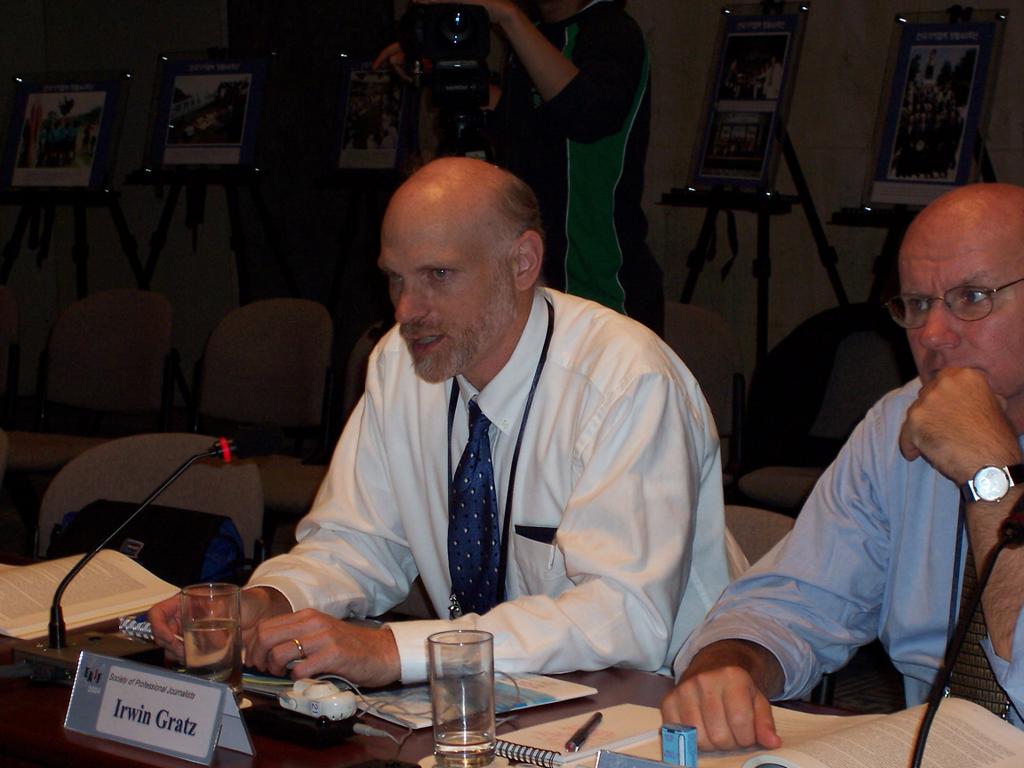
Irwin Gratz in Cleveland
SPJ’s fearless leader, Irwin Gratz, is speaking today at The City Club. He joined members of the Cleveland Chapter board for dinner last night at The Harp.
Today’s noontime panel will discuss the use of confidential sources. Join us if you can!
Nike’s new ad campaign
The Times featured this article about marketers turning their attention to “real women” to sell their goods. I say, ’bout time. Of course, we’re still peddling women’s bodies to sell stuff, but that’s a losing battle.
This week, Nike is introducing a humorous print and online campaign for exercise gear, frankly glorifying body parts that until now were almost never seen in ads, much less celebrated. One ad, which begins boldly, "My butt is big," features an oversize photograph of the derrière in question.
Another Nike ad declares, "I have thunder thighs," while a third asserts: "My shoulders aren't dainty or proportional to my hips. Some say they are like a man's. I say, leave men out of it."
Click here to see the new ad campaign.
What body part do you relate to most?
Tuesday, August 16, 2005
Behind those numbers
Ordinarily the District Report Card is a numbers story. It’s always about stats and comparisons and which districts improved and which did not.
Behind those statistics are thousands of personal stories that tell the true nature of learning in ways that No Child Left Behind could never adequately address. I’ll tell one story — that of my middle child, Patrick.
Now going into fifth grade (middle school in Bay Village), Patrick has always struggled with reading. He had a terrible time with phonics that was exacerbated by low confidence. His kindergarten teacher at St. Raphael had requested a conference with me to say that Patrick qualified for Title I reading help.
We were under no obligation to accept help from this federally funded program, she told me. I’m sure my mouth fell open when the teacher explained that some parents refuse the help because of the stigma that their child is not smart.
Puh-leeze! I had already been through teaching one boy to read and I welcomed any and all assistance.
So Patrick worked with a marvelous tutor throughout first grade. He even participated in a summer reading camp through Ohio Reads. However, in second grade we learned that funding was cut and he would be eligible for general education tutoring focused on reading. He worked with his same tutor and made a little more progress.
In third grade, his teacher said she wanted to see how he managed in class. He did okay, his confidence improved slightly but reading remained a struggle.
By fourth grade we had switched him to public school and within the first week his teacher told me he qualified for Title I. I knew he still required the help and felt immense guilt at not having made the switch sooner for his educational benefit. His teacher showed me an entry in his journal that said he was glad to switch to the public school because the kids at his old school teased him about his reading. It broke my heart to see those words on the page. He’s so quiet. He never told me.
Patrick thrived at Westerly School. His reading tutor and his classroom teacher worked closely to ensure his success. And he participated in an extended day program twice a week for several months in preparation of the proficiency tests.
Reading was coming a little easier, but Patrick is very slow and methodical. It’s not that he doesn’t know the answer, it’s that he’s analyzing and thinking critically about a story. He often spots inconsistencies and has a natural curiosity about why things are. Problem is the proficiencies are timed tests. There's no time to ask questions. I knew Patrick needed the practice in reading a short story and answering questions more quickly. His teacher sent home a month’s worth of practice tests and he practiced every night.
Though he is strong in all other subjects, particularly math, I was worried about his performance on the proficiencies for his sake, not mine. I kept that worry to myself and, with the help of his tutor and teacher, prepared him as best we could. He seemed very calm going into the two-week testing period.
On portfolio day we learned that Patrick passed the math, science and citizenship portions of the proficiencies. The reading and writing scores wouldn’t be available until later in the summer.
Those arrived a few weeks ago and Patrick did indeed pass both reading and writing. He even had several areas of strength in writing. He surprised himself and was clearly very proud.
But what illustrates his progress more than anything was the Title I report I received from his tutor at the end of the school year. It was the results of Patrick’s Peabody Individual Achievement Test-Revised (PIAT-R). He had taken a similar test in May 2004 at which time he earned a score of 37 percent. Only one year and a whole lot of work later, he scored a 68 percent — a difference of 31 percentage points!
Next to his score his tutor wrote: “Wow! That is amazing!”
In two weeks, Patrick will start middle school. I ran into his fourth-grade teacher at Heinen’s last weekend and she asked if he was excited about middle school. I said that he was and she assured me he is ready. From the excitement and confidence in his voice I know she’s right.
Monday, August 15, 2005
Keeping me up tonight
Isn't basic training in the U.S. military only eight weeks?
What happens after basic?
Are soldiers considered battle-ready?
Are the young men and women who currently join the armed forces being shipped out to Iraq and Afghanistan as fast as they can complete basic training?
If so, then why is it taking so long for our military to train Iraqi forces?
Can't we just put them through basic?
What happens after basic?
Are soldiers considered battle-ready?
Are the young men and women who currently join the armed forces being shipped out to Iraq and Afghanistan as fast as they can complete basic training?
If so, then why is it taking so long for our military to train Iraqi forces?
Can't we just put them through basic?
Why I do journalism
Interesting read on Jay Rosen’s Press Think from yesterday. (Aside: I like that he uses the term “press” versus “media.”) He talked to j-profs about what they used to teach that they no longer believe.
There are some interesting insights from those who shared. Despite our calling it a profession, it is still a craft, practiced daily and perfected, one hopes, over a lifetime. It’s not a career for the financially driven and clearly that sends some fleeing. But ultimately the posts come back to the fundamental question of why one practices journalism. I don’t know what the answer to that question is for others, but I do know what the answer is for me.
I’m a journalist because I have to be. I love stories. I love researching stories and I love discovering stories. I love people and learning what makes them tick beyond the standard bio and press release. I love learning and exploring subjects I may have previously thought dull.
It goes without saying that I also love to write. I like to think that perhaps I have a knack for seeing things—whether it’s the absurd, the poignant or the humor in a situation. Or that I can put seemingly incompatibles bits and pieces together to weave a narrative. And yes, I’m an idealist. I’m hopeful that what I do makes a difference. But that isn't something instilled in J-school. I've been that way all my life. My parents taught me early on that I could make a difference in this world.
I’ve known what I wanted to do with my career from the time I was in third grade. My uncle was editor of a Tiffin, Ohio, newspaper and I was hooked when I first witnessed the buzz of the newsroom, filled with gravely voiced reporters barking into their phones and pounding on their typewriters. Everything they did was urgent, important to someone, somewhere.
My belief, and it proves I’m a product of my time, is that journalists can make a difference—still. I’m not talking about Watergate difference, though clearly that’s one way. I mean even in smaller ways.
That’s what keeps me going, that what I write matters to someone – even if it’s only one person. That it makes them think or question or relate or act in some way. Much of what I write goes unnoticed. Sometimes what I write helps on a larger scale. Here’s a recent example:
Wendy,
Many thanks for the copies of the Arlington Catholic Herald with your
article on Merton. It’s great.
It has created a further new acquisition for the Center. A lady in Alexandria, VA saw the article and owns an original Merton Calligraphy, which she acquired in the mid sixties. She is currently "downsizing" her home to move to smaller quarters and has donated the calligraphy to the Center. Thank you for the publicity, which made this possible.
With all best wishes,
Paul.
##########################
Dr Paul M Pearson.
Director and Archivist,
Thomas Merton Center,
Bellarmine University,
Louisville, KY
There’s an element of preaching that goes on in journalism, not surprising since we often refer to it as a calling or a vocation. We’re telling people what they should think about, what they should know and, at times, what they should care about.
This summer I did a series of articles for the Catholic Universe Bulletin on some of the diocese’s unsung ecclesial artists. On the surface, it would seem these are not of great importance. I wasn’t writing of the latest encyclical or liturgical changes that affect all Catholics. I was writing about the decorations found in our city’s churches. But in reality, the story of the art in our churches is the story of us. It’s our history and it deserved to be recognized and preserved.
I know my efforts mattered to two people—the son of one of the artist's profiled who has embarked on a personal pilgrimage to see his father's work, and the director of the Center for Sacred Landmarks, which has received calls from other organizations seeking to partner in the protection and celebration of Cleveland’s sacred landmarks — calls that may or may not have happened, but that were spurred on by seeing an article in the paper.
I know plenty of people who left journalism for saner, more lucrative professions. But it’s never been about the money. And maybe that’s something journalism students need to hear in their first course. You have to be in it for more than a paycheck. If you practice it as your calling, it will never cease to surprise and fulfill.
There are some interesting insights from those who shared. Despite our calling it a profession, it is still a craft, practiced daily and perfected, one hopes, over a lifetime. It’s not a career for the financially driven and clearly that sends some fleeing. But ultimately the posts come back to the fundamental question of why one practices journalism. I don’t know what the answer to that question is for others, but I do know what the answer is for me.
I’m a journalist because I have to be. I love stories. I love researching stories and I love discovering stories. I love people and learning what makes them tick beyond the standard bio and press release. I love learning and exploring subjects I may have previously thought dull.
It goes without saying that I also love to write. I like to think that perhaps I have a knack for seeing things—whether it’s the absurd, the poignant or the humor in a situation. Or that I can put seemingly incompatibles bits and pieces together to weave a narrative. And yes, I’m an idealist. I’m hopeful that what I do makes a difference. But that isn't something instilled in J-school. I've been that way all my life. My parents taught me early on that I could make a difference in this world.
I’ve known what I wanted to do with my career from the time I was in third grade. My uncle was editor of a Tiffin, Ohio, newspaper and I was hooked when I first witnessed the buzz of the newsroom, filled with gravely voiced reporters barking into their phones and pounding on their typewriters. Everything they did was urgent, important to someone, somewhere.
My belief, and it proves I’m a product of my time, is that journalists can make a difference—still. I’m not talking about Watergate difference, though clearly that’s one way. I mean even in smaller ways.
That’s what keeps me going, that what I write matters to someone – even if it’s only one person. That it makes them think or question or relate or act in some way. Much of what I write goes unnoticed. Sometimes what I write helps on a larger scale. Here’s a recent example:
Wendy,
Many thanks for the copies of the Arlington Catholic Herald with your
article on Merton. It’s great.
It has created a further new acquisition for the Center. A lady in Alexandria, VA saw the article and owns an original Merton Calligraphy, which she acquired in the mid sixties. She is currently "downsizing" her home to move to smaller quarters and has donated the calligraphy to the Center. Thank you for the publicity, which made this possible.
With all best wishes,
Paul.
##########################
Dr Paul M Pearson.
Director and Archivist,
Thomas Merton Center,
Bellarmine University,
Louisville, KY
There’s an element of preaching that goes on in journalism, not surprising since we often refer to it as a calling or a vocation. We’re telling people what they should think about, what they should know and, at times, what they should care about.
This summer I did a series of articles for the Catholic Universe Bulletin on some of the diocese’s unsung ecclesial artists. On the surface, it would seem these are not of great importance. I wasn’t writing of the latest encyclical or liturgical changes that affect all Catholics. I was writing about the decorations found in our city’s churches. But in reality, the story of the art in our churches is the story of us. It’s our history and it deserved to be recognized and preserved.
I know my efforts mattered to two people—the son of one of the artist's profiled who has embarked on a personal pilgrimage to see his father's work, and the director of the Center for Sacred Landmarks, which has received calls from other organizations seeking to partner in the protection and celebration of Cleveland’s sacred landmarks — calls that may or may not have happened, but that were spurred on by seeing an article in the paper.
I know plenty of people who left journalism for saner, more lucrative professions. But it’s never been about the money. And maybe that’s something journalism students need to hear in their first course. You have to be in it for more than a paycheck. If you practice it as your calling, it will never cease to surprise and fulfill.
Friday, August 12, 2005
Is it fall yet?
Phew! It’s Friday and I’ve made it through the first week back after vacation. I’ve learned a few things this week—namely that being your own boss doesn’t lessen the pressure, it only adds to it. Of course I knew this, but I LIVED it the past two weeks.
Perhaps in retrospect I should have brought my laptop on vacation if only to check e-mail and quiet my restless brain from wondering whether or not something was left unfinished. It wasn’t, but the shame of it all is that I didn’t sleep well on vacation for worrying (save for the nights I popped a Tylenol PM) and I wish to God I could let go and let God. I’m a spiritual work in progress and perhaps one day I’ll learn to give ALL to the Big Man and trust in his divine plan. Anyway, my lack of sleep certainly caught up with me this week.
I was tired, cranky and essentially overwhelmed by everything. Not the optimal way to live, just ask my family who had to endure my crabby tirades and withdrawal. Things will settle down as we begin to move into our school-year routine, now only two weeks away. Woo Hoo! Am I excited about school starting? You bet! And so are my boys. It’s my belief that boys in general and mine in particular positively need structure and routine in their lives.
Sorry, but any mom who tells you they will miss the summer vacation is either delusional or lying out of guilt. What we miss about summer is the lack of schedule, the break from hounding about homework and bed time, the chance to chill by the pool, the ability to let housework and laundry slide. But school starting in the fall is part of the natural order of things and come mid-August both kids and moms are ready to resume the structure.
A side note: On vacation my little niece, Natalie (she’s 2-1/2 and cute as a button), was sitting in a kayak my brother-in-law had rented quietly and contentedly reading her books. My sister, Jen, is due with a little boy in about six weeks. I felt compelled to tell her that that whole sitting quietly reading books on the beach thing—it’s a girl thing. When her little guy is that age, he’ll be a mile down the beach finding the game of chase with mom and dad and the waves an utter delight.
Business and meetings are picking up once again and that’s all good. Hopefully the next month will bring closure to a couple of long-term projects (along with some much-needed coin) and a wealth of new ones.
National pitching report
Did receive two rejections while on vacation and one “Your query is being considered….” The latter left me elated since a handwritten note also accompanied it from the editor. I continue to live on the emotional roller coaster of a national freelance writer. One day the news will be, "I sold my first national magazine piece!"
You’re invited: SPJ program year begins
Society of Professional Journalists national president Irwin Gratz of Maine Public Radio will be in town on Wednesday, Aug. 17, participating in a panel discussion at the City Club of Cleveland on the use and consequences of confidential sources.
Also on the panel are Linda Foley, president of The Newspaper Guild, and Mike Needs, public editor of the Akron Beacon Journal. Tim Smith, professor of news at Kent State University, will serve as moderator.
SPJ members can get lunch for the City Club member rate. Tickets are $13 for City Club and SPJ members and $20 for non-members. They can be purchased by calling The City Club at 216.621.0082 or visiting the Web site.
This event kicks off our 2005-06 program year. For more information on our events, to subscribe to our weekly e-newsletter the Writer's Week or to join SPJ, please visit our new and improved Web site. Special thanks to my pal Jim Kukral for his fabulous redesign.
What I covet
One of my favorite magazines is Inc. Been a subscriber for the past four years, met an editor in New York in April and would love to write for it someday. Though I used to write business stories on a regular basis, I’m afraid I’ve not done so at all this year.
If I’ve learned anything it’s that things can change in a day—even an hour. So there’s hope that I will alight once again on a fabulous small biz story.
Anyway, Inc. has this feature called The Inc. Life in which entrepreneurs are interviewed about the things they can’t live without—favorite power suit, piece of technology, writing instrument, favorite junk food, etc. Each is asked what they covet and often it’s a snazzy car or boat.
My needs are simple. I covet a buttery soft, toffee-colored leather bag. Big enough to hold the essentials—wallet, cell, keys, notebook, palm, water bottle—but not so big that it causes back pain. The color and texture are of prime importance. This is a timeless bag and as such it should have no trendy apparatus or accoutrements (except a pocket for my cell phone and pens). I hate labels and identifying brand marks of any kind. I want simple, elegant leather. And if it also came in black that would be swell. I mean, brown is great and rich and warm and autumnal but face it, black is, well, essential.
On the coming autumn
I’m sure I’ve written about this before, but fall is simply my favorite time of year. Right about now is when I start dreaming of ribbed turtlenecks, cashmere sweaters and great leather shoes (to go with my bag). Crisp air, crunchy leaves, coffee steaming in my mug, my boys' football games, Danny’s chili, walks with Riley. Does it get any better than fall?
The fall catalogs are arriving daily and I find it amazing that I can be fantasizing about sweaters and Donegal slacks when it’s 90 degrees. Can one will it to be 60 degrees out?
So I dog-ear the catalogs with all the things I want to buy, knowing full well I never will. I’m not much of a shopper and tend not to buy much for myself. Something else always comes up and I just don’t have that kind of disposable income anyway. That’s why I require classic pieces … like the leather bag I covet. (sigh)
Okay, enough dreaming. Now it's back to work.
UPDATE — Birthday wishes
Almost forgot (for shame!). Wanted to wish my older brother, Chris and very happy 40th birthday. Holy cow! Can't believe it! The sad thing is that now I'm only two years away from the big 4-0. Happy Birthday, Chrissie, you old bird you.
Perhaps in retrospect I should have brought my laptop on vacation if only to check e-mail and quiet my restless brain from wondering whether or not something was left unfinished. It wasn’t, but the shame of it all is that I didn’t sleep well on vacation for worrying (save for the nights I popped a Tylenol PM) and I wish to God I could let go and let God. I’m a spiritual work in progress and perhaps one day I’ll learn to give ALL to the Big Man and trust in his divine plan. Anyway, my lack of sleep certainly caught up with me this week.
I was tired, cranky and essentially overwhelmed by everything. Not the optimal way to live, just ask my family who had to endure my crabby tirades and withdrawal. Things will settle down as we begin to move into our school-year routine, now only two weeks away. Woo Hoo! Am I excited about school starting? You bet! And so are my boys. It’s my belief that boys in general and mine in particular positively need structure and routine in their lives.
Sorry, but any mom who tells you they will miss the summer vacation is either delusional or lying out of guilt. What we miss about summer is the lack of schedule, the break from hounding about homework and bed time, the chance to chill by the pool, the ability to let housework and laundry slide. But school starting in the fall is part of the natural order of things and come mid-August both kids and moms are ready to resume the structure.
A side note: On vacation my little niece, Natalie (she’s 2-1/2 and cute as a button), was sitting in a kayak my brother-in-law had rented quietly and contentedly reading her books. My sister, Jen, is due with a little boy in about six weeks. I felt compelled to tell her that that whole sitting quietly reading books on the beach thing—it’s a girl thing. When her little guy is that age, he’ll be a mile down the beach finding the game of chase with mom and dad and the waves an utter delight.
Business and meetings are picking up once again and that’s all good. Hopefully the next month will bring closure to a couple of long-term projects (along with some much-needed coin) and a wealth of new ones.
National pitching report
Did receive two rejections while on vacation and one “Your query is being considered….” The latter left me elated since a handwritten note also accompanied it from the editor. I continue to live on the emotional roller coaster of a national freelance writer. One day the news will be, "I sold my first national magazine piece!"
You’re invited: SPJ program year begins
Society of Professional Journalists national president Irwin Gratz of Maine Public Radio will be in town on Wednesday, Aug. 17, participating in a panel discussion at the City Club of Cleveland on the use and consequences of confidential sources.
Also on the panel are Linda Foley, president of The Newspaper Guild, and Mike Needs, public editor of the Akron Beacon Journal. Tim Smith, professor of news at Kent State University, will serve as moderator.
SPJ members can get lunch for the City Club member rate. Tickets are $13 for City Club and SPJ members and $20 for non-members. They can be purchased by calling The City Club at 216.621.0082 or visiting the Web site.
This event kicks off our 2005-06 program year. For more information on our events, to subscribe to our weekly e-newsletter the Writer's Week or to join SPJ, please visit our new and improved Web site. Special thanks to my pal Jim Kukral for his fabulous redesign.
What I covet
One of my favorite magazines is Inc. Been a subscriber for the past four years, met an editor in New York in April and would love to write for it someday. Though I used to write business stories on a regular basis, I’m afraid I’ve not done so at all this year.
If I’ve learned anything it’s that things can change in a day—even an hour. So there’s hope that I will alight once again on a fabulous small biz story.
Anyway, Inc. has this feature called The Inc. Life in which entrepreneurs are interviewed about the things they can’t live without—favorite power suit, piece of technology, writing instrument, favorite junk food, etc. Each is asked what they covet and often it’s a snazzy car or boat.
My needs are simple. I covet a buttery soft, toffee-colored leather bag. Big enough to hold the essentials—wallet, cell, keys, notebook, palm, water bottle—but not so big that it causes back pain. The color and texture are of prime importance. This is a timeless bag and as such it should have no trendy apparatus or accoutrements (except a pocket for my cell phone and pens). I hate labels and identifying brand marks of any kind. I want simple, elegant leather. And if it also came in black that would be swell. I mean, brown is great and rich and warm and autumnal but face it, black is, well, essential.
On the coming autumn
I’m sure I’ve written about this before, but fall is simply my favorite time of year. Right about now is when I start dreaming of ribbed turtlenecks, cashmere sweaters and great leather shoes (to go with my bag). Crisp air, crunchy leaves, coffee steaming in my mug, my boys' football games, Danny’s chili, walks with Riley. Does it get any better than fall?
The fall catalogs are arriving daily and I find it amazing that I can be fantasizing about sweaters and Donegal slacks when it’s 90 degrees. Can one will it to be 60 degrees out?
So I dog-ear the catalogs with all the things I want to buy, knowing full well I never will. I’m not much of a shopper and tend not to buy much for myself. Something else always comes up and I just don’t have that kind of disposable income anyway. That’s why I require classic pieces … like the leather bag I covet. (sigh)
Okay, enough dreaming. Now it's back to work.
UPDATE — Birthday wishes
Almost forgot (for shame!). Wanted to wish my older brother, Chris and very happy 40th birthday. Holy cow! Can't believe it! The sad thing is that now I'm only two years away from the big 4-0. Happy Birthday, Chrissie, you old bird you.
Thursday, August 11, 2005
In this month's Quill
I do my share of writing gratis, including right here on Creative Ink. But one I'm particularly enjoying is the monthly column on freelancing I pen for the Society of Professional Journalist's Quill magazine. Here's the latest column that was a direct result of my participation in the Ted Scripps Leadership Institute in June.
Peter's passing
Tuned in last night to the ABC News special on Peter Jennings. Brought tears to my eyes and lump to my throat. I was a Peter Jennings gal in the way that my husband is a Miller Lite guy. He was THE source when it came to network news. Every election night, it was Peter and Company. Sure I'd flick over to see what CNN was up to, but for great context and commentary it was always Peter. On the Millennium, no one did it better than Peter. He was downright punchy as the ball dropped on Times Square and darnit, he deserved to be after a masterful, marathon run. And during every breaking news and in-depth piece, it was always, for me, Peter Jennings. He will be missed...
Peter's passing
Tuned in last night to the ABC News special on Peter Jennings. Brought tears to my eyes and lump to my throat. I was a Peter Jennings gal in the way that my husband is a Miller Lite guy. He was THE source when it came to network news. Every election night, it was Peter and Company. Sure I'd flick over to see what CNN was up to, but for great context and commentary it was always Peter. On the Millennium, no one did it better than Peter. He was downright punchy as the ball dropped on Times Square and darnit, he deserved to be after a masterful, marathon run. And during every breaking news and in-depth piece, it was always, for me, Peter Jennings. He will be missed...
The paradox of the pithy narrative
This is funny. It’s an article titled, “I'll Be Brief,” by Carl Sessions Stepp, a J-prof at U Maryland and senior editor at American Journalism Review. (I’m pretty sure I had textbook in J-school written in part by Stepp.)
Anyway, his point is that “In a world of tight newsholes, no-jump edicts and time-starved readers, newspapers are turning to short-form narratives in an effort to bring heightened creativity to small spaces.”
The teaser for this piece on Romenesko was “Pithy narratives.”
Love that word pithy. It sounds derogatory, but it is the essence of what good journalism should be in this ADD world. According to my M-W Dictionary, pithy means “having substance and point: tersely cogent.”
Stepp could take a lesson from his column because he takes 2,747 words to tell us how to write stories concisely:
Zipping through newsrooms are catchphrases like "container stories" (which contain themselves to the section front) and "short-form narrative" (storytelling produced in a day or two rather than weeks or months). A columnist won a Pulitzer Prize this year for a range of vignette-filled small masterpieces. Even the venerable Associated Press has volunteered daily "optional leads" on selected top stories, combining narrative style with wire service punch.
He’s referring of course to Cleveland’s own Connie Schultz, whom he interviewed along with her editor Stuart Warner. Stepp goes through the usual surveys of declining readership and cites examples from all the buzz names in narrative journalism – Jack Hart, Jon Franklin and the like.
But the point is that newspapers in particular have to do a better job of storytelling, period. Here’s a discussion (sorry, SPJ member login required) and example of a pithy narrative by Pulitzer Prizewinner Tom Hallman of the Oregonian.
Newspapers will always need to balance in-depth reporting with smaller fare. But no matter what the size, I say break away from the inverted pyramid and simply tell me a story.
After citing many (I would venture to say too many) examples of pithy narratives, Stepp concludes that short-form narrative isn’t a 1,200-word story cut to fit a 600-word space. It has a different tone, tighter form and sharper edge.
The rub?
To produce them, writers need confidence, and, more than anything else perhaps, supportive editors.
Anyway, his point is that “In a world of tight newsholes, no-jump edicts and time-starved readers, newspapers are turning to short-form narratives in an effort to bring heightened creativity to small spaces.”
The teaser for this piece on Romenesko was “Pithy narratives.”
Love that word pithy. It sounds derogatory, but it is the essence of what good journalism should be in this ADD world. According to my M-W Dictionary, pithy means “having substance and point: tersely cogent.”
Stepp could take a lesson from his column because he takes 2,747 words to tell us how to write stories concisely:
Zipping through newsrooms are catchphrases like "container stories" (which contain themselves to the section front) and "short-form narrative" (storytelling produced in a day or two rather than weeks or months). A columnist won a Pulitzer Prize this year for a range of vignette-filled small masterpieces. Even the venerable Associated Press has volunteered daily "optional leads" on selected top stories, combining narrative style with wire service punch.
He’s referring of course to Cleveland’s own Connie Schultz, whom he interviewed along with her editor Stuart Warner. Stepp goes through the usual surveys of declining readership and cites examples from all the buzz names in narrative journalism – Jack Hart, Jon Franklin and the like.
But the point is that newspapers in particular have to do a better job of storytelling, period. Here’s a discussion (sorry, SPJ member login required) and example of a pithy narrative by Pulitzer Prizewinner Tom Hallman of the Oregonian.
Newspapers will always need to balance in-depth reporting with smaller fare. But no matter what the size, I say break away from the inverted pyramid and simply tell me a story.
After citing many (I would venture to say too many) examples of pithy narratives, Stepp concludes that short-form narrative isn’t a 1,200-word story cut to fit a 600-word space. It has a different tone, tighter form and sharper edge.
The rub?
To produce them, writers need confidence, and, more than anything else perhaps, supportive editors.
Wednesday, August 10, 2005
How 'bout a little humanity?
Thank the Lord, Maureen Dowd is back!
After taking a few months off to write her next book and then unexpectedly grieve for her mother who recently passed away, Dowd has returned to the op-ed pages of the New York Times just in time to point out the inhumanity of George W. Bush.
She writes of the plight of Cindy Sheehan, a mom who lost her 24-year-old son, Casey to the war in Iraq. Sheehan has camped outside W's Crawford, Texas, ranch (where our esteemed president will spend five weeks of vacation) in order to get a little face time with the prez.
But he's too inhuman and lacking in what Dowd calls "elementary shrewdness" to walk down the end of his driveway and hear her out. That's because he lacks what Clinton possessed in spades, the ability to feel another's pain.
In his first meeting with Sheehan a month after the tragic death of her son he referred to her as "Mom." When it comes to my three sons, I am a great big Mama Bear and I'm afraid such a comment would cause me to snarl my teeth and swat my bear claw at his smug face.
Hasn't anyone ever taught this guy basic human compassion and sincerity? That's it! What bothers me most (and the list is quite long) about W is that he lacks sincerity. I swear there's not one authentic emotional reaction from that guy save for the faces he made during the first televised presidential debate last fall.
Calling the grieving mother of a soldier he sent to war "Mom." How patronizing and absurd and had that been me I may have had to spit on his shoes and remind him that I am most assuredly NOT his mom and that the person who called me mom DIED in a war he sent him to fight for reasons that later proved not to be valid.
Dowd writes:
It's hard to think of another president who lived in such meta-insulation. His rigidly controlled environment allows no chance encounters with anyone who disagrees. He never has to defend himself to anyone, and that is cognitively injurious. He's a populist who never meets people...
We traveled through our nation's capital while on vacation and it was a great opportunity to talk to the kids about history. I'm convinced that what makes a great president is his (and hopefully soon, her) humanity.
My fellow Berea High School classmate Tim Russo asked the question recently: Who are your heroes? My heroes are people who understand basic human compassion, those who are imperfectly, splendidly human:
My dad, Chuck Lewis
My husband, Dan Hoke
My mom, Nancy Lewis
My grandparents, Emil (deceased Feb. 3, 1995) & Nancy Litvak
Abraham Lincoln
Thomas Jefferson
Harry Truman
FDR
Thomas Merton
Writer, William Zinsser
Writer and Pulitzer Prizewinner, Edith Wharton
John F. Kennedy
Photographer, Margaret Bourke-White
St. Theresa of Avila
And the three most important people in my life -- Ryan, Patrick and Michael Hoke.
Who are your heroes? And why?
Soliciting questions for Supreme Court nominee
Received an e-mail from my colleague Rick Knee at National Writer's Union. He forwarded this message from U.S. Sen. Barbara Boxer who is seeking questions for Supreme Court nominee John Roberts from her constituents:
Dear Friend:
Judge John G. Roberts has been nominated to fill the Supreme Court vacancy left by the retirement of Justice Sandra Day O'Connor. This is a lifetime appointment to the highest court in the land.
Without prejudging the nominee, I do believe that Judge Roberts' record raises questions about his commitment to the right to privacy, protection of the environment, and other important issues. With so many rights and freedoms hanging in the balance, this Supreme Court nomination deserves a thorough and in-depth evaluation by the Senate Judiciary Committee.
I believe that it shouldn't be only Senators who get to ask the questions of Judge Roberts. I want to know what you care about the most. That is why I have joined with six of my colleagues -- Senators Barbara Mikulski, Patty Murray, Mary Landrieu, Debbie Stabenow, Maria Cantwell, and Hillary Clinton -- in reaching out to the American people.
We are asking you to help us let the Judiciary Committee know the questions that are on the minds of many Americans. If you have a question for Judge Roberts, please visit our special webpage. There you can fill out a simple form and submit your question. I will compile all questions from you and other California constituents and submit them to the Judiciary Committee as it considers the Roberts nomination.
Sincerely,
Barbara Boxer
United States Senator
Knee points at that you may also want to read this report , compiled by the Reporters Committee for Freedom of the Press, examining Roberts' record on cases dealing with media-related issues such as the First Amendment, freedom of information and ownership consolidation.
Lawyers back shield law
Finally, there's this report from AP that the American Bar Association has overwhelmingly voted to support the federal shield law.
"Our action today acknowledges the important role of journalists and the media to providing the public with significant information to ensure an informed democracy, and reporters' need to be able to protect sources in order to get that information," said Michael S. Greco of Boston, ABA's president. "It also recognizes reasonable standards for compelling journalists to name sources or disclose information gleaned in gathering news," he said.
After taking a few months off to write her next book and then unexpectedly grieve for her mother who recently passed away, Dowd has returned to the op-ed pages of the New York Times just in time to point out the inhumanity of George W. Bush.
She writes of the plight of Cindy Sheehan, a mom who lost her 24-year-old son, Casey to the war in Iraq. Sheehan has camped outside W's Crawford, Texas, ranch (where our esteemed president will spend five weeks of vacation) in order to get a little face time with the prez.
But he's too inhuman and lacking in what Dowd calls "elementary shrewdness" to walk down the end of his driveway and hear her out. That's because he lacks what Clinton possessed in spades, the ability to feel another's pain.
In his first meeting with Sheehan a month after the tragic death of her son he referred to her as "Mom." When it comes to my three sons, I am a great big Mama Bear and I'm afraid such a comment would cause me to snarl my teeth and swat my bear claw at his smug face.
Hasn't anyone ever taught this guy basic human compassion and sincerity? That's it! What bothers me most (and the list is quite long) about W is that he lacks sincerity. I swear there's not one authentic emotional reaction from that guy save for the faces he made during the first televised presidential debate last fall.
Calling the grieving mother of a soldier he sent to war "Mom." How patronizing and absurd and had that been me I may have had to spit on his shoes and remind him that I am most assuredly NOT his mom and that the person who called me mom DIED in a war he sent him to fight for reasons that later proved not to be valid.
Dowd writes:
It's hard to think of another president who lived in such meta-insulation. His rigidly controlled environment allows no chance encounters with anyone who disagrees. He never has to defend himself to anyone, and that is cognitively injurious. He's a populist who never meets people...
We traveled through our nation's capital while on vacation and it was a great opportunity to talk to the kids about history. I'm convinced that what makes a great president is his (and hopefully soon, her) humanity.
My fellow Berea High School classmate Tim Russo asked the question recently: Who are your heroes? My heroes are people who understand basic human compassion, those who are imperfectly, splendidly human:
My dad, Chuck Lewis
My husband, Dan Hoke
My mom, Nancy Lewis
My grandparents, Emil (deceased Feb. 3, 1995) & Nancy Litvak
Abraham Lincoln
Thomas Jefferson
Harry Truman
FDR
Thomas Merton
Writer, William Zinsser
Writer and Pulitzer Prizewinner, Edith Wharton
John F. Kennedy
Photographer, Margaret Bourke-White
St. Theresa of Avila
And the three most important people in my life -- Ryan, Patrick and Michael Hoke.
Who are your heroes? And why?
Soliciting questions for Supreme Court nominee
Received an e-mail from my colleague Rick Knee at National Writer's Union. He forwarded this message from U.S. Sen. Barbara Boxer who is seeking questions for Supreme Court nominee John Roberts from her constituents:
Dear Friend:
Judge John G. Roberts has been nominated to fill the Supreme Court vacancy left by the retirement of Justice Sandra Day O'Connor. This is a lifetime appointment to the highest court in the land.
Without prejudging the nominee, I do believe that Judge Roberts' record raises questions about his commitment to the right to privacy, protection of the environment, and other important issues. With so many rights and freedoms hanging in the balance, this Supreme Court nomination deserves a thorough and in-depth evaluation by the Senate Judiciary Committee.
I believe that it shouldn't be only Senators who get to ask the questions of Judge Roberts. I want to know what you care about the most. That is why I have joined with six of my colleagues -- Senators Barbara Mikulski, Patty Murray, Mary Landrieu, Debbie Stabenow, Maria Cantwell, and Hillary Clinton -- in reaching out to the American people.
We are asking you to help us let the Judiciary Committee know the questions that are on the minds of many Americans. If you have a question for Judge Roberts, please visit our special webpage. There you can fill out a simple form and submit your question. I will compile all questions from you and other California constituents and submit them to the Judiciary Committee as it considers the Roberts nomination.
Sincerely,
Barbara Boxer
United States Senator
Knee points at that you may also want to read this report , compiled by the Reporters Committee for Freedom of the Press, examining Roberts' record on cases dealing with media-related issues such as the First Amendment, freedom of information and ownership consolidation.
Lawyers back shield law
Finally, there's this report from AP that the American Bar Association has overwhelmingly voted to support the federal shield law.
"Our action today acknowledges the important role of journalists and the media to providing the public with significant information to ensure an informed democracy, and reporters' need to be able to protect sources in order to get that information," said Michael S. Greco of Boston, ABA's president. "It also recognizes reasonable standards for compelling journalists to name sources or disclose information gleaned in gathering news," he said.
Monday, August 08, 2005
Back to the grind
Amazing what happens when you're gone for a week.
• Iraqi insurgent attack resulting in death of Ohio Marines
• Barbara Byrd-Bennett resigns followed failed levy
• Peter Jennings dies of lung cancer
There's so much to write about this week and I'll try to squeeze it in as best I can. But today I'm dealing with a sick dog. So sad. I hated taking Riley to the kennel. We even came home a day early and were able to pick her up Friday night. But she's had stomach problems ever since. It's almost as bad as dealing with a sick kid, only she can't tell me what's making her feel bad and she's very lethargic.
Boys start football practice today and of course the heat and humidity are climbing. But they admitted to me that they are ready for school to start. It's a boy thing. I think they function better with routines and schedules.
But we did have a very pleasant week away. Wish I was better at relaxing but since I'm self-employed I always feel a pull to check on things, even when I don't actually do so. Hardly slept Saturday night wondering what I may have left untended and so awoke early Sunday and spent two and a half hours going through e-mail. Glad I did because last night I finally slept well.
I'd like to share some photos of the trip, but everytime I try to upload an image, my browser crashes. Oh well. I bought a Nikon Coolpix 4600 the night before we left and had a ball playing around with it on vacation. Got some great photos of the kids in the surf and the beautiful scenery.
Read two books and started a third. Finally read The DaVinci Code. A great beach read. Read my many magazines that were piling up and just sat with my eyes closed enjoying the sounds and smells of the surf. Taught Patrick how to duck under or dive through a wave and did some major boogie boarding.
We had a good time, but one of the best parts of vacation is coming home rested. So with this post, Creative Ink is officially back to work. Will post more as time permits.
• Iraqi insurgent attack resulting in death of Ohio Marines
• Barbara Byrd-Bennett resigns followed failed levy
• Peter Jennings dies of lung cancer
There's so much to write about this week and I'll try to squeeze it in as best I can. But today I'm dealing with a sick dog. So sad. I hated taking Riley to the kennel. We even came home a day early and were able to pick her up Friday night. But she's had stomach problems ever since. It's almost as bad as dealing with a sick kid, only she can't tell me what's making her feel bad and she's very lethargic.
Boys start football practice today and of course the heat and humidity are climbing. But they admitted to me that they are ready for school to start. It's a boy thing. I think they function better with routines and schedules.
But we did have a very pleasant week away. Wish I was better at relaxing but since I'm self-employed I always feel a pull to check on things, even when I don't actually do so. Hardly slept Saturday night wondering what I may have left untended and so awoke early Sunday and spent two and a half hours going through e-mail. Glad I did because last night I finally slept well.
I'd like to share some photos of the trip, but everytime I try to upload an image, my browser crashes. Oh well. I bought a Nikon Coolpix 4600 the night before we left and had a ball playing around with it on vacation. Got some great photos of the kids in the surf and the beautiful scenery.
Read two books and started a third. Finally read The DaVinci Code. A great beach read. Read my many magazines that were piling up and just sat with my eyes closed enjoying the sounds and smells of the surf. Taught Patrick how to duck under or dive through a wave and did some major boogie boarding.
We had a good time, but one of the best parts of vacation is coming home rested. So with this post, Creative Ink is officially back to work. Will post more as time permits.
Thursday, July 28, 2005
Creative Ink is on vacation
I've done a lot of traveling in the past two years, but it has always been work-related. I'm thrilled to say Creative Ink is finally going on vacation.
My creative battery needs a recharge and so I'll not be posting, checking e-mail or voicemail. I'm bringing only pleasure reading, absolutely nothing that smacks of work. I'll have my notebook because I always do and I'm sure throughout the next eight days I'll have collected a number of observations. Perhaps I'll share some of them here when I return.
Mostly, I'm looking forward to playing with my family — laughing, riding the waves, eating fresh seafood, cooking together and just generally relaxing. See you back here on August 8th.
Travel not only stirs the blood … It also gives strength to the spirit. — Florence Prag Kahn, U.S. Congresswoman from California ( 1925-1937)
My creative battery needs a recharge and so I'll not be posting, checking e-mail or voicemail. I'm bringing only pleasure reading, absolutely nothing that smacks of work. I'll have my notebook because I always do and I'm sure throughout the next eight days I'll have collected a number of observations. Perhaps I'll share some of them here when I return.
Mostly, I'm looking forward to playing with my family — laughing, riding the waves, eating fresh seafood, cooking together and just generally relaxing. See you back here on August 8th.
Travel not only stirs the blood … It also gives strength to the spirit. — Florence Prag Kahn, U.S. Congresswoman from California ( 1925-1937)
Wednesday, July 27, 2005
Some great chops
Anne Applebaum proves once again why she is on the op-ed pages of the Washington Post in this searing look at the little-covered, little-attended Senate confirmation hearing of Karen Hughes to undersecretary of state for public diplomacy and public affairs.
And thus with no discussion and no debate, Hughes takes over the least noticed, least respected and possibly most important job in the State Department … In plain English, her job is to fight anti-Americanism, promote American culture and above all to do intellectual battle with the ideology of radical Islam, a set of beliefs so powerful that they can persuade middle-class, second-generation British Muslims to blow themselves up on buses and trains.
The traditional tools of public diplomacy -- American libraries, Fourth of July parties, “citizen ambassadors” -- are uniquely unsuited to the task of encouraging debate within Islam as well. But Hughes has nothing to lose by dropping the four "E's," going back to the rest of the alphabet, and thinking way, way outside the box. Judging by Bali, Madrid, London and Sharm el-Sheikh, not to mention New York and Washington, whatever we're doing right now, it isn't working.
And thus with no discussion and no debate, Hughes takes over the least noticed, least respected and possibly most important job in the State Department … In plain English, her job is to fight anti-Americanism, promote American culture and above all to do intellectual battle with the ideology of radical Islam, a set of beliefs so powerful that they can persuade middle-class, second-generation British Muslims to blow themselves up on buses and trains.
The traditional tools of public diplomacy -- American libraries, Fourth of July parties, “citizen ambassadors” -- are uniquely unsuited to the task of encouraging debate within Islam as well. But Hughes has nothing to lose by dropping the four "E's," going back to the rest of the alphabet, and thinking way, way outside the box. Judging by Bali, Madrid, London and Sharm el-Sheikh, not to mention New York and Washington, whatever we're doing right now, it isn't working.
A warm welcome home
When Riley and I wandered out to get the newspaper this morning we were surprised to see some girls hanging around the driveway of my neighbor's house. After all, it was 6:30 in the morning.
But then I remembered... Sarah and Lauren, my neighbor's daughters, were due to arrive home after having spent the past six weeks in Taiwan. The girls (Sarah is 13, Lauren is 11) left a few days after school let out to spend time getting to know their parents' native country.
Frank and Ellen were excited about the girls practicing their Chinese with their many cousins, grandparents and assorted relatives. And the chance for them to immerse themselves in the culture. Frank flew over with them and spent two weeks. Ellen left two weeks ago to fly back with them. In between, the girls spent two weeks living with their relatives.
So I watched out my living room window, feeling a bit like a voyeur, as the gaggle of girls (and one boy) gathered in their drive. Two were sword-fighting with what looked like chopsticks. And then they excitedly grabbed their large welcome home sign and began jumping up and down just like young, gangly teenage girls are apt to do — all arms and legs and ponytails flinging about.
Sarah hopped out of the car and ran to hug her friends. I've known her since she was four and I was struck by how much older she appeared. Her hair had been long and now it was cut shorter. And then little Lauren, still with a ponytail down to her waist got out of the car, clearly excited to be home.
Their grandmother, whom they call Poh Poh, came back with them. She's spent every summer that I can remember with the girls. She always enjoyed seeing my Michael. One year she pointed to him, said something in Chinese and smiled.
"My Grandma says the baby has gotten big," Sarah translated. I nodded to her and said thank you for noticing.
Perhaps tomorrow I'll head over and get the full story. For now, we'll let the girls revel in being back home.
But then I remembered... Sarah and Lauren, my neighbor's daughters, were due to arrive home after having spent the past six weeks in Taiwan. The girls (Sarah is 13, Lauren is 11) left a few days after school let out to spend time getting to know their parents' native country.
Frank and Ellen were excited about the girls practicing their Chinese with their many cousins, grandparents and assorted relatives. And the chance for them to immerse themselves in the culture. Frank flew over with them and spent two weeks. Ellen left two weeks ago to fly back with them. In between, the girls spent two weeks living with their relatives.
So I watched out my living room window, feeling a bit like a voyeur, as the gaggle of girls (and one boy) gathered in their drive. Two were sword-fighting with what looked like chopsticks. And then they excitedly grabbed their large welcome home sign and began jumping up and down just like young, gangly teenage girls are apt to do — all arms and legs and ponytails flinging about.
Sarah hopped out of the car and ran to hug her friends. I've known her since she was four and I was struck by how much older she appeared. Her hair had been long and now it was cut shorter. And then little Lauren, still with a ponytail down to her waist got out of the car, clearly excited to be home.
Their grandmother, whom they call Poh Poh, came back with them. She's spent every summer that I can remember with the girls. She always enjoyed seeing my Michael. One year she pointed to him, said something in Chinese and smiled.
"My Grandma says the baby has gotten big," Sarah translated. I nodded to her and said thank you for noticing.
Perhaps tomorrow I'll head over and get the full story. For now, we'll let the girls revel in being back home.
Tuesday, July 26, 2005
Summer reading
“Just as there are songs that forever remind you of a certain summer in your life, there are books that claim a particular summer: the summer when everyone read "The Mists of Avalon"; the Harry Potter summers; the summer you tackled Dickens.”
Or so writes author Alice Hoffman on the op-ed pages of today’s New York Times. My summers were spent devouring books, sometimes series, sometimes a mishmosh of stuff. Today, I spend summer reading lighter fare and save more challenging works for winter.
When I was 9, it was the summer of Laura Ingalls Wilder. I had the entire set of “Little House” books and though they were paperback, I had a nifty cardboard case for storing them on my bookshelf.
Once, when my family was camping, I nearly risked life and limb to safe my precious book. We were out on a family hike and I was (of course) carrying my book with me. As we negotiated a somewhat treacherous part of the path along Cowan Lake in southwestern Ohio, I dropped my beloved book facedown into the lake.
Panicked and near tears, I stepped out on a limb precariously hanging over the shore to fetch my book. “Wendy!” my mom screamed, not realizing I was after my book.
Another summer, though I can’t recall if it was before or after that, I read the “Anne of Avonlea” series. Even as a child I can always remember wanting to know more about the characters than some authors gave. So I invented many of the missing details myself.
Girls of a certain age will probably remember their summer of the disturbing V.C. Andrews series (“Flowers in the Attic, etc.). If my mom had any notion of what those were about she never would have allowed my sister and I to read them.
But the one I remember as “the one perched between childhood and adolescence; the dividing line between then and now,” was the summer I read Judy Blume’s “Are You There God It’s Me, Margaret?”
My mom remembers me lying on top of our picnic table on the patio reading nonstop, ALL day.
Oh jeez, how could I forget the Nancy Drew series! My all-time favorite was “The Spider Sapphire Mystery.” But “The Hidden Staircase” was a close second. The young sleuth was in Kenya and I remember fantasizing about going to Kenya. I pored through my dad’s old National Geographics to find stories and photos of Kenya.
This summer I’ve read an eclectic selection of books: “The Mermaid Chair” and “The Kite Runner,” “The Moviegoer” and “The Fourth Hand.” I’m in the midst of reading “The Sisterhood of the Traveling Pants” series loaned to me by my pal, Lisa Best. My niece, Mary, was telling me she loved the books. She’s 12 going on 13 and I’m sure this summer will be her summer of the Traveling Pants books.
I’ll probably finish the second book before we leave for vacation, which means I’ll be bringing with me the following:
• “Hudson River Bracketed” by Edith Wharton (I can’t believe there’s one I’ve not yet read.)
• “The Heart of the Matter” by Graham Greene
• “The DaVinci Code” by Dan Brown (What the hell, everyone else has read it. I suppose I might as well.)
What I won’t have with me are any of the review books that seem to be blurring together these days.
Happy reading!
Or so writes author Alice Hoffman on the op-ed pages of today’s New York Times. My summers were spent devouring books, sometimes series, sometimes a mishmosh of stuff. Today, I spend summer reading lighter fare and save more challenging works for winter.
When I was 9, it was the summer of Laura Ingalls Wilder. I had the entire set of “Little House” books and though they were paperback, I had a nifty cardboard case for storing them on my bookshelf.
Once, when my family was camping, I nearly risked life and limb to safe my precious book. We were out on a family hike and I was (of course) carrying my book with me. As we negotiated a somewhat treacherous part of the path along Cowan Lake in southwestern Ohio, I dropped my beloved book facedown into the lake.
Panicked and near tears, I stepped out on a limb precariously hanging over the shore to fetch my book. “Wendy!” my mom screamed, not realizing I was after my book.
Another summer, though I can’t recall if it was before or after that, I read the “Anne of Avonlea” series. Even as a child I can always remember wanting to know more about the characters than some authors gave. So I invented many of the missing details myself.
Girls of a certain age will probably remember their summer of the disturbing V.C. Andrews series (“Flowers in the Attic, etc.). If my mom had any notion of what those were about she never would have allowed my sister and I to read them.
But the one I remember as “the one perched between childhood and adolescence; the dividing line between then and now,” was the summer I read Judy Blume’s “Are You There God It’s Me, Margaret?”
My mom remembers me lying on top of our picnic table on the patio reading nonstop, ALL day.
Oh jeez, how could I forget the Nancy Drew series! My all-time favorite was “The Spider Sapphire Mystery.” But “The Hidden Staircase” was a close second. The young sleuth was in Kenya and I remember fantasizing about going to Kenya. I pored through my dad’s old National Geographics to find stories and photos of Kenya.
This summer I’ve read an eclectic selection of books: “The Mermaid Chair” and “The Kite Runner,” “The Moviegoer” and “The Fourth Hand.” I’m in the midst of reading “The Sisterhood of the Traveling Pants” series loaned to me by my pal, Lisa Best. My niece, Mary, was telling me she loved the books. She’s 12 going on 13 and I’m sure this summer will be her summer of the Traveling Pants books.
I’ll probably finish the second book before we leave for vacation, which means I’ll be bringing with me the following:
• “Hudson River Bracketed” by Edith Wharton (I can’t believe there’s one I’ve not yet read.)
• “The Heart of the Matter” by Graham Greene
• “The DaVinci Code” by Dan Brown (What the hell, everyone else has read it. I suppose I might as well.)
What I won’t have with me are any of the review books that seem to be blurring together these days.
Happy reading!
Monday, July 25, 2005
The week ahead
Why do we have to work like dogs in order to leave for stinking week's vacation?
The family is pulling out at 6 a.m. on Friday for the Outer Banks (yeah!), but before Friday I've got to write two book reviews, a column, a feature story, attend two meetings, one last baseball game, buy two birthday presents (for two birthday parties this week), deposit Riley at the kennel, take Ryan to his physical, get an oil change in the van and somehow in there find time to pack. (Boo!)
And I wonder why I'm such a psychotic freak before every vacation. It's over-freaking-whelming!
Postings this week will either be short, erratic or (possibly, though I'll try to resist) ranting. And then Creative Ink is going on vacation for a week. I'll not be bringing the laptop, nor will I be bringing any book I HAVE to read. I am looking forward to unplugging and recharging the old battery.
Jill's a blogger
My good pal Jill Zimon has finally launched her blog, Writes Like She Talks, which if you know Jill personally is a perfect choice of titles. Welcome, Jill.
Almost there
Aahhhh…
The family is pulling out at 6 a.m. on Friday for the Outer Banks (yeah!), but before Friday I've got to write two book reviews, a column, a feature story, attend two meetings, one last baseball game, buy two birthday presents (for two birthday parties this week), deposit Riley at the kennel, take Ryan to his physical, get an oil change in the van and somehow in there find time to pack. (Boo!)
And I wonder why I'm such a psychotic freak before every vacation. It's over-freaking-whelming!
Postings this week will either be short, erratic or (possibly, though I'll try to resist) ranting. And then Creative Ink is going on vacation for a week. I'll not be bringing the laptop, nor will I be bringing any book I HAVE to read. I am looking forward to unplugging and recharging the old battery.
Jill's a blogger
My good pal Jill Zimon has finally launched her blog, Writes Like She Talks, which if you know Jill personally is a perfect choice of titles. Welcome, Jill.
Almost there
Aahhhh…

Thursday, July 21, 2005
Federal shield law gets a hearing
So the latest federal shield law got its first hearing yesterday. I am both surprised and not surprised. I am surprised that there exists some pretty nice bipartisan support for something so seemingly abhorrent to politicians as journalistic privilege.
But I’m not surprised at the Department of Justice’s problem with the nature of the legislation. As the New York Times reported this morning, the two-and-a-half-hour hearing was standing-room-only. While the DOJ expressed problems with the bill, its representative did not bother to attend or testify before the committee. Here's the Times:
James B. Comey, deputy attorney general, said in a statement, "The bill is bad public policy primarily because it would bar the government from obtaining information about media sources - even in the most urgent of circumstances affecting the public's health or safety or national security."
"The bill would seriously jeopardize traditional notions of grand jury secrecy and unnecessarily delay the completion of criminal investigations," Mr. Comey added.
To address concerns in Congress and the Justice Department, both the Senate and the identical House bill were recently revised to carve out an exception for national security issues.
Basically, Comey and the DOJ were working off an outdated version that didn’t specify exceptions in the case of imminent national security threat.
What frequently gets lost in the discussion about a federal shield law or any reporter’s privilege is that the goal is NOT to protect any criminals or blatant criminal activity, nor is it to raise journalists above the law, it is simply to protect the public’s right to know what its government, business and others are doing.
Case in point is this piece in this week’s Scene magazine that points to possible corruption at Cleveland City Hall throughout the 1990s. Here’s the Plain Dealer story that many feel was one being held for fear for legal repercussions.
An editorial in today’s Times even mentions the Plain Dealer’s dilemma as evidence of the need for a federal shield law since the stories above involve a federal grand jury.
Norman Pearlstine, editor in chief of Time Inc., testified yesterday that since his decision to turn over notes in the Valerie Wilson case to the federal prosecutor, Time reporters had shown him mail "from valuable sources who insisted that they no longer trusted the magazine." The Cleveland Plain Dealer has announced it will not publish two investigative reports because they are based on leaked documents and the paper fears the possibility of subpoenas. Its editor said, "Jail is too high a price to pay." We regret that decision, but it should at least ring alarm bells for Congress.
The Society of Professional Journalists has been involved with the issue and National President Irwin Gratz issued this statement yesterday.
Irwin writes of recent court interpretations and how those are driving discussion of the need for shield law.
Then, two years ago next month (August 2003), Judge Richard Posner of the 7th Circuit Court of Appeals, in a ruling involving Michael McKevitt took issues with those court rulings:
“Some of the cases that recognize the privilege, such as Madden, essentially ignore Branzburg, ... some treat the "majority" opinion in Branzburg as actually just a plurality opinion, such as Smith, ... some audaciously declare that Branzburg actually created a reporter's privilege.”
Posner's findings have been echoed by several other judges in the past two years, leading to the increased likelihood that prosecutors would subpoena reporters. And they have. In the most notorious case to date, New York Times reporter Judy Miller has been jailed for refusing to comply with a subpoena. So, we, and other journalism groups are turning to a practical solution that has worked in 31 other states: a shield law. Some don’t like a shield law because it will lead to Congress to classify who is a journalist. But SPJ is pushing for language, currently in the draft statute, that would create a “function test.” In other words, whoever you are, if you are doing journalism, you’ll be covered. Others have argued a law passed by Congress can be repealed by a future Congress piqued by our work. So what? That won’t leave us any worse off than we are now. And some still prefer to believe the First Amendment is all the protection we need. But recent court rulings make it clear that’s not true.
I’ll be writing about this in my next Quill column.
And finally today
I am deeply humbled to have read this post by my pal and fellow writer, John Ettorre. He and a handful of others have steadily encouraged me to push my skills ever further in the past two years. But he was the first to grant me permission to let my voice be heard and it was through that gentle prodding that I found my courage to write.
Thank you, John.
But I’m not surprised at the Department of Justice’s problem with the nature of the legislation. As the New York Times reported this morning, the two-and-a-half-hour hearing was standing-room-only. While the DOJ expressed problems with the bill, its representative did not bother to attend or testify before the committee. Here's the Times:
James B. Comey, deputy attorney general, said in a statement, "The bill is bad public policy primarily because it would bar the government from obtaining information about media sources - even in the most urgent of circumstances affecting the public's health or safety or national security."
"The bill would seriously jeopardize traditional notions of grand jury secrecy and unnecessarily delay the completion of criminal investigations," Mr. Comey added.
To address concerns in Congress and the Justice Department, both the Senate and the identical House bill were recently revised to carve out an exception for national security issues.
Basically, Comey and the DOJ were working off an outdated version that didn’t specify exceptions in the case of imminent national security threat.
What frequently gets lost in the discussion about a federal shield law or any reporter’s privilege is that the goal is NOT to protect any criminals or blatant criminal activity, nor is it to raise journalists above the law, it is simply to protect the public’s right to know what its government, business and others are doing.
Case in point is this piece in this week’s Scene magazine that points to possible corruption at Cleveland City Hall throughout the 1990s. Here’s the Plain Dealer story that many feel was one being held for fear for legal repercussions.
An editorial in today’s Times even mentions the Plain Dealer’s dilemma as evidence of the need for a federal shield law since the stories above involve a federal grand jury.
Norman Pearlstine, editor in chief of Time Inc., testified yesterday that since his decision to turn over notes in the Valerie Wilson case to the federal prosecutor, Time reporters had shown him mail "from valuable sources who insisted that they no longer trusted the magazine." The Cleveland Plain Dealer has announced it will not publish two investigative reports because they are based on leaked documents and the paper fears the possibility of subpoenas. Its editor said, "Jail is too high a price to pay." We regret that decision, but it should at least ring alarm bells for Congress.
The Society of Professional Journalists has been involved with the issue and National President Irwin Gratz issued this statement yesterday.
Irwin writes of recent court interpretations and how those are driving discussion of the need for shield law.
Then, two years ago next month (August 2003), Judge Richard Posner of the 7th Circuit Court of Appeals, in a ruling involving Michael McKevitt took issues with those court rulings:
“Some of the cases that recognize the privilege, such as Madden, essentially ignore Branzburg, ... some treat the "majority" opinion in Branzburg as actually just a plurality opinion, such as Smith, ... some audaciously declare that Branzburg actually created a reporter's privilege.”
Posner's findings have been echoed by several other judges in the past two years, leading to the increased likelihood that prosecutors would subpoena reporters. And they have. In the most notorious case to date, New York Times reporter Judy Miller has been jailed for refusing to comply with a subpoena. So, we, and other journalism groups are turning to a practical solution that has worked in 31 other states: a shield law. Some don’t like a shield law because it will lead to Congress to classify who is a journalist. But SPJ is pushing for language, currently in the draft statute, that would create a “function test.” In other words, whoever you are, if you are doing journalism, you’ll be covered. Others have argued a law passed by Congress can be repealed by a future Congress piqued by our work. So what? That won’t leave us any worse off than we are now. And some still prefer to believe the First Amendment is all the protection we need. But recent court rulings make it clear that’s not true.
I’ll be writing about this in my next Quill column.
And finally today
I am deeply humbled to have read this post by my pal and fellow writer, John Ettorre. He and a handful of others have steadily encouraged me to push my skills ever further in the past two years. But he was the first to grant me permission to let my voice be heard and it was through that gentle prodding that I found my courage to write.
Thank you, John.
Wednesday, July 20, 2005
The daily challenge
This advice was directed toward newspaper, but I think it applies to all writers.
"Each day we must publish a newspaper that makes us proud, but not so proud that we forget that it is not our newspaper, but our readers'. To accomplish that, we must:
Be fresh.
Be informative.
Be inviting.
Be accurate and fair.
Be appetizing.
Be clear.
Be imaginative.
Be unselfish.
Care. Care. Care. Take it and show it."
— John "Chips" Quinn, editor, Poughkeepsie (NY) Journal, 1990, in a memo to his staff. Quinn died at age 34, but there's a scholarship program in his name.
"Each day we must publish a newspaper that makes us proud, but not so proud that we forget that it is not our newspaper, but our readers'. To accomplish that, we must:
Be fresh.
Be informative.
Be inviting.
Be accurate and fair.
Be appetizing.
Be clear.
Be imaginative.
Be unselfish.
Care. Care. Care. Take it and show it."
— John "Chips" Quinn, editor, Poughkeepsie (NY) Journal, 1990, in a memo to his staff. Quinn died at age 34, but there's a scholarship program in his name.
Tuesday, July 19, 2005
Time stands still at Linwood Park
For as long as I’ve known my husband (18 years), we have always indulged in a Hoke tradition — a summer visit to Linwood Park in Vermilion. Just a mere 40 minutes from his childhood home in Bay Village, Linwood was where his mom, dad and his seven brothers and sisters and assorted friends and family would set up camp for a few weeks every summer.
Danny’s dad, an insurance agent, would commute from Linwood to his Lorain office during the summer. There was a time, Joanne told us a few years ago, when she and my father-in-law could have purchased a cottage out there for a mere $20,000. Of course at the time it might as well have been $200,000.
When we were there on Sunday, a small cottage in need of some major TLC, sitting just two back from Lake Erie was listed at $285,000.
Times have changed and yet at Linwood they never really do. I suppose that is the park’s charm.
People from all over, including a family from London, England, make the trip every summer to this small strip of beach along Lake Erie, filled with towering trees, the chiming of church bells in the Tabernacle and rows of white cottages.
My first trip there was in September 1990. Danny and I were dating and we had both taken our first paid vacation. We didn’t have enough money to go away anywhere, so we decided to take little day trips in and around Cleveland.
He was so excited to show me Linwood. We packed a picnic and made the short drive west. Once you drive through the gates of Linwood you realize that time has virtually stopped here. The playground equipment is the old metal stuff you never see. Kids roam freely on their bikes and parents placidly stroll hand-in-hand along its sandstone walkways. Generations of families convene for a little rest and relaxation.
From The Stand comes the familiar sound of a screen door slamming as kids run in and out with their stash of penny candy, slushies and change for the game room.
Most of the cottages look just as they did at the turn of the 20th century. White Victorians with green shutters and plenty of white wicker furniture on overstuffed screened porches. No air conditioning here. Only the Lake Erie breezes and the whirring of oscillating fans to keep cool. Clever names on placards adorn their fronts — Snug Harbor, Sea Breeze, Friendly Inn, Seventh Heaven.
Most of the cottages are without insulation, phones or cable. There’s a tiny wooden booth with a single pay phone in case you feel compelled to make a call. But the point out there is to completely unplug.
Our first day there, Danny and I sat on the beach and he told me stories about the old guy who walked the beach day in and day out and would smother his body in vinegar. Or how his dad would give a whistle and a wave when they had all gone too far out into the water. Or how he had to share a bedroom with his little niece, Kelly, who is now 25 and getting married next year. He found a heart-shaped rock on the beach that he gave me that day and I still have it in my jewelry box.
The only drawback of the place is the rocks. You can’t get into the water without having to walk over a two-foot-wide patch of rocks on the shoreline. Most experienced Linwood visitors have a pair or two of water shoes to protect their feet from cuts.
We spent our first family vacation there. Danny, Ryan and I had moved into our first house a month earlier. It was over Labor Day and we found that many of the planes heading for the Cleveland Air Show would buzz the beach on their way in to Burke.
To this day, we both agree that was the most relaxing vacation we’ve ever had for many reasons. Life with one very easy-going baby was pretty simple.
We’ve not spent a week out there since. It’s pretty pricey these days and now the thought of spending our precious week’s vacation so close to home sounds depressing. But a summer doesn’t go by that the Hokes don’t pile into the car and spend the day at Linwood.
My sister-in-law and her family are out there this week. We spent the day and on into the evening with them on Sunday. It was heavenly. My niece, Mary is an aspiring artist and she spent the day collecting flat rocks she could paint. When we were leaving she gave me one as a present. As we drove home the boys talked about how "awesome" Linwood is. "Can we get a cottage there next summer?" they asked.
Mary Beth and Jack have invited us to come back and stay on Thursday night. We’ll see. We’re getting ready to go on our own vacation on the 29th to our family’s other favorite spot — the Outer Banks of North Carolina. But really, one can never get too much of the beach in summer.
Danny’s dad, an insurance agent, would commute from Linwood to his Lorain office during the summer. There was a time, Joanne told us a few years ago, when she and my father-in-law could have purchased a cottage out there for a mere $20,000. Of course at the time it might as well have been $200,000.
When we were there on Sunday, a small cottage in need of some major TLC, sitting just two back from Lake Erie was listed at $285,000.
Times have changed and yet at Linwood they never really do. I suppose that is the park’s charm.
People from all over, including a family from London, England, make the trip every summer to this small strip of beach along Lake Erie, filled with towering trees, the chiming of church bells in the Tabernacle and rows of white cottages.
My first trip there was in September 1990. Danny and I were dating and we had both taken our first paid vacation. We didn’t have enough money to go away anywhere, so we decided to take little day trips in and around Cleveland.
He was so excited to show me Linwood. We packed a picnic and made the short drive west. Once you drive through the gates of Linwood you realize that time has virtually stopped here. The playground equipment is the old metal stuff you never see. Kids roam freely on their bikes and parents placidly stroll hand-in-hand along its sandstone walkways. Generations of families convene for a little rest and relaxation.
From The Stand comes the familiar sound of a screen door slamming as kids run in and out with their stash of penny candy, slushies and change for the game room.
Most of the cottages look just as they did at the turn of the 20th century. White Victorians with green shutters and plenty of white wicker furniture on overstuffed screened porches. No air conditioning here. Only the Lake Erie breezes and the whirring of oscillating fans to keep cool. Clever names on placards adorn their fronts — Snug Harbor, Sea Breeze, Friendly Inn, Seventh Heaven.
Most of the cottages are without insulation, phones or cable. There’s a tiny wooden booth with a single pay phone in case you feel compelled to make a call. But the point out there is to completely unplug.
Our first day there, Danny and I sat on the beach and he told me stories about the old guy who walked the beach day in and day out and would smother his body in vinegar. Or how his dad would give a whistle and a wave when they had all gone too far out into the water. Or how he had to share a bedroom with his little niece, Kelly, who is now 25 and getting married next year. He found a heart-shaped rock on the beach that he gave me that day and I still have it in my jewelry box.
The only drawback of the place is the rocks. You can’t get into the water without having to walk over a two-foot-wide patch of rocks on the shoreline. Most experienced Linwood visitors have a pair or two of water shoes to protect their feet from cuts.
We spent our first family vacation there. Danny, Ryan and I had moved into our first house a month earlier. It was over Labor Day and we found that many of the planes heading for the Cleveland Air Show would buzz the beach on their way in to Burke.
To this day, we both agree that was the most relaxing vacation we’ve ever had for many reasons. Life with one very easy-going baby was pretty simple.
We’ve not spent a week out there since. It’s pretty pricey these days and now the thought of spending our precious week’s vacation so close to home sounds depressing. But a summer doesn’t go by that the Hokes don’t pile into the car and spend the day at Linwood.
My sister-in-law and her family are out there this week. We spent the day and on into the evening with them on Sunday. It was heavenly. My niece, Mary is an aspiring artist and she spent the day collecting flat rocks she could paint. When we were leaving she gave me one as a present. As we drove home the boys talked about how "awesome" Linwood is. "Can we get a cottage there next summer?" they asked.
Mary Beth and Jack have invited us to come back and stay on Thursday night. We’ll see. We’re getting ready to go on our own vacation on the 29th to our family’s other favorite spot — the Outer Banks of North Carolina. But really, one can never get too much of the beach in summer.
Monday, July 18, 2005
Bad news, good news
Was bound to happen soon. Picked up the mail to find one of my SASE among the stack of bills from the many pitches I've been sending out lately.
This one was from Continental magazine. When I opened the letter I was pleased to see that it contained a handwritten note from the editor that said he liked my idea, but that he couldn't bend the format to fit. "Free free to send more ideas. MB"
Sweet! I will.
This one was from Continental magazine. When I opened the letter I was pleased to see that it contained a handwritten note from the editor that said he liked my idea, but that he couldn't bend the format to fit. "Free free to send more ideas. MB"
Sweet! I will.
The meaning of sacrifice
Today’s PD features a letter to the editor by a woman in North Royalton who expresses concern about today’s mothers trying to “protect” their children from military recruiters.
She compares today’s moms in particular (parents in general) with the moms of World War II, no doubt a dismal comparison. She writes:
”The children these moms of today are trying to protect are products of privilege who have never been asked to give up a thing to preserve and protect our country.
“Sacrifice is not in their vocabulary. But I am willing to bet it is these same moms (and dads) who make their presence known at sporting events such as the recent one where a concession worker was killed and an umpire badly beaten.
“I truly fear for the future of this country with parents and children like these in charge.” — Dorothy M. Olson, North Royalton
Well, Mrs. Olson, your letter gave me pause and even made me ashamed of my generation. We arespoiled and privileged. Though our parents didn’t fight in World War II, our grandparents did. We were too young to remember Vietnam and the Gulf War was, for many, a television experience. So maybe as a generation we’re slow to learn the meaning of the word “sacrifice” because we’ve never been asked to. Our parents and grandparents fought bravely so that we could have the privileges we do.
Unfortunately, some of us have forgotten the value of that sacrifice. It’s become a distant memory and our generation never felt the discomfort and pain it brought. We only felt the freedoms and prosperity that ensued.
But we live in a different time from the turn of the millennium. And it would behoove us to listen to the wisdom of our elders.
I come from a long line of military-serving family. My father recently learned that his natural father’s family traces its roots back to the American Revolution. His biological dad was a Navy SEABEE in World War II.
My paternal grandfather was an Army infantryman in Guam in World War II. Somewhere in his attic are Bronze Star and Purple Heart medals, though he’s never told us how and why he came to receive those honors. We suspect he never will because he saw things in that war that people just don’t discuss.
My maternal grandfather was in the Coast Guard serving in the Pacific Theater. My dad spent time on Navy subs, my uncle served in the Navy in the Philippines during Vietnam. On the Fourth of July in 1972, we had a great party and a family photo that I still have. My uncle was there only briefly, I recall. My Gram told me recently that he was shipping out to Vietnam that day and she had him for only a few hours. And in those few hours she had to share him with dozens of relatives, despite wanting to hold onto him for herself.
I didn’t see my older brother, Chris for four years. He served in the Air Force in Germany and even missed my wedding 14 years ago. After all, this was in the months after the Gulf War.
But I keep coming back to this word “sacrifice.” What exactly does it mean today?
I’ve had many kitchen table conversations with my Gram about World War II. I was a history and political science minor in college and focused much of my education on contemporary history. I’m interested in learning lessons from the past and how we can apply those to the future. I get antsy when I think we’re not seeing history repeat itself and so that shapes my world view.
I’m also the family archivist of sorts and would regularly page through albums, asking Gram how she managed on her own in New York City with a baby (my mom). My mom was born on July 4, 1942 in Staten Island. My Grandpa saw my mom when she was born, but then was gone for 2-1/2 years. My mom didn’t know who he was when he came home from the war. I can’t imagine how hard that was for both my grandparents.
My Gram’s response always is: “We just did what we had to. Everyone had to make sacrifices and it didn’t do you any good to complain.”
So how do we teach such noble notions, sacrifice without complaint, to our children in this culture of instant gratification and continuous whining?
It comes down to widening your view — realizing that it isn’t all about you or me or us. It means making sure your children read and consume news. Encourage them to ask questions about what’s happening in the world. Explore together ways to find answers and to learn about things you don’t currently understand. A front-page photo of a grieving mother from Kosovo years ago opened the door for a discussion with Ryan about hatred and the confusion and mayhem and destruction that can result from one group not understanding or accepting another group.
The night of September 11, 2001, as I tucked my children in to bed, Patrick asked me: “Do I have to forgive the terrorists?” That opened a discussion on the real nature of forgiveness and why it is so bloody difficult.
I have three sons and there’s a good chance that in five years, when Ryan turns 18, the War in Iraq will still be going on. My Patrick is almost 11 and keenly interested in all things military. It would not surprise me in the least if he finds himself called to serve.
It will break my heart because in my selfishness I will want him to engage in something “safe.” But I will keep that to myself because it will also make me very proud to think that he is so dedicated to his country that he will volunteer to defend it.
I ran into an old friend over the weekend and she was wearing one of those Livestrong-like bands that was Army green and said in celebration of Uncle Dan, U.S.M.C. When I asked her about it, she said her 10-year-old son ordered them online for her brother-in-law who works for CENTCOM.
This is a guy who was born into a wealthy family that owns a Fortune 500 company. He skipped the family business and instead earned a law degree and master’s degree in public policy from Harvard. He has political aspirations but felt it important to have military service before considering politics. So after college he entered officer candidate school. Today he is serving as a lieutenant in the Marines for CENTCOM. He regularly shuttles back and forth from Afghanistan to Iraq. He could have gotten a pass on the War on Terror since at the time his unit was called up he was working in the White House. But he said if his unit was going to the Middle East, he preferred to be with them.
As I told my friend, that kind of person is unfortunately rare.
So, Mrs. Olson, I hope you find hope in such stories and I hope your generation will be willing to speak to ours of the meaning of sacrifice. Because we’re not all so selfish, we’ve just never really been asked to sacrifice before.
She compares today’s moms in particular (parents in general) with the moms of World War II, no doubt a dismal comparison. She writes:
”The children these moms of today are trying to protect are products of privilege who have never been asked to give up a thing to preserve and protect our country.
“Sacrifice is not in their vocabulary. But I am willing to bet it is these same moms (and dads) who make their presence known at sporting events such as the recent one where a concession worker was killed and an umpire badly beaten.
“I truly fear for the future of this country with parents and children like these in charge.” — Dorothy M. Olson, North Royalton
Well, Mrs. Olson, your letter gave me pause and even made me ashamed of my generation. We arespoiled and privileged. Though our parents didn’t fight in World War II, our grandparents did. We were too young to remember Vietnam and the Gulf War was, for many, a television experience. So maybe as a generation we’re slow to learn the meaning of the word “sacrifice” because we’ve never been asked to. Our parents and grandparents fought bravely so that we could have the privileges we do.
Unfortunately, some of us have forgotten the value of that sacrifice. It’s become a distant memory and our generation never felt the discomfort and pain it brought. We only felt the freedoms and prosperity that ensued.
But we live in a different time from the turn of the millennium. And it would behoove us to listen to the wisdom of our elders.
I come from a long line of military-serving family. My father recently learned that his natural father’s family traces its roots back to the American Revolution. His biological dad was a Navy SEABEE in World War II.
My paternal grandfather was an Army infantryman in Guam in World War II. Somewhere in his attic are Bronze Star and Purple Heart medals, though he’s never told us how and why he came to receive those honors. We suspect he never will because he saw things in that war that people just don’t discuss.
My maternal grandfather was in the Coast Guard serving in the Pacific Theater. My dad spent time on Navy subs, my uncle served in the Navy in the Philippines during Vietnam. On the Fourth of July in 1972, we had a great party and a family photo that I still have. My uncle was there only briefly, I recall. My Gram told me recently that he was shipping out to Vietnam that day and she had him for only a few hours. And in those few hours she had to share him with dozens of relatives, despite wanting to hold onto him for herself.
I didn’t see my older brother, Chris for four years. He served in the Air Force in Germany and even missed my wedding 14 years ago. After all, this was in the months after the Gulf War.
But I keep coming back to this word “sacrifice.” What exactly does it mean today?
I’ve had many kitchen table conversations with my Gram about World War II. I was a history and political science minor in college and focused much of my education on contemporary history. I’m interested in learning lessons from the past and how we can apply those to the future. I get antsy when I think we’re not seeing history repeat itself and so that shapes my world view.
I’m also the family archivist of sorts and would regularly page through albums, asking Gram how she managed on her own in New York City with a baby (my mom). My mom was born on July 4, 1942 in Staten Island. My Grandpa saw my mom when she was born, but then was gone for 2-1/2 years. My mom didn’t know who he was when he came home from the war. I can’t imagine how hard that was for both my grandparents.
My Gram’s response always is: “We just did what we had to. Everyone had to make sacrifices and it didn’t do you any good to complain.”
So how do we teach such noble notions, sacrifice without complaint, to our children in this culture of instant gratification and continuous whining?
It comes down to widening your view — realizing that it isn’t all about you or me or us. It means making sure your children read and consume news. Encourage them to ask questions about what’s happening in the world. Explore together ways to find answers and to learn about things you don’t currently understand. A front-page photo of a grieving mother from Kosovo years ago opened the door for a discussion with Ryan about hatred and the confusion and mayhem and destruction that can result from one group not understanding or accepting another group.
The night of September 11, 2001, as I tucked my children in to bed, Patrick asked me: “Do I have to forgive the terrorists?” That opened a discussion on the real nature of forgiveness and why it is so bloody difficult.
I have three sons and there’s a good chance that in five years, when Ryan turns 18, the War in Iraq will still be going on. My Patrick is almost 11 and keenly interested in all things military. It would not surprise me in the least if he finds himself called to serve.
It will break my heart because in my selfishness I will want him to engage in something “safe.” But I will keep that to myself because it will also make me very proud to think that he is so dedicated to his country that he will volunteer to defend it.
I ran into an old friend over the weekend and she was wearing one of those Livestrong-like bands that was Army green and said in celebration of Uncle Dan, U.S.M.C. When I asked her about it, she said her 10-year-old son ordered them online for her brother-in-law who works for CENTCOM.
This is a guy who was born into a wealthy family that owns a Fortune 500 company. He skipped the family business and instead earned a law degree and master’s degree in public policy from Harvard. He has political aspirations but felt it important to have military service before considering politics. So after college he entered officer candidate school. Today he is serving as a lieutenant in the Marines for CENTCOM. He regularly shuttles back and forth from Afghanistan to Iraq. He could have gotten a pass on the War on Terror since at the time his unit was called up he was working in the White House. But he said if his unit was going to the Middle East, he preferred to be with them.
As I told my friend, that kind of person is unfortunately rare.
So, Mrs. Olson, I hope you find hope in such stories and I hope your generation will be willing to speak to ours of the meaning of sacrifice. Because we’re not all so selfish, we’ve just never really been asked to sacrifice before.
Thursday, July 14, 2005
Of little time and many topics
Quick correction
Larry Savage, editor of the Star-Banner weeklies in Ocala, Fla., e-mailed to tell me that it was not Jodie Foster who starred in the original "Bad News Bears," but Tatum O'Neal. But, of course. So thank you, Larry for sending that along. And thanks for reading.
So many things to write about and so little time.
Judy Miller is still in jail. Karl Rove is still employed. Scott McClellan is (finally) getting battered by White House Press Corps. For great giggles, check out The Daily Show spin. God, I love that Jon Stewart. Too bad I can't hack stayin up that late. Instead I catch him a day later at the dinner hour just before (or maybe it's after) MAD-TV.
Such a quandary. Instead, I'll settle for an abbreviated version of what I was going to write about, which is as follows:
Journalism and patriotism
Charles Madigan wrote a brilliant column in the Chicago Tribune earlier this week. Here's the gist:
The problem conservative critics have with modern news media is the same problem conservative critics have always had with news media.
It's not just that they despise liberals. They do. But I think the whole liberal thing is a ruse.
What they really dislike is journalism.
Truth, unlike spin, is unpatriotic. Or at least that's what many in the current administration would have us believe. Here's Madigan again.
In a democracy based on the thought that an informed electorate will make wise decisions, someone has to point out all of these unpleasant things, just so you know what your government is up to.
I know, it's not happy to hear it. It's not patriotic either.
It is just truth building up over time and playing out in context. If you really long for flag-waving news, go to a parade. But that is not what journalism is about.
Or, if you prefer the Hollywood version:
I'm tired of being labeled anti-American because I ask questions. — Actress Susan Sarandon
Actors as journalists
Speaking of actors, my neighbor gave me a couple issues of a magazine called Interview. The basic premise is that celebrities interview other celebrities in Q and A style.
Some of it is pure dreck. But some of it is quite good. For example, the May cover story on Russell Crowe (Yum!) is "written" by actor Paul Giamatti. Perhaps the better title for this pub is "Conversations," because that's what these really are. Here's an excerpt:
PG: But didn't you like working in secret before? Did you prefer working that way?
RC: A whole part of my creative life has been ruined by becoming famous. I was the prime observer. I was the person who could just slip into any situation, see what I needed to see, and take the information away. But that way of working has been taken from me."
PG: So how do you compensate for that?
RC: You can't. But there are still ways of walking down the street without being recognized—and without getting a false nose or moustache. If you just change your energy, you can sort of get away with it. But you do go from being an observer to being the one who is observed. That's when the whole theory falls apart. But, on the positive side, you get access to better minds. That's one advantage, I think, in the way things have come down for me."
I'm sure the same could be said for writers who have been propelled into fame. One moment they quietly make their living as the observer, the next they are in the spotlight, the monkey in the zoo. I wonder how that affects their creative process and how they compensate.
Bad News Bears
When was the last time you saw the original Walter Matthau / Jodie Foster version of "Bad News Bears?" My husband and I rented it last summer for the boys, thinking fondly on how much we enjoyed the movie.
But what we saw was jarring to say the least. I'm convinced we only saw the scrubbed-up TV version of this movie because the original is pretty bad. There's ample sexual, racial and social stereotyping and overtones, not to mention the whole drunk coach thing.
Now there's a remake starring Billy Bob Thornton. A friend of mine saw the trailer in the theater recently and said there's no way her kids are going to see this movie. "The trailer should have been rated PG-13," she said.
I'm no prude, and neither is she, when it comes to our kids seeing movies, but I have to say the original seemed a dinosaur from another age. Danny and I may have to screen the new version first.
One last thing
My labor of love story on Thomas Merton ran in last week's Catholic Herald in Arlington, Va. Special thanks to my SPJ gal pal and fellow Korean traveler, Ann Augherton for helping me place the story.
Larry Savage, editor of the Star-Banner weeklies in Ocala, Fla., e-mailed to tell me that it was not Jodie Foster who starred in the original "Bad News Bears," but Tatum O'Neal. But, of course. So thank you, Larry for sending that along. And thanks for reading.
So many things to write about and so little time.
Judy Miller is still in jail. Karl Rove is still employed. Scott McClellan is (finally) getting battered by White House Press Corps. For great giggles, check out The Daily Show spin. God, I love that Jon Stewart. Too bad I can't hack stayin up that late. Instead I catch him a day later at the dinner hour just before (or maybe it's after) MAD-TV.
Such a quandary. Instead, I'll settle for an abbreviated version of what I was going to write about, which is as follows:
Journalism and patriotism
Charles Madigan wrote a brilliant column in the Chicago Tribune earlier this week. Here's the gist:
The problem conservative critics have with modern news media is the same problem conservative critics have always had with news media.
It's not just that they despise liberals. They do. But I think the whole liberal thing is a ruse.
What they really dislike is journalism.
Truth, unlike spin, is unpatriotic. Or at least that's what many in the current administration would have us believe. Here's Madigan again.
In a democracy based on the thought that an informed electorate will make wise decisions, someone has to point out all of these unpleasant things, just so you know what your government is up to.
I know, it's not happy to hear it. It's not patriotic either.
It is just truth building up over time and playing out in context. If you really long for flag-waving news, go to a parade. But that is not what journalism is about.
Or, if you prefer the Hollywood version:
I'm tired of being labeled anti-American because I ask questions. — Actress Susan Sarandon
Actors as journalists
Speaking of actors, my neighbor gave me a couple issues of a magazine called Interview. The basic premise is that celebrities interview other celebrities in Q and A style.
Some of it is pure dreck. But some of it is quite good. For example, the May cover story on Russell Crowe (Yum!) is "written" by actor Paul Giamatti. Perhaps the better title for this pub is "Conversations," because that's what these really are. Here's an excerpt:
PG: But didn't you like working in secret before? Did you prefer working that way?
RC: A whole part of my creative life has been ruined by becoming famous. I was the prime observer. I was the person who could just slip into any situation, see what I needed to see, and take the information away. But that way of working has been taken from me."
PG: So how do you compensate for that?
RC: You can't. But there are still ways of walking down the street without being recognized—and without getting a false nose or moustache. If you just change your energy, you can sort of get away with it. But you do go from being an observer to being the one who is observed. That's when the whole theory falls apart. But, on the positive side, you get access to better minds. That's one advantage, I think, in the way things have come down for me."
I'm sure the same could be said for writers who have been propelled into fame. One moment they quietly make their living as the observer, the next they are in the spotlight, the monkey in the zoo. I wonder how that affects their creative process and how they compensate.
Bad News Bears
When was the last time you saw the original Walter Matthau / Jodie Foster version of "Bad News Bears?" My husband and I rented it last summer for the boys, thinking fondly on how much we enjoyed the movie.
But what we saw was jarring to say the least. I'm convinced we only saw the scrubbed-up TV version of this movie because the original is pretty bad. There's ample sexual, racial and social stereotyping and overtones, not to mention the whole drunk coach thing.
Now there's a remake starring Billy Bob Thornton. A friend of mine saw the trailer in the theater recently and said there's no way her kids are going to see this movie. "The trailer should have been rated PG-13," she said.
I'm no prude, and neither is she, when it comes to our kids seeing movies, but I have to say the original seemed a dinosaur from another age. Danny and I may have to screen the new version first.
One last thing
My labor of love story on Thomas Merton ran in last week's Catholic Herald in Arlington, Va. Special thanks to my SPJ gal pal and fellow Korean traveler, Ann Augherton for helping me place the story.
Wednesday, July 13, 2005
A little experiment
So Ryan and I were chatting the other day in the car about teen stuff and writing about teen stuff and I mentioned it would be great to start a Web site geared toward the more "normal" end of parenting teens, whatever the heck that is.
And then I thought, it would be oodles of fun to have him (and eventually other teens) write a bit from time to time about being a kid and dealing with parents, yada, yada, yada.
Here's Ryan's most pressing issue of the moment:
Okay, so you've been talking on the phone with your friends and there's a big party and everyone in the entire seventh grade will be there. Then your parents tell you that you're babysitting that night. What do you do, especially when they don't pay you a DIME!?
Eek! Okay, maybe this isn't what I bargained for. So I very diplomatically explain how important it is for mom and dad to get a little time away from home together. And how it's your duty as oldest child to care (cash-free) for your younger siblings. We've all done it before.
Screw younger siblings, it's all about me!
Ah, yes, and so it is. But isn't there a happy middle ground, somewhere maybe?
Heck no! Not unless you're going to cough up the cash!
So it's really all about you and cash, right?
Correctamundo. I need the green to support my social life.
So let's talk specifics, Ry-Guy. What is fair pay for say three hours of babysitting your brothers who essentially care for themselves on a Saturday night?
Three hours of babysitting, let's say $25 clams and call it a night.
Okay, I'm mathematically challenged, but trying to figure this out. $25 divided by hours = $8.33 per hour divided by two children in your charge equals $4.17 per kid per hour. Hmmm. Let me think about this.
Tick, tock, tick, tock.
Alright, already! It's a deal. Jeez, Dad and I thought we were done paying for sitters. Didn't know we'd have to pony up the dough for our kid to watch our other kids.
Looks like we have a winner, Hank! Mom, treaty accepted. This is what I call a win-win. But if you and dad can be home by 9, can I still go to the party?
Oy!
In need of some techy help
There's no question that in the next six months I'm going to have to lay out some cash for some technology — new computer, software, Web site. I don't need help with the computer stuff — I'm a diehard Mac fan. That's a no-brainer.
Thing is, I'd like to create a Web site that allows me to post samples of my work, bio info, photos, contact, etc. The realization that I don't have access to my PD stories in electronic format led me to panic when trying to send samples to a national magazine editor recently. Given the flurry of pitching I've been engaged in, I'd like to be able to point editors to a site.
I'd also like to keep the blog, but a search of Creative Ink as a domain reveals the URL is taken. Huge bummer.
Any suggestions on expanding my Web presence, my friends? I'd be willing to barter writing services for Web design services. Or I'd take suggestions on software that would allow me to do it myself.
Thanks!
And then I thought, it would be oodles of fun to have him (and eventually other teens) write a bit from time to time about being a kid and dealing with parents, yada, yada, yada.
Here's Ryan's most pressing issue of the moment:
Okay, so you've been talking on the phone with your friends and there's a big party and everyone in the entire seventh grade will be there. Then your parents tell you that you're babysitting that night. What do you do, especially when they don't pay you a DIME!?
Eek! Okay, maybe this isn't what I bargained for. So I very diplomatically explain how important it is for mom and dad to get a little time away from home together. And how it's your duty as oldest child to care (cash-free) for your younger siblings. We've all done it before.
Screw younger siblings, it's all about me!
Ah, yes, and so it is. But isn't there a happy middle ground, somewhere maybe?
Heck no! Not unless you're going to cough up the cash!
So it's really all about you and cash, right?
Correctamundo. I need the green to support my social life.
So let's talk specifics, Ry-Guy. What is fair pay for say three hours of babysitting your brothers who essentially care for themselves on a Saturday night?
Three hours of babysitting, let's say $25 clams and call it a night.
Okay, I'm mathematically challenged, but trying to figure this out. $25 divided by hours = $8.33 per hour divided by two children in your charge equals $4.17 per kid per hour. Hmmm. Let me think about this.
Tick, tock, tick, tock.
Alright, already! It's a deal. Jeez, Dad and I thought we were done paying for sitters. Didn't know we'd have to pony up the dough for our kid to watch our other kids.
Looks like we have a winner, Hank! Mom, treaty accepted. This is what I call a win-win. But if you and dad can be home by 9, can I still go to the party?
Oy!
In need of some techy help
There's no question that in the next six months I'm going to have to lay out some cash for some technology — new computer, software, Web site. I don't need help with the computer stuff — I'm a diehard Mac fan. That's a no-brainer.
Thing is, I'd like to create a Web site that allows me to post samples of my work, bio info, photos, contact, etc. The realization that I don't have access to my PD stories in electronic format led me to panic when trying to send samples to a national magazine editor recently. Given the flurry of pitching I've been engaged in, I'd like to be able to point editors to a site.
I'd also like to keep the blog, but a search of Creative Ink as a domain reveals the URL is taken. Huge bummer.
Any suggestions on expanding my Web presence, my friends? I'd be willing to barter writing services for Web design services. Or I'd take suggestions on software that would allow me to do it myself.
Thanks!
Tuesday, July 12, 2005
ROVE-ing for answers
Karl Rove is allegedly involved in the Valerie Plame outing. But, of course. Here’s how I imagine his conversation with Time magazine reporter, Matthew Cooper, going down.
KR: Did you see that dreck Wilson wrote in yesterday’s Times? Give me a break. Wilson’s just cranked cause his old lady has a better gig than he at the CIA.
Cooper: Are you saying his wife is a CIA operative?
KR: Yeah, she’s some kind of “secret” (using his fingers to make quotation marks) agent. But she — and Wilson — don’t know dick about WMD.
The cocky Rove seems to have no problem picturing himself as untouchable. After all, he’s the mastermind of the 2004 presidential election. No steenkin’ reporter can touch him, let alone a federal grand jury. But heck, that doesn’t even seem to be an issue for him so all this talk about firing the culprit is really just a load of hooey.
Normally, loose lips can sink ships, but in the Bush White House when the enemy (namely the press) strikes clean, it’s simply time to change the rules of the engagement. Today’s Times reports that even if Rove did leak Plame’s name, he’s not a target of the investigation.
Under some circumstances, it can be against the law to disclose the identity of a covert C.I.A. operative. Mr. (Robert D.) Luskin (Rove’s attorney) has said he has been told by the prosecutor, Patrick J. Fitzgerald, that Mr. Rove is not a target of the investigation.
Who is a target of the investigation, Mr. Fitzgerald? A reporter who didn’t even write a story about the incident? You know, the one who is currently sitting in a federal prison?
It seems Fitzgerald isn’t the only one who thinks Rove didn’t commit a crime. First Amendment attorney Bruce S. Sanford who filed a brief on behalf of the reporters in the contempt case, said:
"It is clear that Karl Rove's conversation with Matt Cooper does not fall into that category" of criminal conduct, Mr. Sanford said. "That's not 'knowing.' It doesn't even come close."
And yet both Bush and Press Secretary Scott McClellan made clear a year ago that leaking Plame's identity would be considered a firing offense by the White House. But then again that was over a year ago and, well, when you don’t like the game and the kids are playing at your house, you defiantly proclaim that since it's YOUR house, you'll play any way you decide and you decided that game just changed.
The kicker in all this is that there appears to be some dispute over just how "secret" a secret agent Valerie Plame was.
"She had a desk job in Langley," said Ms. (Victoria) Toensing (chief counsel to the Senate intelligence committee when the law making it a crime to disclose the identities of covert agents was enacted) … "When you want someone in deep cover, they don't go back and forth to Langley."
Then can someone please explain to me why a reporter sits in jail as a result of all this hullabaloo?
Click hereto sign a statement in support of Judith Miller.
More updates
Here's the transcript from yesterday's White House briefing.
I'd like to spare you the time and say it's all a lot of nothing, but I think it's important that the public, not simply the press, see the level of stonewalling that occurs on the part of its elected leader.
And Timothy Noah at Slate rather eloquently makes the case that regardless of what crime he did or did not commit, Turd Blossom, er, Rove must go.
KR: Did you see that dreck Wilson wrote in yesterday’s Times? Give me a break. Wilson’s just cranked cause his old lady has a better gig than he at the CIA.
Cooper: Are you saying his wife is a CIA operative?
KR: Yeah, she’s some kind of “secret” (using his fingers to make quotation marks) agent. But she — and Wilson — don’t know dick about WMD.
The cocky Rove seems to have no problem picturing himself as untouchable. After all, he’s the mastermind of the 2004 presidential election. No steenkin’ reporter can touch him, let alone a federal grand jury. But heck, that doesn’t even seem to be an issue for him so all this talk about firing the culprit is really just a load of hooey.
Normally, loose lips can sink ships, but in the Bush White House when the enemy (namely the press) strikes clean, it’s simply time to change the rules of the engagement. Today’s Times reports that even if Rove did leak Plame’s name, he’s not a target of the investigation.
Under some circumstances, it can be against the law to disclose the identity of a covert C.I.A. operative. Mr. (Robert D.) Luskin (Rove’s attorney) has said he has been told by the prosecutor, Patrick J. Fitzgerald, that Mr. Rove is not a target of the investigation.
Who is a target of the investigation, Mr. Fitzgerald? A reporter who didn’t even write a story about the incident? You know, the one who is currently sitting in a federal prison?
It seems Fitzgerald isn’t the only one who thinks Rove didn’t commit a crime. First Amendment attorney Bruce S. Sanford who filed a brief on behalf of the reporters in the contempt case, said:
"It is clear that Karl Rove's conversation with Matt Cooper does not fall into that category" of criminal conduct, Mr. Sanford said. "That's not 'knowing.' It doesn't even come close."
And yet both Bush and Press Secretary Scott McClellan made clear a year ago that leaking Plame's identity would be considered a firing offense by the White House. But then again that was over a year ago and, well, when you don’t like the game and the kids are playing at your house, you defiantly proclaim that since it's YOUR house, you'll play any way you decide and you decided that game just changed.
The kicker in all this is that there appears to be some dispute over just how "secret" a secret agent Valerie Plame was.
"She had a desk job in Langley," said Ms. (Victoria) Toensing (chief counsel to the Senate intelligence committee when the law making it a crime to disclose the identities of covert agents was enacted) … "When you want someone in deep cover, they don't go back and forth to Langley."
Then can someone please explain to me why a reporter sits in jail as a result of all this hullabaloo?
Click hereto sign a statement in support of Judith Miller.
More updates
Here's the transcript from yesterday's White House briefing.
I'd like to spare you the time and say it's all a lot of nothing, but I think it's important that the public, not simply the press, see the level of stonewalling that occurs on the part of its elected leader.
And Timothy Noah at Slate rather eloquently makes the case that regardless of what crime he did or did not commit, Turd Blossom, er, Rove must go.
Monday, July 11, 2005
From babies to braces
Not so long ago my husband and I congratulated ourselves on making our last child care payment after 12 long years. Seemed like a milestone in our life and my husband was near-giddy at the prospect of having that extra cash in our monthly budget.
I tempered his enthusiasm with a comment to the effect of "I'm sure that cash will be consumed by something else, say athletic shoes."
Alas we enjoyed two months of no payments and then we had our fateful meeting with the orthodontist last week and our long-term financial trajectory has become crystal clear. It is thus:
• Child care
• Braces/orthodontics
• College tuition
We knew we were in for braces with Ryan, (early indications are that we'll go three-for-three on braces) but I for one had to scoop my jaw off the floor when I saw the price tag. Clearly the cost has quadrupled since I had braces. But like all other necessary expenses, we'll grin (with our million-dollar smiles) and bear it.
Besides maybe we'll one day experience the flip side of a financial whammy, otherwise known as a windfall. One can hope for the unexpected. After all, and with a nod to author Ursula K. LeGuin, the only thing that makes life tolerable is not knowing what comes next.
Oy!
I tempered his enthusiasm with a comment to the effect of "I'm sure that cash will be consumed by something else, say athletic shoes."
Alas we enjoyed two months of no payments and then we had our fateful meeting with the orthodontist last week and our long-term financial trajectory has become crystal clear. It is thus:
• Child care
• Braces/orthodontics
• College tuition
We knew we were in for braces with Ryan, (early indications are that we'll go three-for-three on braces) but I for one had to scoop my jaw off the floor when I saw the price tag. Clearly the cost has quadrupled since I had braces. But like all other necessary expenses, we'll grin (with our million-dollar smiles) and bear it.
Besides maybe we'll one day experience the flip side of a financial whammy, otherwise known as a windfall. One can hope for the unexpected. After all, and with a nod to author Ursula K. LeGuin, the only thing that makes life tolerable is not knowing what comes next.
Oy!
Thursday, July 07, 2005
Journalistic solidarity
I feel spoiled. I sit in my office week in and week out researching, reporting, pitching, writing and editing stories about which I’m passionate. My beat is not foreign affairs, courts or cops, government or war.
No, I write about the softer subjects – books, authors, religion, arts, people and health. But I do so in relative security that what I’m doing isn’t rocking anybody’s boat, that it’s the sugar found in your morning newspaper.
And that’s why this morning I stand in awe of the courage and conviction of Judith Miller, the latest in a line of journalists jailed for protecting a source. Miller sits in a detention center outside of Washington, D.C., because she won’t reveal a confidential source who leaked the identity of a CIA operative to her to a federal grand jury in a story she never wrote.
"Your Honor," she said, "in this case I cannot break my word just to stay out of jail. The right of civil disobedience based on personal conscience is fundamental to our system and honored throughout our history."
She noted that she had covered the war in Iraq, and had lived and worked all over the world.
"The freest and fairest societies are not only those with independent judiciaries," she said, "but those with an independent press that works every day to keep government accountable by publishing what the government might not want the public to know."
I’m a First Amendment absolutist, meaning I believe it to be for everyone, not just journalists. I’d like to think the prospect of being jailed would never happen to me. And I’d like to think that given the same set of circumstances as Miller that I would be just as strong in my convictions, bravely facing prison to stand up for what I believe.
But then I looked in on my sleeping babes this morning and wondered if I would have the strength to survive not seeing them for up to six months. I don’t know and I sincerely hope I’m never tested as such.
What is frightening is how little concern the larger public has for such violations of our free society. Outside of the handful of journalist friends with whom I’ve corresponded in the past few days, no one is proclaiming the great injustice that has befallen Miller.
I’m afraid they know not what is at stake. Despite the public’s disregard for the fate of what they may see as an obstinate reporter and large media organization, the fight is really about our country's basic freedoms and the public's right to know.
In a statement, Arthur Sulzberger Jr., the publisher of The Times, said Ms. Miller had followed her conscience, with the paper's support. "There are times when the greater good of our democracy demands an act of conscience," Mr. Sulzberger said. "I sincerely hope that now Congress will move forward on federal shield legislation so that other journalists will not have to face imprisonment for doing their jobs."
How many others face prison for doing their jobs? For working for the greater good of society? For exposing corruption? The answer is not many. But it’s something that with increasing frequency is befalling journalistic colleagues.
Jim Taricani, of WJAR-TV, Providence spent six months in house arrest in 2004 for refusing to reveal who gave him an FBI videotape that was evidence in an investigation of government corruption.
Six others since 1990 have shared similar fates. This string began in 1978 with Myron Farber, the New York Times reporter who refused to submit news files to a judge presiding over a surgeon’s murder trial. He spent 40 days in jail.
But of all the incidents, the case of Vanessa Leggett of Houston is most chilling. In 2001, this freelance writer spent 168 days in jail for refusing to surrender research for a book about a federal murder-for-hire case. And now another woman, Judith Miller, stands to spend more than 100 days in jail until the grand jury expires on Oct. 28.
So when I become complacent about what I do, I pause to remember that it isn't just reporters at large media organizations whose work is subject to such charges. It is also the independents among us. Leggett, whom I saw speak in Fort Worth, Texas after she was released, did what many before her had not been forced to do. She spent half a year of her young life behind bars without the benefit of a larger media organization working on her behalf.
She stood her ground on behalf of freelancers and journalists everywhere. The government maintained that she was not a professional journalist, but larger media organizations across the country knew better, and knew the consequences of allowing the federal government to define who is and who is not a journalist.
A New York Times editorial proclaimed: "Integral to our freedom of the press is the notion that the First Amendment protects those who are engaged in journalism, not those certified as journalists by the government. If the government refuses to recognize a fledgling freelancer as a real journalist, it may next decree that someone who works for a small newspaper also fails to make the grade."
Society of Professional Journalists past president Ray Marcano said in a 2001 statement that freedoms guaranteed by the First Amendment of the U.S. Constitution should apply to all individuals, not simply to a full-time staff member of a print or broadcast media entity. Individuals should be free to gather and report without fear of becoming an arm of the government.
"Leggett's arrest and jailing smacks of gestapo tactics in a society in which journalists and other writers perform their duties without fear of government interference," said Marcano, an assistant managing editor at the Dayton (Ohio) Daily News. "She has been unjustly jailed because she doesn't want to hand over her unpublished materials. She also was jailed by an unnamed judge during a closed proceeding, ensuring no one knows how the judge concluded she should be jailed. She should be released immediately."
Of course she was not released immediately. Freelancers are worried. They don’t have the Newspaper Guild behind them. They don’t have the high-priced media lawyers retained by their employers to file motions on their behalf. But, as Leggett’s case proved, they are just as susceptible to such contempt charges as Judith Miller.
By now, Judith Miller has spent her first night in jail, and from all accounts the gravity of the situation has sunk in. Speaking from the jail last night she said:
"They put shackles on my hands and my feet," she said. "They put you in the back of this car. I passed the Capitol and all the office buildings I used to cover. And I thought, 'My God, how did it come to this?' "
"She doesn't want to be a martyr," (Miller’s husband) Mr. (Jason) Epstein said. "She just doesn't want to reveal her sources."
Back on Aug. 31, 2001, Austin Chronicle reporter Michael Ventura penned this passionate open letter to Vanessa Leggett. Clearly the members of the press, both independent and employed, must stand together on this issue. We’ve had our battles in the past, but we’re all working toward the same end — a free press, which is vital to a free society. Since I feel the same as Ventura about both Leggett and Miller, I’ll let him have the last word.
I've professed journalism -- the keeping of the record of my day, in my own way -- for 27 years. I've had death threats, swastikas painted on my car, that sort of thing ... but I've never been tested as you're being tested. With every all-too-human mistake and contradiction I could manage, I've tried to walk my talk ... but I've never been called to do what you're doing.
So I don't consider you a novice -- as even the sympathetic reports call you. In making your stand, you're way ahead of where most of us have been. I'm writing this letter to offer my gratitude and my solidarity. The reason all those high-flyin' news organizations are getting behind you is that you've reminded them of who they are and what they're for. And reminded me.
Don't let any bastards ever let you feel you're not the real deal.
Your colleague in the profession.
No, I write about the softer subjects – books, authors, religion, arts, people and health. But I do so in relative security that what I’m doing isn’t rocking anybody’s boat, that it’s the sugar found in your morning newspaper.
And that’s why this morning I stand in awe of the courage and conviction of Judith Miller, the latest in a line of journalists jailed for protecting a source. Miller sits in a detention center outside of Washington, D.C., because she won’t reveal a confidential source who leaked the identity of a CIA operative to her to a federal grand jury in a story she never wrote.
"Your Honor," she said, "in this case I cannot break my word just to stay out of jail. The right of civil disobedience based on personal conscience is fundamental to our system and honored throughout our history."
She noted that she had covered the war in Iraq, and had lived and worked all over the world.
"The freest and fairest societies are not only those with independent judiciaries," she said, "but those with an independent press that works every day to keep government accountable by publishing what the government might not want the public to know."
I’m a First Amendment absolutist, meaning I believe it to be for everyone, not just journalists. I’d like to think the prospect of being jailed would never happen to me. And I’d like to think that given the same set of circumstances as Miller that I would be just as strong in my convictions, bravely facing prison to stand up for what I believe.
But then I looked in on my sleeping babes this morning and wondered if I would have the strength to survive not seeing them for up to six months. I don’t know and I sincerely hope I’m never tested as such.
What is frightening is how little concern the larger public has for such violations of our free society. Outside of the handful of journalist friends with whom I’ve corresponded in the past few days, no one is proclaiming the great injustice that has befallen Miller.
I’m afraid they know not what is at stake. Despite the public’s disregard for the fate of what they may see as an obstinate reporter and large media organization, the fight is really about our country's basic freedoms and the public's right to know.
In a statement, Arthur Sulzberger Jr., the publisher of The Times, said Ms. Miller had followed her conscience, with the paper's support. "There are times when the greater good of our democracy demands an act of conscience," Mr. Sulzberger said. "I sincerely hope that now Congress will move forward on federal shield legislation so that other journalists will not have to face imprisonment for doing their jobs."
How many others face prison for doing their jobs? For working for the greater good of society? For exposing corruption? The answer is not many. But it’s something that with increasing frequency is befalling journalistic colleagues.
Jim Taricani, of WJAR-TV, Providence spent six months in house arrest in 2004 for refusing to reveal who gave him an FBI videotape that was evidence in an investigation of government corruption.
Six others since 1990 have shared similar fates. This string began in 1978 with Myron Farber, the New York Times reporter who refused to submit news files to a judge presiding over a surgeon’s murder trial. He spent 40 days in jail.
But of all the incidents, the case of Vanessa Leggett of Houston is most chilling. In 2001, this freelance writer spent 168 days in jail for refusing to surrender research for a book about a federal murder-for-hire case. And now another woman, Judith Miller, stands to spend more than 100 days in jail until the grand jury expires on Oct. 28.
So when I become complacent about what I do, I pause to remember that it isn't just reporters at large media organizations whose work is subject to such charges. It is also the independents among us. Leggett, whom I saw speak in Fort Worth, Texas after she was released, did what many before her had not been forced to do. She spent half a year of her young life behind bars without the benefit of a larger media organization working on her behalf.
She stood her ground on behalf of freelancers and journalists everywhere. The government maintained that she was not a professional journalist, but larger media organizations across the country knew better, and knew the consequences of allowing the federal government to define who is and who is not a journalist.
A New York Times editorial proclaimed: "Integral to our freedom of the press is the notion that the First Amendment protects those who are engaged in journalism, not those certified as journalists by the government. If the government refuses to recognize a fledgling freelancer as a real journalist, it may next decree that someone who works for a small newspaper also fails to make the grade."
Society of Professional Journalists past president Ray Marcano said in a 2001 statement that freedoms guaranteed by the First Amendment of the U.S. Constitution should apply to all individuals, not simply to a full-time staff member of a print or broadcast media entity. Individuals should be free to gather and report without fear of becoming an arm of the government.
"Leggett's arrest and jailing smacks of gestapo tactics in a society in which journalists and other writers perform their duties without fear of government interference," said Marcano, an assistant managing editor at the Dayton (Ohio) Daily News. "She has been unjustly jailed because she doesn't want to hand over her unpublished materials. She also was jailed by an unnamed judge during a closed proceeding, ensuring no one knows how the judge concluded she should be jailed. She should be released immediately."
Of course she was not released immediately. Freelancers are worried. They don’t have the Newspaper Guild behind them. They don’t have the high-priced media lawyers retained by their employers to file motions on their behalf. But, as Leggett’s case proved, they are just as susceptible to such contempt charges as Judith Miller.
By now, Judith Miller has spent her first night in jail, and from all accounts the gravity of the situation has sunk in. Speaking from the jail last night she said:
"They put shackles on my hands and my feet," she said. "They put you in the back of this car. I passed the Capitol and all the office buildings I used to cover. And I thought, 'My God, how did it come to this?' "
"She doesn't want to be a martyr," (Miller’s husband) Mr. (Jason) Epstein said. "She just doesn't want to reveal her sources."
Back on Aug. 31, 2001, Austin Chronicle reporter Michael Ventura penned this passionate open letter to Vanessa Leggett. Clearly the members of the press, both independent and employed, must stand together on this issue. We’ve had our battles in the past, but we’re all working toward the same end — a free press, which is vital to a free society. Since I feel the same as Ventura about both Leggett and Miller, I’ll let him have the last word.
I've professed journalism -- the keeping of the record of my day, in my own way -- for 27 years. I've had death threats, swastikas painted on my car, that sort of thing ... but I've never been tested as you're being tested. With every all-too-human mistake and contradiction I could manage, I've tried to walk my talk ... but I've never been called to do what you're doing.
So I don't consider you a novice -- as even the sympathetic reports call you. In making your stand, you're way ahead of where most of us have been. I'm writing this letter to offer my gratitude and my solidarity. The reason all those high-flyin' news organizations are getting behind you is that you've reminded them of who they are and what they're for. And reminded me.
Don't let any bastards ever let you feel you're not the real deal.
Your colleague in the profession.
Wednesday, July 06, 2005
Need your feedback
Love the feedback I received in the parenting teens post. What do you say to a Web site devoted to the lighter side of raising teens? I'm open to input and suggestions but think it a fun prospect.
Send me an email or post your comments here.
Send me an email or post your comments here.
Smokey the Bear says...
...this is why you don't play with fireworks.
So it's Sunday and my family is all gathered at my parents home in Brunswick. Come dusk my brother-in-law, Marty and my brother, Chris decide to haul out the less-than-legal stash of fireworks Marty picked up in Georgia earlier this year.
They take all necessary precautions, bucket of water, safe distance from the kids, long lighting mechanism, etc. Things are going smoothly as all the grandkids and some of the neighborhood kids oohh and aahh at the Roman Candles and assorted tricks in Marty's fireworks bag.
But then something goes haywire. He lights two Roman Candles at once and instead of shooting upward, they zoom on a trajectory that is headed smack for the grassy embankment on the other side of the creek that runs along the back of my parent's property.
In a flash, the work explodes and instantly ignites about five little fires in the dry brush. With lightning speed, Marty, Chris, Danny and the older boys sprint down the backyard with Marty and Chris sludging through the muck of the creek.
Danny grabs two buckets of water and races back to the scene while Marty and Chris try to stomp it out. In an unusual twist, it seems none of the guys hear nature's call and can't summon on their personal fire extinguisher to tame the blaze. Fear-induced stage fright, no doubt.
In a matter of about three minutes, the fire is out, Marty and Chris pour the buckets of water over the hot spots and all is well. Had those guys waited only a few seconds more, we would have witnessed a full-fledged brush fire, and most likely a very large fine.
Marty was clearly shook up by the incident and went up to my dad, apologizing profusely for the misfire. He packed up the rest of his stash and then we resorted less spectacular fireworks — sparklers.
It was a good lesson for the kids, all of whom are getting older and more adventuresome, about the dangers of fireworks. As I heard Ryan retelling it to his buddies on Monday I realized that THIS is a Fourth of July they'll remember for a long time.
So it's Sunday and my family is all gathered at my parents home in Brunswick. Come dusk my brother-in-law, Marty and my brother, Chris decide to haul out the less-than-legal stash of fireworks Marty picked up in Georgia earlier this year.
They take all necessary precautions, bucket of water, safe distance from the kids, long lighting mechanism, etc. Things are going smoothly as all the grandkids and some of the neighborhood kids oohh and aahh at the Roman Candles and assorted tricks in Marty's fireworks bag.
But then something goes haywire. He lights two Roman Candles at once and instead of shooting upward, they zoom on a trajectory that is headed smack for the grassy embankment on the other side of the creek that runs along the back of my parent's property.
In a flash, the work explodes and instantly ignites about five little fires in the dry brush. With lightning speed, Marty, Chris, Danny and the older boys sprint down the backyard with Marty and Chris sludging through the muck of the creek.
Danny grabs two buckets of water and races back to the scene while Marty and Chris try to stomp it out. In an unusual twist, it seems none of the guys hear nature's call and can't summon on their personal fire extinguisher to tame the blaze. Fear-induced stage fright, no doubt.
In a matter of about three minutes, the fire is out, Marty and Chris pour the buckets of water over the hot spots and all is well. Had those guys waited only a few seconds more, we would have witnessed a full-fledged brush fire, and most likely a very large fine.
Marty was clearly shook up by the incident and went up to my dad, apologizing profusely for the misfire. He packed up the rest of his stash and then we resorted less spectacular fireworks — sparklers.
It was a good lesson for the kids, all of whom are getting older and more adventuresome, about the dangers of fireworks. As I heard Ryan retelling it to his buddies on Monday I realized that THIS is a Fourth of July they'll remember for a long time.
Subscribe to:
Posts (Atom)