It's official... Judith Miller has "retired" from the New York Times.
Here's the official story.
Wednesday, November 09, 2005


Does demise of PD Sunday Mag spell opportunity?
This is truly sad news, but rumors have been swirling for a few weeks so it’s not altogether surprising. While I was unsuccessful in placing a story in the Sunday Magazine (I was trying for essays), I remained hopeful that I would hit the sweet spot in 2006. This loss got me thinking:
Where else will readers find the solid long-form narrative writing on the issues and people that comprise Northeast Ohio?
Markets are drying up faster than my printer’s ink cartridges. PD Editor Doug Clifton says some of the stories will appear throughout the paper. I hope he sticks to that pledge because I’d hate to see the PD lose talented writers such as Andrea Simakis. The reality is that shrinking news holes rarely allow for the expansive narrative that was found in the Sunday Mag.
Every time news of this sort hits the streets, I begin fantasizing again about my dream publication (and my dream job of leading said dream publication). Since current city pubs are doing a miserable job, I’d love to see a monthly New Yorker-type publication in this town or a regional Salon and here’s why:
We have some serious issues to discuss that affect a wide swath of people and our current staple of pubs are doing a lackluster job at best. Most are filled with gratuitous nods to advertisers that everyone can see through. Even the advertisers are getting fatigued by the crappy advertorial that dominates each month.
We have some incredible editorial and design talent in this town. (I’ve already got an art director in mind.) I’d love to do some market research about the viability of a regional pub devoted to in-depth personality profiles, solid public affairs reporting, extensive arts, medical and business coverage (our region’s big economic engines) and an assortment of departments that include:
• nurturing a city columnist in the Roldo Bartimole vein
• look at research of all kinds happening at local universities
• food and wine coverage that’s much more than simply restaurant reviews or news of openings and closings
• personal essay column to bring in fresh voices and perspectives
The only way to be truly successful is to take a bit from existing pubs (pull in-depth reporting of PD Sunday Mag, only the best business coverage in Inside Business, and only the best arts coverage in Northern Ohio Live), add hipness of Cool Cleveland, mix in stronger editorial content presented in a visually unique way (either in print or online or both) to create something uniquely Northeast Ohio. Maybe it's a new collaboration among these pubs.
When it comes to regional pubs, I think Texas Monthly blows everyone out of the water. Of course it also has the backing of Indiana-based Emmis Communications. Skip Hollandsworth is as gifted a writer as they come and sets the bar for narrative nonfiction writing at such pubs.
But we've also got talented writers. And we’ve certainly got the stories. Now how about we get some financial backers who have the guts to put their money into something truly provocative and reflective of Northeast Ohio? I’m not talking your staidly parents’ and grandparents’ magazine (ala Cleveland and Ohio).
Take the energy of the younger population segment (young pros ages 25-45), the doggedness and intensity of the local blogosphere and the buying power of the 35-60-year-old demographic. Mix that together with this town’s incredible reporting and writing talent, illustrated with its complementary visual artistic talent and you’ve got buzz.
Well, anyway, a girl can dream...
"Where God Was Born” review
Today’s review book was listed as number three on the Local Bestsellers List. The author was at Joseph-Beth last night and I’m sorry the review couldn’t have been timed to come out before his appearance.
Here’s the text from today’s PD:
Where God Was Born: A Journey by Land to the Roots of Religion
(William Morrow, $26.95) by Bruce Feiler.
Feiler is a masterful storyteller weaving his way through luminous descriptions of people, places and feelings. He takes readers on a moving and at times dangerous journey to ground zero of religion through Israel, Iraq and Iran. It's a personal quest to find meaning in his religion beyond the limitations of place and land.
With his Hebrew Bible as guide, Feiler explores the heart of civilization, visiting the ancient places that gave us prophets, kings, scientists and writers. Helping him parse the stories and their meanings is an amazing cast of theologians, adventurers and archaeologists.
As a result, his story becomes more than one man's search for God, it's also one of the great political, historical, geographical and archaeological adventures of all time.
The author's writing transports you to another time and place. When he writes of the desert you become thirsty, when he describes ruins you want to reach out and run your hand along the smooth stone surfaces. "The tunnel smelled like the inside of a tank I used as a boy to grow tadpoles into frogs -- a fetid, muddy grog that gave off the disquieting odor of evolution," he writes.
Vivid descriptions of people give you amazing insight into the author's mind. "Gabi Barkay is an archaeologist who looks like the vintage newspaper editor from Spider-Man, with a stringy black comb-over, nicotine-stained fingers and an air of seen-it-all-before."
Throughout the journey we discover what the Bible really says: God is not confined. We experience God through humanity and relationships with others.
Wendy Hoke Special to The Plain Dealer
Where else will readers find the solid long-form narrative writing on the issues and people that comprise Northeast Ohio?
Markets are drying up faster than my printer’s ink cartridges. PD Editor Doug Clifton says some of the stories will appear throughout the paper. I hope he sticks to that pledge because I’d hate to see the PD lose talented writers such as Andrea Simakis. The reality is that shrinking news holes rarely allow for the expansive narrative that was found in the Sunday Mag.
Every time news of this sort hits the streets, I begin fantasizing again about my dream publication (and my dream job of leading said dream publication). Since current city pubs are doing a miserable job, I’d love to see a monthly New Yorker-type publication in this town or a regional Salon and here’s why:
We have some serious issues to discuss that affect a wide swath of people and our current staple of pubs are doing a lackluster job at best. Most are filled with gratuitous nods to advertisers that everyone can see through. Even the advertisers are getting fatigued by the crappy advertorial that dominates each month.
We have some incredible editorial and design talent in this town. (I’ve already got an art director in mind.) I’d love to do some market research about the viability of a regional pub devoted to in-depth personality profiles, solid public affairs reporting, extensive arts, medical and business coverage (our region’s big economic engines) and an assortment of departments that include:
• nurturing a city columnist in the Roldo Bartimole vein
• look at research of all kinds happening at local universities
• food and wine coverage that’s much more than simply restaurant reviews or news of openings and closings
• personal essay column to bring in fresh voices and perspectives
The only way to be truly successful is to take a bit from existing pubs (pull in-depth reporting of PD Sunday Mag, only the best business coverage in Inside Business, and only the best arts coverage in Northern Ohio Live), add hipness of Cool Cleveland, mix in stronger editorial content presented in a visually unique way (either in print or online or both) to create something uniquely Northeast Ohio. Maybe it's a new collaboration among these pubs.
When it comes to regional pubs, I think Texas Monthly blows everyone out of the water. Of course it also has the backing of Indiana-based Emmis Communications. Skip Hollandsworth is as gifted a writer as they come and sets the bar for narrative nonfiction writing at such pubs.
But we've also got talented writers. And we’ve certainly got the stories. Now how about we get some financial backers who have the guts to put their money into something truly provocative and reflective of Northeast Ohio? I’m not talking your staidly parents’ and grandparents’ magazine (ala Cleveland and Ohio).
Take the energy of the younger population segment (young pros ages 25-45), the doggedness and intensity of the local blogosphere and the buying power of the 35-60-year-old demographic. Mix that together with this town’s incredible reporting and writing talent, illustrated with its complementary visual artistic talent and you’ve got buzz.
Well, anyway, a girl can dream...
"Where God Was Born” review
Today’s review book was listed as number three on the Local Bestsellers List. The author was at Joseph-Beth last night and I’m sorry the review couldn’t have been timed to come out before his appearance.
Here’s the text from today’s PD:
Where God Was Born: A Journey by Land to the Roots of Religion
(William Morrow, $26.95) by Bruce Feiler.
Feiler is a masterful storyteller weaving his way through luminous descriptions of people, places and feelings. He takes readers on a moving and at times dangerous journey to ground zero of religion through Israel, Iraq and Iran. It's a personal quest to find meaning in his religion beyond the limitations of place and land.
With his Hebrew Bible as guide, Feiler explores the heart of civilization, visiting the ancient places that gave us prophets, kings, scientists and writers. Helping him parse the stories and their meanings is an amazing cast of theologians, adventurers and archaeologists.
As a result, his story becomes more than one man's search for God, it's also one of the great political, historical, geographical and archaeological adventures of all time.
The author's writing transports you to another time and place. When he writes of the desert you become thirsty, when he describes ruins you want to reach out and run your hand along the smooth stone surfaces. "The tunnel smelled like the inside of a tank I used as a boy to grow tadpoles into frogs -- a fetid, muddy grog that gave off the disquieting odor of evolution," he writes.
Vivid descriptions of people give you amazing insight into the author's mind. "Gabi Barkay is an archaeologist who looks like the vintage newspaper editor from Spider-Man, with a stringy black comb-over, nicotine-stained fingers and an air of seen-it-all-before."
Throughout the journey we discover what the Bible really says: God is not confined. We experience God through humanity and relationships with others.
Wendy Hoke Special to The Plain Dealer
Monday, November 07, 2005
Bloggers and MSM in Philly
Wow. Check this out from Suburban Guerilla in Philly. Seems the bloggers and MSM got together in the City of Brotherly Love for a little chat about the future of news and newspapers.
Can we do something similar in Cleveland?
Can we do something similar in Cleveland?
The glass is half …
There is a temptation in blogging to follow the pack and post on the big issues. Admittedly this is a sweeping generalization, but it sometimes takes a conscious effort to resist joining the fray.
But in my humble opinion, it’s critical that blogs maintain their individuality because otherwise there’s no point in reading them. Regular readers of CI know that my paying gig is as a freelance journalist, writing primarily for mainstream media. Creative Ink, by contrast, is my writing laboratory.
Still I'm a news junkie and at times I struggle with not adding my voice to the cacophony as I scan the day’s headlines. I confess to secretly fantasizing about being a national beat reporter for a daily newspaper. But then I remember that my chosen path is one of independent because it suits my desire to follow my writing passions and it fits well with my family life.
Daily newspapers, no matter how I may romanticize about reporting on national issues, are not the place to be right now. According to WAPO’s Howard Kurtz, “If the (newspaper) industry were a person, a shrink would prescribe Prozac.”
News is particularly bad at The Times Co., which reports profits down by more than half this quarter. That The New York Times is beleaguered is undeniable and I’ve not resisted my chance to take shots. But what’s missing from the daily/hourly discourse is that what's happening at The Times can happen anywhere. Newspapers are losing readers and losing sight of the big picture in the quest to please Wall Street.
Here's the glass-is-half-full view from a CJR editorial. “A great shift in how people get their news and spend their time is under way. Much of this is beyond our control,” writes CJR:
But not all of it. And crisis can bring opportunity. Take a look at the front page of your newspaper today. How many stories are on events that the average reader has already heard something about? The Metro section, is it riveting and creative? Or incremental and cramped? Does the paper have strong voices? Does it provide the kind of context that cuts through the fog of information? Does it have any fun? Does the photography speak volumes? Does the Web site offer more than digital newsprint? Can a reader get into the conversation? Do you want to read this newspaper? Bold is mine.
And now the glass-is-half-empty view. Kurtz concludes:
Except for an uptick during Hurricane Katrina, the media's stock seems to be in a gradual decline -- journalistically, financially and psychologically. That is unlikely to change as long as journalists keep behaving in ways that alienate their audiences.
The Wall Street Journal, which is FREE this week, (Woo Hoo!) has a similarly dire report.
It’s easy for those of us in the business to armchair quarterback the problems and the solutions. But just because we’re not in the newsroom daily and don’t understand the grind and the pressures doesn’t mean our suggestions for improvement should be summarily dismissed. We are, after all, consumers of the news. Let's at least start the conversation, yes?
Women bylines at Conde Nast
One Conde Nast editor has taken it upon herself to track the male to female byline ratio in the publishing powerhouse’s mags. Ruth Davis Konigsberg started her site as a pet project, only the evidence is crystal. Gender imbalance pervades many national magazines, particularly those involved in reporting public affairs.
Now The Times has picked up the story.
Cullen Murphy, the managing editor of The Atlantic Monthly (61 male bylines to 18 female bylines, according to Ms. Davis Konigsberg's count), responded to questions from a reporter in an e-mail message: "The byline imbalance is endemic in public affairs magazines. At The Atlantic we are aware of the problem and have been actively taking steps to address it."
I wonder what those steps are? As I've written here before, I know many women skilled in writing about public affairs. I wonder about the barriers to entry.
Comic relief
This was sent to me today by Joe Skeel, editor of Quill magazine .
A councilman is apparently trying to access ISP records so he can find out what blogger called him paranoid in order to convince people he’s not … paranoid. HAH!
Court rules that official cannot unmask blogger
The Delaware Supreme Court ruled that a Smyrna city councilman cannot force an Internet service provider to reveal the identity of a blogger without substantial evidence of defamation, The New York Times reported Oct. 5.
According to The Times, court records showed the blogger said that Councilman Patrick Cahill had ''an obvious mental deterioration" and was "as paranoid as everyone in the town thinks he is.''
David Finger, the blogger's lawyer, told The Times, ''statements on an electronic bulletin board with hyperbole and profanity are generally not considered as credible sources of facts. The court found that people who read these types of blogs cannot reasonably expect them to be anything more than the writer's opinion.''
The court found no distinction between protections on Internet communication and other forms of media, The Times reported. The court said this was the first state or federal Supreme Court ruling on anonymous bloggers' rights.
But in my humble opinion, it’s critical that blogs maintain their individuality because otherwise there’s no point in reading them. Regular readers of CI know that my paying gig is as a freelance journalist, writing primarily for mainstream media. Creative Ink, by contrast, is my writing laboratory.
Still I'm a news junkie and at times I struggle with not adding my voice to the cacophony as I scan the day’s headlines. I confess to secretly fantasizing about being a national beat reporter for a daily newspaper. But then I remember that my chosen path is one of independent because it suits my desire to follow my writing passions and it fits well with my family life.
Daily newspapers, no matter how I may romanticize about reporting on national issues, are not the place to be right now. According to WAPO’s Howard Kurtz, “If the (newspaper) industry were a person, a shrink would prescribe Prozac.”
News is particularly bad at The Times Co., which reports profits down by more than half this quarter. That The New York Times is beleaguered is undeniable and I’ve not resisted my chance to take shots. But what’s missing from the daily/hourly discourse is that what's happening at The Times can happen anywhere. Newspapers are losing readers and losing sight of the big picture in the quest to please Wall Street.
Here's the glass-is-half-full view from a CJR editorial. “A great shift in how people get their news and spend their time is under way. Much of this is beyond our control,” writes CJR:
But not all of it. And crisis can bring opportunity. Take a look at the front page of your newspaper today. How many stories are on events that the average reader has already heard something about? The Metro section, is it riveting and creative? Or incremental and cramped? Does the paper have strong voices? Does it provide the kind of context that cuts through the fog of information? Does it have any fun? Does the photography speak volumes? Does the Web site offer more than digital newsprint? Can a reader get into the conversation? Do you want to read this newspaper? Bold is mine.
And now the glass-is-half-empty view. Kurtz concludes:
Except for an uptick during Hurricane Katrina, the media's stock seems to be in a gradual decline -- journalistically, financially and psychologically. That is unlikely to change as long as journalists keep behaving in ways that alienate their audiences.
The Wall Street Journal, which is FREE this week, (Woo Hoo!) has a similarly dire report.
It’s easy for those of us in the business to armchair quarterback the problems and the solutions. But just because we’re not in the newsroom daily and don’t understand the grind and the pressures doesn’t mean our suggestions for improvement should be summarily dismissed. We are, after all, consumers of the news. Let's at least start the conversation, yes?
Women bylines at Conde Nast
One Conde Nast editor has taken it upon herself to track the male to female byline ratio in the publishing powerhouse’s mags. Ruth Davis Konigsberg started her site as a pet project, only the evidence is crystal. Gender imbalance pervades many national magazines, particularly those involved in reporting public affairs.
Now The Times has picked up the story.
Cullen Murphy, the managing editor of The Atlantic Monthly (61 male bylines to 18 female bylines, according to Ms. Davis Konigsberg's count), responded to questions from a reporter in an e-mail message: "The byline imbalance is endemic in public affairs magazines. At The Atlantic we are aware of the problem and have been actively taking steps to address it."
I wonder what those steps are? As I've written here before, I know many women skilled in writing about public affairs. I wonder about the barriers to entry.
Comic relief
This was sent to me today by Joe Skeel, editor of Quill magazine .
A councilman is apparently trying to access ISP records so he can find out what blogger called him paranoid in order to convince people he’s not … paranoid. HAH!
Court rules that official cannot unmask blogger
The Delaware Supreme Court ruled that a Smyrna city councilman cannot force an Internet service provider to reveal the identity of a blogger without substantial evidence of defamation, The New York Times reported Oct. 5.
According to The Times, court records showed the blogger said that Councilman Patrick Cahill had ''an obvious mental deterioration" and was "as paranoid as everyone in the town thinks he is.''
David Finger, the blogger's lawyer, told The Times, ''statements on an electronic bulletin board with hyperbole and profanity are generally not considered as credible sources of facts. The court found that people who read these types of blogs cannot reasonably expect them to be anything more than the writer's opinion.''
The court found no distinction between protections on Internet communication and other forms of media, The Times reported. The court said this was the first state or federal Supreme Court ruling on anonymous bloggers' rights.
Sunday, November 06, 2005
Time was ... 1996
Last Friday I spent the bulk of my day in the archives of a longtime Cleveland nonprofit in preparation for a project I'm working on. While thumbing through the piles and piles of newspaper clippings, annual reports, photos, letters, etc., I stumbled across a flyer celebrating Cleveland's Bicentennial in 1996. Wasn't sure whether to laugh or cry.
Do you remember how high our collective city was a mere 10 years ago?
Do you remember how high our collective city was a mere 10 years ago?
Stealing moments
I sometimes worry that I’ve not taken sufficient care to help my children enjoy life’s simple pleasures.
Here I sit on another Sunday afternoon and the weekend has literally flown by in a flurry of kids’ activities and household chores and errands. It’s inexcusable that there are entire weekends when I don’t sit except in my car. I hate that feeling just as I recognize it’s within my own power to change. Then it hit me:
Attention must be paid or life’s simple pleasures will be lost to the next generation.
It was a rainy, gloomy morning, the ideal setting to roll over, pull up the blankets and sleep a little longer. That’s what we did this morning. No alarm set for practices or games. I wasn’t going to push to get everyone to Mass. Heinen’s can wait until later in the day. No program for the day. This morning was for lazing about.
One of my simple pleasures is to be up before everyone else with the coffee on and the Sunday paper spread before me. Because in all the frenzy of our daily lives, it’s quiet I most desire. Time to either think or not think.
This morning I was thumbing through the Sunday ads shaking my head at all the Christmas promotions and decorations. Can it be? Of course, Halloween has passed and we’re on to the next big consumer-driven holiday. What happened to fall? Have I missed it completely?
With sadness, I realized how we never did take a Sunday to go apple picking. We missed the divine taste of biting into a tart apple picked right from the tree. We missed the peace of wandering aimlessly through the orchard, giving our kids the chance to sample what it feels like to roam with no fences or neighbors' yards, driveways and streets delineating the boundaries. The only reference points are where the Macintosh trees start and the Jonathan’s end.
I almost missed this fall’s golden-colored trees. So much of the past two months has been spent right here, with my back to the window and my face to the computer screen that I realized how easily I could’ve missed fall completely.
The leaves have turned late this year and it seemed as if they were just waiting for sunny days to warm their hues into the striking brilliance we’ve seen the past few days. Fortunately, I was driving home from Columbus on Wednesday afternoon and had miles and miles of brilliant color lining my way home.
While raking yesterday I inhaled the sweet, smoky smell of autumn and I wondered if I’ve told the kids how each season has a distinct smell. Have I told them how you can taste winter’s coolness? Or how snow clouds look so heavy hanging in the sky? Have I told them about the earthy smell of spring and how the green of new growth is only visible in nature for a few short weeks?
Perhaps they won’t care at this point (Mom, we’re missing the game!), but I’ve got to steal the moments while I can. Someday they will be out raking with their kids and remember how mom described the smell of autumn.
Here I sit on another Sunday afternoon and the weekend has literally flown by in a flurry of kids’ activities and household chores and errands. It’s inexcusable that there are entire weekends when I don’t sit except in my car. I hate that feeling just as I recognize it’s within my own power to change. Then it hit me:
Attention must be paid or life’s simple pleasures will be lost to the next generation.
It was a rainy, gloomy morning, the ideal setting to roll over, pull up the blankets and sleep a little longer. That’s what we did this morning. No alarm set for practices or games. I wasn’t going to push to get everyone to Mass. Heinen’s can wait until later in the day. No program for the day. This morning was for lazing about.
One of my simple pleasures is to be up before everyone else with the coffee on and the Sunday paper spread before me. Because in all the frenzy of our daily lives, it’s quiet I most desire. Time to either think or not think.
This morning I was thumbing through the Sunday ads shaking my head at all the Christmas promotions and decorations. Can it be? Of course, Halloween has passed and we’re on to the next big consumer-driven holiday. What happened to fall? Have I missed it completely?
With sadness, I realized how we never did take a Sunday to go apple picking. We missed the divine taste of biting into a tart apple picked right from the tree. We missed the peace of wandering aimlessly through the orchard, giving our kids the chance to sample what it feels like to roam with no fences or neighbors' yards, driveways and streets delineating the boundaries. The only reference points are where the Macintosh trees start and the Jonathan’s end.
I almost missed this fall’s golden-colored trees. So much of the past two months has been spent right here, with my back to the window and my face to the computer screen that I realized how easily I could’ve missed fall completely.
The leaves have turned late this year and it seemed as if they were just waiting for sunny days to warm their hues into the striking brilliance we’ve seen the past few days. Fortunately, I was driving home from Columbus on Wednesday afternoon and had miles and miles of brilliant color lining my way home.
While raking yesterday I inhaled the sweet, smoky smell of autumn and I wondered if I’ve told the kids how each season has a distinct smell. Have I told them how you can taste winter’s coolness? Or how snow clouds look so heavy hanging in the sky? Have I told them about the earthy smell of spring and how the green of new growth is only visible in nature for a few short weeks?
Perhaps they won’t care at this point (Mom, we’re missing the game!), but I’ve got to steal the moments while I can. Someday they will be out raking with their kids and remember how mom described the smell of autumn.
Thursday, November 03, 2005
Stories of Strength
There’s no question that Jill and I are tight pals and supportive writerly companions. But that doesn’t lessen the incredible honor it is for her to be included in the Stories of Strength anthology. If you only know Jill through her blog then you’ve only gotten a little taste of her skill as an essayist.
Her story, “A Real, Super Human,” joins the stories of more than 100 other gifted writers in this amazing collection. And it’s for a good cause. Profits support disaster relief for victims of Hurricane Katrina. Read on, support the cause and perhaps you'll be inspired to write your own story of strength.
From the site:
“At times tear-jerking, at times humorous, this book is guaranteed to inspire and remind readers that the human spirit knows no boundaries.”
Her story, “A Real, Super Human,” joins the stories of more than 100 other gifted writers in this amazing collection. And it’s for a good cause. Profits support disaster relief for victims of Hurricane Katrina. Read on, support the cause and perhaps you'll be inspired to write your own story of strength.
From the site:
“At times tear-jerking, at times humorous, this book is guaranteed to inspire and remind readers that the human spirit knows no boundaries.”
Monday, October 31, 2005
Women in the workplace
Today’s Business Monday feature was a real eye-opener for me on many levels.
Special thanks goes to Mary Vanac for her extraordinary support of this story.
Another busy day and so much to post about: developing CIA leak story, new Supreme Court nominee, etc. But I’ve got to stay focused on the deadlines before me. Hopefully, I can post more later in between handing out treats.
Happy Halloween!
Special thanks goes to Mary Vanac for her extraordinary support of this story.
Another busy day and so much to post about: developing CIA leak story, new Supreme Court nominee, etc. But I’ve got to stay focused on the deadlines before me. Hopefully, I can post more later in between handing out treats.
Happy Halloween!
Friday, October 28, 2005
This week at the White House
• U.S. Military deaths in Iraq surpass 2,000
• Harriett Miers withdraws nomination to U.S. Supreme Court after Republican legislators turn up the heat and the religious right turns it’s back on Bush.
• Scooter Libby is indicted on five counts of lying and obstruction of justice in the leaking of CIA operative Valerie Plame’s name to the press.
• Karl Rove isn’t free and clear yet. He remains under investigation.
“I’ve earned capital, and I intend to spend it.” — President George W. Bush following his November 2004 re-election.
Hey, Mr. President, how’s that working out for you?
“The freedom to share one’s insights and judgments verbally or in writing is, just like the freedom to think, a sacred and inviolable human right that, as a universal human right, is above all the rights of princes.” — Carl Friedrich Bahrdt, German author/theologian, 1787
• Harriett Miers withdraws nomination to U.S. Supreme Court after Republican legislators turn up the heat and the religious right turns it’s back on Bush.
• Scooter Libby is indicted on five counts of lying and obstruction of justice in the leaking of CIA operative Valerie Plame’s name to the press.
• Karl Rove isn’t free and clear yet. He remains under investigation.
“I’ve earned capital, and I intend to spend it.” — President George W. Bush following his November 2004 re-election.
Hey, Mr. President, how’s that working out for you?
“The freedom to share one’s insights and judgments verbally or in writing is, just like the freedom to think, a sacred and inviolable human right that, as a universal human right, is above all the rights of princes.” — Carl Friedrich Bahrdt, German author/theologian, 1787
Wednesday, October 26, 2005
Nuclear proliferation of work
I’m writing like a madwoman in order to meet some deadlines this week, but wanted to direct your attention to the proliferation of work taking place in my little Bay Village office. Sometimes we forget to toot our own horn, but I thought I’d point out some of the print (and paying) work I’ve been doing lately and why I may appear somewhat scattered here. Plus I'm just grubbing for compliments.
Here’s my latest column on freelancing in Quill magazine.
And this book review from today’s PD. I’ve had some very interesting books of late and continue to research local bookstores and publisher catalogs for the more compelling religion titles.
I’m working on another review for the January/February issue of PAGES magazine.
Had a profile of a young man who recently returned from Iraq where he was a member of the Christian Peacemakers Team in the Oct. 21 issue of the Catholic Universe Bulletin, though it’s not available online.
And I received copies of Cleveland Clinic Magazine for which I wrote a short piece on a new heart scan back in summer. The entire fall pub is available online in PDF.
I’ve got a lengthy and IMHO moving nonprofit marketing piece heading to the printer this week and another in layout. Working on a column and two stories for Quill today and (editors willing) will have a cover piece in the PD’s Business Monday section on Monday.
I’m wrapping up some long-term projects just in time to start on another in early November.
Time willing by the end of this week I will have written half the book manuscript that has been something of a monkey on my back. It’s a great project, but tough to coordinate since the doc is so very busy doing his real job and often travels worldwide.
I can’t see straight and have probably forever ruined both my posture and my eyesight for the sheer number of hours seated at my computer in the past month, but it’s all good. And when the good stuff is rolling, you’ve got to ride the wave, baby.
Here’s my latest column on freelancing in Quill magazine.
And this book review from today’s PD. I’ve had some very interesting books of late and continue to research local bookstores and publisher catalogs for the more compelling religion titles.
I’m working on another review for the January/February issue of PAGES magazine.
Had a profile of a young man who recently returned from Iraq where he was a member of the Christian Peacemakers Team in the Oct. 21 issue of the Catholic Universe Bulletin, though it’s not available online.
And I received copies of Cleveland Clinic Magazine for which I wrote a short piece on a new heart scan back in summer. The entire fall pub is available online in PDF.
I’ve got a lengthy and IMHO moving nonprofit marketing piece heading to the printer this week and another in layout. Working on a column and two stories for Quill today and (editors willing) will have a cover piece in the PD’s Business Monday section on Monday.
I’m wrapping up some long-term projects just in time to start on another in early November.
Time willing by the end of this week I will have written half the book manuscript that has been something of a monkey on my back. It’s a great project, but tough to coordinate since the doc is so very busy doing his real job and often travels worldwide.
I can’t see straight and have probably forever ruined both my posture and my eyesight for the sheer number of hours seated at my computer in the past month, but it’s all good. And when the good stuff is rolling, you’ve got to ride the wave, baby.
Tuesday, October 25, 2005
More food for thought
Eugene Robinson at WAPO penned an interested column today about Secretary of State Condoleeza Rice’s image among African Americans. He writes:
…I've long wondered what the deal was with Condoleezza Rice and the issue of race. How does she work so loyally for George W. Bush, whose approval rating among blacks was measured in a recent poll at a negligible 2 percent? (Lower, according to Newsweek, than Jefferson Davis’s approval rating among blacks during the Civil War.*) How did she come to a worldview so radically different from that of most black Americans? Is she blind, is she in denial, is she confused -- or what?
*Parenthetical comment added is mine.
Robinson had spent three days with Rice in Birmingham. In a bizarre conversation, she proclaims that Civil Rights leaders Frederick Douglass and Martin Luther King Jr. worked their magic from the inside. If that’s so then why do the majority of African Americans still feel on the outside? There’s a connection missing and it’s a human one.
One of the things she somehow missed was that in Titusville and other black middle-class enclaves, a guiding principle was that as you climbed, you were obliged to reach back and bring others along. You know, let them inside. Kinda works for humanity as a whole. Send the elevator back down.
Rice may be able to talk about race and struggles among African Americans, but she was sheltered from its harsh realities. While dogs and fire hoses were unleashed on men, women and children marching for Civil Rights during her youth, Rice sat in her finery playing piano or practicing ballet.
There’s a disconnect between her and African Americans and to extend Robinson's point further I would say there’s also a disconnect between her and other women. It’s not much different than the disconnect between her boss and the American people. Maybe that explains their mutual admiration.
…I've long wondered what the deal was with Condoleezza Rice and the issue of race. How does she work so loyally for George W. Bush, whose approval rating among blacks was measured in a recent poll at a negligible 2 percent? (Lower, according to Newsweek, than Jefferson Davis’s approval rating among blacks during the Civil War.*) How did she come to a worldview so radically different from that of most black Americans? Is she blind, is she in denial, is she confused -- or what?
*Parenthetical comment added is mine.
Robinson had spent three days with Rice in Birmingham. In a bizarre conversation, she proclaims that Civil Rights leaders Frederick Douglass and Martin Luther King Jr. worked their magic from the inside. If that’s so then why do the majority of African Americans still feel on the outside? There’s a connection missing and it’s a human one.
One of the things she somehow missed was that in Titusville and other black middle-class enclaves, a guiding principle was that as you climbed, you were obliged to reach back and bring others along. You know, let them inside. Kinda works for humanity as a whole. Send the elevator back down.
Rice may be able to talk about race and struggles among African Americans, but she was sheltered from its harsh realities. While dogs and fire hoses were unleashed on men, women and children marching for Civil Rights during her youth, Rice sat in her finery playing piano or practicing ballet.
There’s a disconnect between her and African Americans and to extend Robinson's point further I would say there’s also a disconnect between her and other women. It’s not much different than the disconnect between her boss and the American people. Maybe that explains their mutual admiration.
Food for thought
The power is to set the agenda. What we print and what we don't print matter a lot. — Katherine Graham, publisher of the Washington Post, 1993
Monday, October 24, 2005
Trading spaces?

Time was… 1984.
That phrase will always remind me of junior year in high school when I had American Tradition (American history and lit combined), known as AmTrad. We used to watch the old Dick Cavett program, “Time was…1930s, 1940s,” you get the picture.
Anyway, I was thinking of that phrase because time was when I was a neat individual. I mean, look at this mess on my office floor. My co-workers used to mock me for my clean desk. I had this fetish about not leaving work until I had all files probably filed, all post-it messages resolved, all e-mail answered and all items crossed off daily list.
Not anymore. Maybe I’ve become lazy because I work at home. Maybe I need an assistant. I dunno. But I better get a system in place for this mess because chucking all the mags, books, papers, files, etc. into this one corner of my office is getting precariously close to slovenly behavior (something I abhor!).
'Tis a montage of Wendy Hoke, freelance journalist (not to mention a bizarrely cozy place for Riley to perch). I look at this photo (or at the “live” pile) and I see magazines I’m trying to pitch, magazines containing my work, books I’m either reviewing or pitching for review, publisher catalogs, leftover SPJ convention droppings, printout of an article that needs a little more revising, notebook of notes just waiting to be transcribed into something resembling an article and various miscellany that either needs to be tossed or filed.
Oooh, wait, save the deck of cards from Vegas.
Hey, how’d that photo get in the file for the pain book?
How many books can one read simultaneously? Isn’t there a way to make more money reviewing books?
The Didion is a treat for moi and must be relocated to the very large stack growing near my bed, but at least that gets it out of THIS stack.
Gotta save those issues of The Working Press for Stan.
What happened to all my magazine files? Oh, wait, they’re full. Crap! Maybe I can jam a few of these things into … my … book…sh–, oh wait, it’s full, too.
Oy! Anybody want to trade spaces?
Sunday, October 23, 2005
Creative Ink gets ink!

I’m breaking my "no weekend posting" rule to share this news with you, readers.
Creative Ink has been featured in The Blog Spot column in Writer’s Digest Personal Writing magazine (November issue is on newsstands now).
I can’t link to the exact article because it’s not available online, but I’m thrilled at the exposure. Doug White, a Cincinnati-based freelancer, contacted me last spring after I submitted a write-up to Writer’s Digest on why I blog. The result is a great little piece that really captures my reasons.
Here’s what Doug writes about CI:
Wendy Hoke launched Creative Ink after leaving her job as managing editor of a small publishing company. Initially, Hoke’s goal was to simply keep her writing muscles tuned for her new career as a full-time freelance writer. But blogging soon became her passion.
“It became a way for me to explore myself as a person and as a writer—kind of like my personal therapy sessions,” she says. “It didn’t start out that way, but that’s what it’s turned into.
“The process of blog writing gets me out of myself,” says Hoke. “I work alone in my house all day and tend to think too much. Sometimes you need to offload some of that information.”
Here’s part of a post titled, “How Wendy gets her groove back,” about breaking through a creative block:
It’s not easy when you work alone. You spend so much time inside your head that you forget to look up and around at the possibilities everywhere. I keep using the excuse of scaling back for the summer for my seeming lack of productivity, but in reality it’s been because so little has inspired me of late. I’ve become complacent, which is a scary place for a writer.
But even in that complacency, I’ve taken recently to scribbling ideas and fragments on scraps of paper that now litter my desk. (Don’t throw away that envelope!) And in my heavy reading, I’m finding the inspiration to keep going by putting one foot in front of the other even when I feel like crawling back into bed.
Hoke says Creative Ink allows her to be open and fearless in expressing her feelings about writing and life in general. She adds that blogging has given her the courage and confidence to move from reporting on other people’s lives into writing personal essays—and pitching them to national publications.
The other two bloggers sharing that space are Joshilyn Jackson a novelist who blogs at Faster Than Kudzu and Maggie Downs, a columnist for The Cincinnati Enquirer who blogs at Maggie Jumps!
So thank you Doug and Writer’s Digest for such a nice write up.
Other kind news
The PSR teacher I substituted for a couple of weeks ago just came to my door with a stack of letters of apology from his class. It was an unnecessary though much appreciated gesture. He said it was a good lesson in living the values we’re trying to teach the kids. I agree and though I know they did so under duress, I am glad for their efforts and certainly forgiving of their behavior.
Joe Wessels on Judith Miller
My SPJ pal Joe Wessels from the Cincy Pro Chapter has written on Miller's visit to the SPJ convention, sharing his thoughts and photos. Report This! brings an interesting mix of personal, professional and photographic experiences of yet another freelance journalist. If you scroll way down you'll find a photo of a very serious looking reporter interviewing a very serious looking Miller. So far this from Tim Porter is one of the best I've seen yet on the whole Miller fiasco.
Friday, October 21, 2005
If I were Newsweek
Newsweek disappoints again. (By again I am first referring to the cover story on Judith Warner's book, "Perfect Madness.")
Regular Creative Ink readers know how passionately I feel about leadership and leadership development. While on the flight home from Las Vegas I read with great interest this week’s Newsweek cover package: “When Women Lead.” Oprah on the cover, Karen Hughes on the inside and all in all an under-whelming package that missed the boat in a HUGE way.
Here’s the subhead:
As a growing number of female executives rise to the top, how will they change the culture of the workplace?
It begins with a look at how women have important roles — AS TELEVISION CHARACTERS! As if that’s helpful to a real-word discussion. And then it cites as recent examples (never mind that they are dated) Harvard President Lawrence Summers gender/science snafu, articles about women at elite colleges ditching it all to stay home with kids and younger women deciding that the struggle their mothers navigated just isn’t worth it.
The one shining quote comes from Marie Wilson, of the White House Project, saying: “There is no real balance of work and family in America.” No kidding!!!!
But then writer Barbara Kantrowitz asks the following questions in the intro, which features a double truck photo spread of KAREN HUGHES of all people. She may be big cheese inside the Beltway, but to middle America she’s just a Bush croney with a job she’s under-qualified to handle:
“Do women lead differently than men?”
“Have they changed management culture when they make it to the top?”
“What lessons would they pass on to the women who aspire to follow their path?”
The answers are not found in the pages of this magazine. Instead it is filled with gratuitous first-person narratives dubbed, “How I Got There” and pithy quotes that could have been pithier had they stopped at the first lines:
• You must make sacrifices.
• Surround yourself by people whom you respect and who know more than you know.
• Maintain a sense of humor.
• Always leave a little something on the table (this from the head of Martha Stewart Omnimedia).
• See everything as an opportunity to grow.
• Take responsibility for your own career.
• Adversity breeds character.
• Successful people are passionate about that they do.
• Set goals.
• Delegate.
• Nurture support.
• Find your voice.
I’m not interested in curriculum vitae. There are many paths to the top. I want to know how they define leadership because I think everyone’s definition is different. I want to know how they survived in the face of seemingly insurmountable odds.
I want to know how they’d shorten the learning curve for other women. I want to know how they kept their cool when they really wanted to blow. I want to know who were their earliest influences. What did their fathers tell them? Or their mothers? How did they bounce back from a dressing down by a higher up?
What was the single greatest piece of advice they ever received? What role does mentoring play in the lives of female leaders? Are they actively mentoring young women today? If not, why?
Did they envision themselves in this role? If they could change anything about their career path would they? What personal sacrifices were made to get where they are today? Were those sacrifices worth it?
How do they achieve balance between work and family? Is it even possible at the upper levels of leadership? What would they say to younger women who look at the struggles and sacrifices and deem the attempt not worth it?
How have they nurtured female relationships (personal and professional) in light of their career success? Do they ever feel isolated by their success? What keeps them grounded? What needs to change in order to encourage women to aspire to leadership?
Does their spouse or partner support their choices? How do they handle the conflict inherent in one person’s success over another? What do they tell their sons and daughters about being a leader?
Is a leader born or made? What specific changes to the workplace culture have they brought? What do they do differently from their predecessor that has made marked change? Do they consider themselves an insider or outsider? Do they believe women are "entitled" to leadership or do they happen upon it accidentally?
There were some bright spots in this coverage. One piece, "A New Team in Town," profiled the three women in charge of San Francisco's public safety — police chief, fire chief and district attorney. Very cool and nicely done with good narrative illustrating how they do their job differently.
And of course there was the incredible good sense found in the mind and pen of Anna Quindlen, who reminds us of the value of being an outsider. "You're less wedded to the shape of the table if haven't been permitted to sit at it."
And so I give her the last word on why this issue is of such importance:
More than ever people yearn for someone worth following, someone interested in more than self-aggrandizement. Our world is filled with prominent women now, women who manage law firms and give out grants and run museums and oversee the Ivy League. yet virtually all of them came of age, and come to power, with the institutional pushback that grows out of prejudice.
There's a fire in the belly that creates a willingness to step off that treadmill of custom. They are a new breed: the Inside Outsiders. Powerful, accomplished, yet among their male peers still in some essential way apart. Often you will hear them say, "I never expected to wind up here." Maybe that's a good thing. Maybe that's the secret to leadership, the path not of entitlement or enrichment but the liberation of the unexpected.
Regular Creative Ink readers know how passionately I feel about leadership and leadership development. While on the flight home from Las Vegas I read with great interest this week’s Newsweek cover package: “When Women Lead.” Oprah on the cover, Karen Hughes on the inside and all in all an under-whelming package that missed the boat in a HUGE way.
Here’s the subhead:
As a growing number of female executives rise to the top, how will they change the culture of the workplace?
It begins with a look at how women have important roles — AS TELEVISION CHARACTERS! As if that’s helpful to a real-word discussion. And then it cites as recent examples (never mind that they are dated) Harvard President Lawrence Summers gender/science snafu, articles about women at elite colleges ditching it all to stay home with kids and younger women deciding that the struggle their mothers navigated just isn’t worth it.
The one shining quote comes from Marie Wilson, of the White House Project, saying: “There is no real balance of work and family in America.” No kidding!!!!
But then writer Barbara Kantrowitz asks the following questions in the intro, which features a double truck photo spread of KAREN HUGHES of all people. She may be big cheese inside the Beltway, but to middle America she’s just a Bush croney with a job she’s under-qualified to handle:
“Do women lead differently than men?”
“Have they changed management culture when they make it to the top?”
“What lessons would they pass on to the women who aspire to follow their path?”
The answers are not found in the pages of this magazine. Instead it is filled with gratuitous first-person narratives dubbed, “How I Got There” and pithy quotes that could have been pithier had they stopped at the first lines:
• You must make sacrifices.
• Surround yourself by people whom you respect and who know more than you know.
• Maintain a sense of humor.
• Always leave a little something on the table (this from the head of Martha Stewart Omnimedia).
• See everything as an opportunity to grow.
• Take responsibility for your own career.
• Adversity breeds character.
• Successful people are passionate about that they do.
• Set goals.
• Delegate.
• Nurture support.
• Find your voice.
I’m not interested in curriculum vitae. There are many paths to the top. I want to know how they define leadership because I think everyone’s definition is different. I want to know how they survived in the face of seemingly insurmountable odds.
I want to know how they’d shorten the learning curve for other women. I want to know how they kept their cool when they really wanted to blow. I want to know who were their earliest influences. What did their fathers tell them? Or their mothers? How did they bounce back from a dressing down by a higher up?
What was the single greatest piece of advice they ever received? What role does mentoring play in the lives of female leaders? Are they actively mentoring young women today? If not, why?
Did they envision themselves in this role? If they could change anything about their career path would they? What personal sacrifices were made to get where they are today? Were those sacrifices worth it?
How do they achieve balance between work and family? Is it even possible at the upper levels of leadership? What would they say to younger women who look at the struggles and sacrifices and deem the attempt not worth it?
How have they nurtured female relationships (personal and professional) in light of their career success? Do they ever feel isolated by their success? What keeps them grounded? What needs to change in order to encourage women to aspire to leadership?
Does their spouse or partner support their choices? How do they handle the conflict inherent in one person’s success over another? What do they tell their sons and daughters about being a leader?
Is a leader born or made? What specific changes to the workplace culture have they brought? What do they do differently from their predecessor that has made marked change? Do they consider themselves an insider or outsider? Do they believe women are "entitled" to leadership or do they happen upon it accidentally?
There were some bright spots in this coverage. One piece, "A New Team in Town," profiled the three women in charge of San Francisco's public safety — police chief, fire chief and district attorney. Very cool and nicely done with good narrative illustrating how they do their job differently.
And of course there was the incredible good sense found in the mind and pen of Anna Quindlen, who reminds us of the value of being an outsider. "You're less wedded to the shape of the table if haven't been permitted to sit at it."
And so I give her the last word on why this issue is of such importance:
More than ever people yearn for someone worth following, someone interested in more than self-aggrandizement. Our world is filled with prominent women now, women who manage law firms and give out grants and run museums and oversee the Ivy League. yet virtually all of them came of age, and come to power, with the institutional pushback that grows out of prejudice.
There's a fire in the belly that creates a willingness to step off that treadmill of custom. They are a new breed: the Inside Outsiders. Powerful, accomplished, yet among their male peers still in some essential way apart. Often you will hear them say, "I never expected to wind up here." Maybe that's a good thing. Maybe that's the secret to leadership, the path not of entitlement or enrichment but the liberation of the unexpected.
Thursday, October 20, 2005
Waiting for Judy
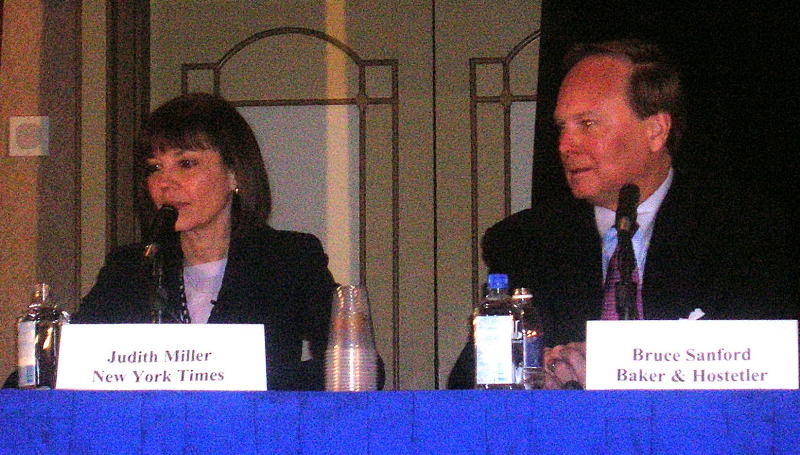
As I sat sipping hot tea in the small boardroom at the conference center of the Aladdin Hotel in Las Vegas on Tuesday morning, I began rehashing the events that led to this moment.
About six weeks ago, I got a call from Joe Skeel, editor of SPJ’s Quill magazine asking if I would be willing to cover a couple of stories about the convention. One, of course, would be about Judy Miller. But at that time, she was still in jail for not revealing the name of confidential source and her appearance at the convention was not likely.
In a twist, however, she was released from prison after agreeing to testify before the federal grand jury. About a week and half out from the convention I received an e-mail saying, “Judy Miller is in.” Suddenly I had a seriously big story on my hands.
The Society was awarding Miller the First Amendment Award for her actions on behalf of protecting her source. It was a controversial award both inside and outside the Society. Miller was going to receive the award, make a short speech and then participate on a panel about the use of confidential sources.
Of course I immediately I asked if I could get a one-on-one with her. I was told they would run it by her but it wasn’t likely. She was swooping in and out and not likely to grant any interviews.
When I approached the registration desk on Sunday afternoon, Chris Vachon, SPJ director of programs and convention mastermind extraordinaire pulled me aside and said that Judy Miller agreed to an interview with Quill — and no one else.
I let out a big, “Woo Hoo!“ The catch, of course, was that I was on standby and had to be ready to go whenever she said, “Now.”
Made for a stressful couple of days, as did the saturation of coverage in both the mainstream media and the blogosphere. On nearly all fronts, Miller was getting crucified. A part of me was sure she would back out. And the media converging on the convention was persistent in attempts to garner interviews.
But she didn’t back out of ours and she didn’t grant them to anyone else. I was told to meet her in the room at 7:15 a.m. Tuesday. The interview was kept hush-hush. The few people who knew what I was doing would come up to me and say, “You should ask her about …”
That continued for two days until my brain could no longer get a handle on exactly what to get from this interview. So in a fit of exhaustion, I slumped down on the floor of the hallway next to Joe Skeel and we hashed strategy. We worked out worst-case scenario and moved on from there.
I was feeling better, but still got up at 5 a.m. to check out what was being written. It was a feeding frenzy and so was our convention. It turned into a media circus when the local Vegas gossip columnist had quoted Chris Vachon as saying, “We’re preparing for the worst” and cited protests being organized outside the hotel by bloggers. (Appparently those protests never materialized.)
With my Starbucks, tape recorder and notes, I tried to clear my mind and focus on what I would ask. This kind of preparation isn’t how I normally interview people. I prefer to wing it, but I felt that simply wasn’t an option in this case. Too many issues, too many expectations.
Ultimately, I felt I had to tie my questions to the Society’s mission. And I would try to interject some personal questions. I mean, how does one handle the lambasting by your profession in such a spectacularly vicious and public way?
But then my cell rang and it was SPJ Associate Executive Director Julie Grimes telling me Miller had to postpone to prepare for her speech. Hurry up and wait. Hurry up and wait. That’s what this endeavor became.
Fellow freelancer/photographer/blogger/newly elected regional director and all-around good guy, Joe Wessels and I convinced the staff to essentially make us staff for the big event. And that got us into the main ballroom and front-row seats before the stampede of hyperactive journalists stormed the ballroom.
There were many delays and pregnant pauses while the packed room awaited Miller’s arrival. Word was that Bruce Sanford, SPJ’s attorney from Baker & Hostetler, was going to ask the questions. It was a dubious format, but the organizers were unsure how to handle a roomful of journalists (many of whom were hostile toward her) clamoring to ask questions. They heard about that later as they also were grilled about why this showcase program was moderated and run by attorneys. (The short answer? They pitched the program idea.)
Scheduled to begin at 8:15, the program didn’t start until 8:45. While I sat taking notes, I was tapped on the shoulder and told to be in Sapphire 1 in 15 minutes. Miller was going to be escorted through the bowels of the Aladdin and I was to await her entry. I had 15 minutes for the interview.
I was sitting the Sapphire 1 room when finally a rush of very large security guards with earpieces and the SPJ brass and lawyers came through the back door with Miller. For a minute I thought I was conducting this interview before a large audience. Thankfully, most of them left the room and the interview was conducted in relative peace.
With that, you’ll have to wait for the November/December issue of Quill magazine to find out what she had to say.
Brain dead in Bay
Absolute. Utter. Exhaustion. That’s what I’m feeling this morning. Can’t even wrap my brain around all the stuff I have to do nor all the info I have to process. Must. Get. More. Sleep.
Here’s hoping for lucidity later today…
Here’s hoping for lucidity later today…
Monday, October 17, 2005
Live from Las Vegas
Jill and I are having a great time, talking to oodles of journalists young and old and everything in between about the joys and perils of freelance writing. The session I moderated and Jill spoke at on the business of freelance writing was heavily attended and our Q&A went well beyond our allotted hour.
I'm taking a breather after having talked too much, plus I need to replenish my card supply. And in between all of this I'm jumping online to catch the latest buzz about Judy Miller. I'm on standby for a one-on-one interview with her and questions are rapidly filling my notebook. I've apologized to many as I break it open mid-conversation to jot something down before I forget.
I have no idea whether or not she'll answer my questions, but I believe as a fellow journalist at the very least she'll respect the tough questions. There's a lot of media swarming around the convention in anticipation of her talk tomorrow -- CNN, C-SPAN, ABC, FOX, AP. Should be interesting, though there's concern among the conference planners on how to handle the Q&A.
Lucy Dalglish does a mean Arianna Huffington impersonation. Last night she was talking about her appearance on Howard Kurtz's program and Arianna's insistence that she get some new talking points. Very funny stuff.
At last night's opening reception, Jill was introduced to many SPJers from all over the country. We had some terrific conversations and I hope she enjoyed herself. She seemed to, particularly when a young college girl came up to her and complimented her on her smashing outfit.
We're running constantly at this point and I'm off to my next meeting shortly. But despite my sore dogs and my dry throat I'm feeling invigorated by all the conversations. As one little aside: The lack of humidity out in the desert is doing wonders for my hair. No more frizzy curly hair. I actually look as if I have straight hair. Woo Hoo!
Gotta fly ... the region 4 committee meeting awaits. I must nominate young Joe Wessels of the Cincinnati Pro Chapter as our interim regional director. We plied him with liquor last night and encouraged him to take the job.
More later, including photos...
I'm taking a breather after having talked too much, plus I need to replenish my card supply. And in between all of this I'm jumping online to catch the latest buzz about Judy Miller. I'm on standby for a one-on-one interview with her and questions are rapidly filling my notebook. I've apologized to many as I break it open mid-conversation to jot something down before I forget.
I have no idea whether or not she'll answer my questions, but I believe as a fellow journalist at the very least she'll respect the tough questions. There's a lot of media swarming around the convention in anticipation of her talk tomorrow -- CNN, C-SPAN, ABC, FOX, AP. Should be interesting, though there's concern among the conference planners on how to handle the Q&A.
Lucy Dalglish does a mean Arianna Huffington impersonation. Last night she was talking about her appearance on Howard Kurtz's program and Arianna's insistence that she get some new talking points. Very funny stuff.
At last night's opening reception, Jill was introduced to many SPJers from all over the country. We had some terrific conversations and I hope she enjoyed herself. She seemed to, particularly when a young college girl came up to her and complimented her on her smashing outfit.
We're running constantly at this point and I'm off to my next meeting shortly. But despite my sore dogs and my dry throat I'm feeling invigorated by all the conversations. As one little aside: The lack of humidity out in the desert is doing wonders for my hair. No more frizzy curly hair. I actually look as if I have straight hair. Woo Hoo!
Gotta fly ... the region 4 committee meeting awaits. I must nominate young Joe Wessels of the Cincinnati Pro Chapter as our interim regional director. We plied him with liquor last night and encouraged him to take the job.
More later, including photos...
Thursday, October 13, 2005
The pre-trip frenzy begins
I'm nearly through all the work that needs to be done before I leave for the SPJ convention in Las Vegas on Saturday evening.
I've got a review left to write, two more queries to get out and some marketing projects to finish up. And then it's the all-important balance the checkbook, transfer the necessary dough and pay the bills.
The boys are off school tomorrow and I'm hoping to work tonight and get most of that done so I can spend a little time playing with them tomorrow. Got a quick trip to the salon in the morning, need to hit Crocker Park and maybe pick up another suit and then it's time get my stuff together for the convention.
I'm interviewing New York Times reporter Judy Miller on Tuesday for an article in Quill. I'm trying to stay on top of all the media surrounding her, but it's been crazy. I keep printing stories and blog posts off to read on the plane (oh, who am I kidding, Jill and I will be having a gab fest).
Need to remember all laptop accessories, files for committee meetings, stories, panel discussions and other SJP biz. Tape recorder, gotta bring the tape recorder and batteries. And my digital camera and more batteries. Looks as if I'm going to have to haul out the bigger suitcase (which means checking my baggage) for this trip. I always come home from these conventions with ten times more crap than when I arrived.
Since it's Vegas, I gotta bring some cash to play at least a few slots. Though admittedly I have a low threshold for pain when it comes to gambling.
BUSINESS CARDS!!! Egads I can't forget those. Hope the Info Mart has more Bloomberg or PR Newswire reporter notebooks cause I'm fresh out.
And then there's all the arrangements on the home front. Make sure kids are all accounted for various activities, laundry is done and to remind Danny that bedtime must be enforced, particularly on Sunday night. He ignores it at his own peril.
I can't keep all this in my head. It's time to make the big list. Calgon, take me away.
I've got a review left to write, two more queries to get out and some marketing projects to finish up. And then it's the all-important balance the checkbook, transfer the necessary dough and pay the bills.
The boys are off school tomorrow and I'm hoping to work tonight and get most of that done so I can spend a little time playing with them tomorrow. Got a quick trip to the salon in the morning, need to hit Crocker Park and maybe pick up another suit and then it's time get my stuff together for the convention.
I'm interviewing New York Times reporter Judy Miller on Tuesday for an article in Quill. I'm trying to stay on top of all the media surrounding her, but it's been crazy. I keep printing stories and blog posts off to read on the plane (oh, who am I kidding, Jill and I will be having a gab fest).
Need to remember all laptop accessories, files for committee meetings, stories, panel discussions and other SJP biz. Tape recorder, gotta bring the tape recorder and batteries. And my digital camera and more batteries. Looks as if I'm going to have to haul out the bigger suitcase (which means checking my baggage) for this trip. I always come home from these conventions with ten times more crap than when I arrived.
Since it's Vegas, I gotta bring some cash to play at least a few slots. Though admittedly I have a low threshold for pain when it comes to gambling.
BUSINESS CARDS!!! Egads I can't forget those. Hope the Info Mart has more Bloomberg or PR Newswire reporter notebooks cause I'm fresh out.
And then there's all the arrangements on the home front. Make sure kids are all accounted for various activities, laundry is done and to remind Danny that bedtime must be enforced, particularly on Sunday night. He ignores it at his own peril.
I can't keep all this in my head. It's time to make the big list. Calgon, take me away.
Wednesday, October 12, 2005
Collaboration with editors
What I miss most by working independently is the steady influence of an editor. There’s a saying that a good editor can make a mediocre writer great and a bad editor can make a good writer mediocre.
I’ve had my share of both kinds. When the editor/writer relationship works, it is simply a thing of beauty. After 17 years in this gig, I’ve found that editors, much like writers, all have their strengths—and weaknesses.
My first editor was Ellen Walker. She was a generation older than me, a chain smoker and intense newspaperwoman who banged away on her typewriter taking notes while talking on the phone. Though diminutive in stature, she scared the crap out of me. She was so … authentic.
Under her tutelage, I learned reporting skills such as how to read a school budget, how to cover a municipal story when the mayor won’t talk and how to investigate land deals. I received crash courses in the functions of municipal government. I learned (or at least I tried) photography and getting over the fear of asking strangers for their opinion for a man on the street column.
We were a staff of two and with her help I began to figure out what this newspapering business was all about.
She made me feel at turns incredibly inept and incredibly gifted. I never knew precisely where I stood and I suppose that kept me hungry and working. I wanted to please her.
The next five years of my career left me without a strong editor as guide, though I had an assistant editor I worked with who set a quiet example for professionalism, strong reporting and gifted writing. Though we have both long-since moved on, we continue to remain friends and have worked together at another magazine as freelancer and editor.
What I learned during those years was how to push myself when no one else did. Any amount of success I had there was a reflection of my own initiative and not the mandates or the challenge of any editors. I attempted my first series, volunteered for investigative teams and dabbled in column writing.
I was very unsure of myself in my first magazine job, but I had a sense that the longer form would allow me to develop and exand as a writer. My editor there was not so much a reporter as she was a wordsmith. My writing abilities grew there in ways they never would have otherwise. Her influence is found in my writing to this day.
At my last job, I had a colleague who didn’t so much serve as an editor, though she did review my work, as much as she was a collaborator. We could get together over coffee and brainstorm like crazy. We could take rough copy and make it sing. And we prided ourselves on finding diamonds in the rough and nurturing them into writers. It was great fun and we did what did out of love. That relationship gave me my first taste at sharing what I know about journalism with others.
But now I don’t work with AN editor, I work with many. Some of those relationships are very good, some are strictly on a “get me the work, this is your deadline, this is your fee” basis. No warm and fuzzy collaboration.
I miss plopping down in an editor’s office and saying, “I’m struggling with parts of this story” or “The reporting is not coming together the way I’d like, any suggestions?” It is possible to forge those kinds of relationships with editors as a freelancer, but you straddle the line between being collaborative and being a nuisance. One is clearly good, the other not so much. I’m just not sure where that line is and I suspect it’s different for every editor and every publication.
I’d really to find a way to engage in more collaborative-style relationships with editors. Because in the end, I think it results in expectations met and stronger stories. In the past couple of weeks I've found a great outlet for collaboration. To nurture it along, I'm going to buy this editor a cup of coffee when I get back from Vegas and brainstorm about how we can help each other.
I’ve had my share of both kinds. When the editor/writer relationship works, it is simply a thing of beauty. After 17 years in this gig, I’ve found that editors, much like writers, all have their strengths—and weaknesses.
My first editor was Ellen Walker. She was a generation older than me, a chain smoker and intense newspaperwoman who banged away on her typewriter taking notes while talking on the phone. Though diminutive in stature, she scared the crap out of me. She was so … authentic.
Under her tutelage, I learned reporting skills such as how to read a school budget, how to cover a municipal story when the mayor won’t talk and how to investigate land deals. I received crash courses in the functions of municipal government. I learned (or at least I tried) photography and getting over the fear of asking strangers for their opinion for a man on the street column.
We were a staff of two and with her help I began to figure out what this newspapering business was all about.
She made me feel at turns incredibly inept and incredibly gifted. I never knew precisely where I stood and I suppose that kept me hungry and working. I wanted to please her.
The next five years of my career left me without a strong editor as guide, though I had an assistant editor I worked with who set a quiet example for professionalism, strong reporting and gifted writing. Though we have both long-since moved on, we continue to remain friends and have worked together at another magazine as freelancer and editor.
What I learned during those years was how to push myself when no one else did. Any amount of success I had there was a reflection of my own initiative and not the mandates or the challenge of any editors. I attempted my first series, volunteered for investigative teams and dabbled in column writing.
I was very unsure of myself in my first magazine job, but I had a sense that the longer form would allow me to develop and exand as a writer. My editor there was not so much a reporter as she was a wordsmith. My writing abilities grew there in ways they never would have otherwise. Her influence is found in my writing to this day.
At my last job, I had a colleague who didn’t so much serve as an editor, though she did review my work, as much as she was a collaborator. We could get together over coffee and brainstorm like crazy. We could take rough copy and make it sing. And we prided ourselves on finding diamonds in the rough and nurturing them into writers. It was great fun and we did what did out of love. That relationship gave me my first taste at sharing what I know about journalism with others.
But now I don’t work with AN editor, I work with many. Some of those relationships are very good, some are strictly on a “get me the work, this is your deadline, this is your fee” basis. No warm and fuzzy collaboration.
I miss plopping down in an editor’s office and saying, “I’m struggling with parts of this story” or “The reporting is not coming together the way I’d like, any suggestions?” It is possible to forge those kinds of relationships with editors as a freelancer, but you straddle the line between being collaborative and being a nuisance. One is clearly good, the other not so much. I’m just not sure where that line is and I suspect it’s different for every editor and every publication.
I’d really to find a way to engage in more collaborative-style relationships with editors. Because in the end, I think it results in expectations met and stronger stories. In the past couple of weeks I've found a great outlet for collaboration. To nurture it along, I'm going to buy this editor a cup of coffee when I get back from Vegas and brainstorm about how we can help each other.
Subscribe to:
Posts (Atom)